Research laboratories and equipment manufacturers increasingly depend on materials with well-defined thermal, electrical, and chemical characteristics.
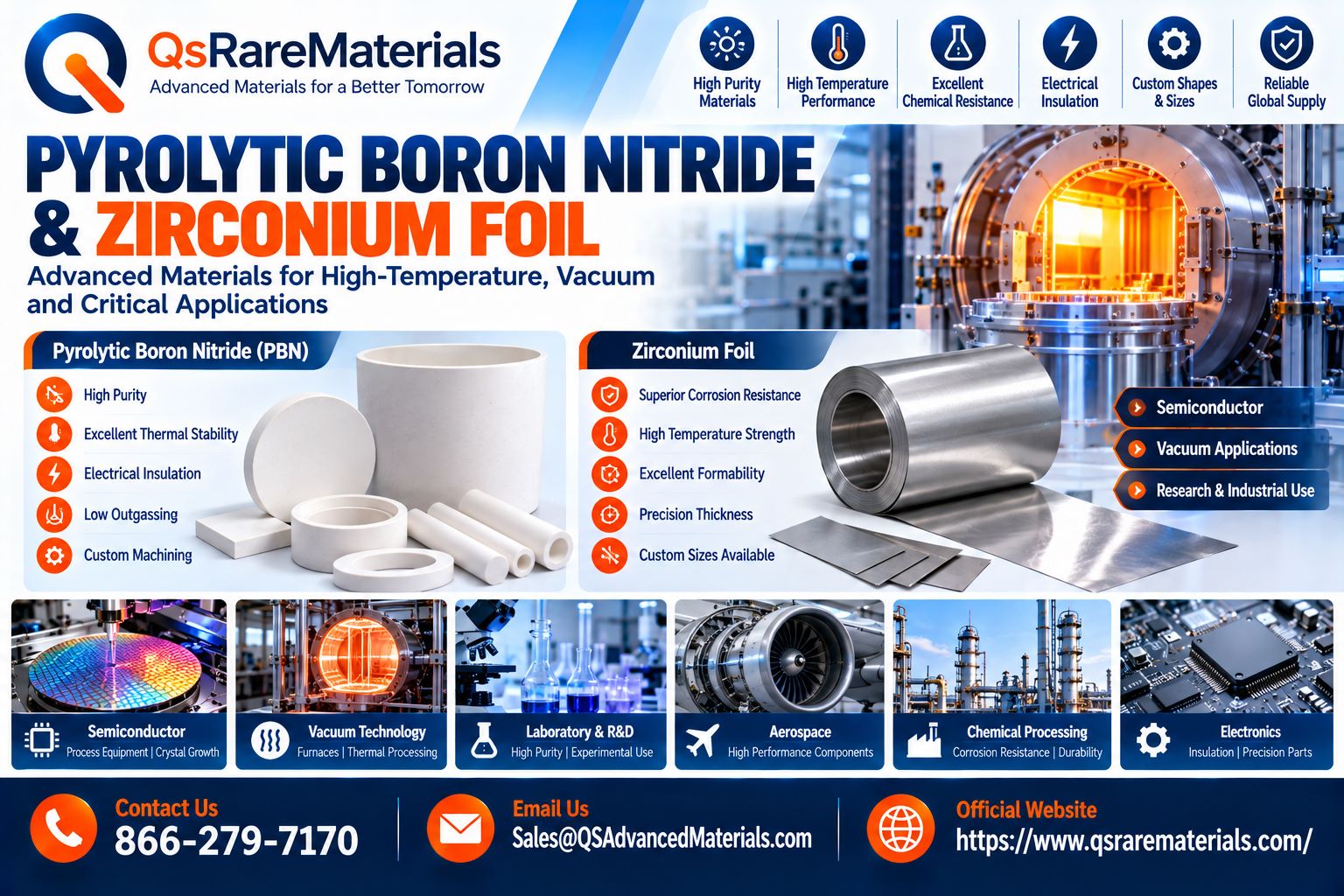
Pyrolytic Boron Nitride offers distinctive ceramic properties that make it useful for selected high-temperature and electrically insulating applications.
Meanwhile, Zirconium Foil provides a thin metallic material that can be used in specialised research, experimental manufacturing, and applications requiring carefully controlled metal characteristics.
Although these materials have different properties, both can contribute to advanced engineering projects when their capabilities and limitations are properly understood.
For researchers, laboratory equipment developers, and industrial buyers, choosing suitable materials is essential for obtaining reliable experimental results.
Why Advanced Materials Selection Matters
Modern research equipment frequently operates under demanding thermal, chemical, or electrical conditions.
Ordinary engineering materials may not provide the required performance in every application.
An unsuitable material can introduce contamination, unwanted reactions, dimensional changes, or measurement inconsistencies.
Specialised ceramics and metals offer additional design possibilities.
However, material selection should begin with a clear understanding of operating requirements.
This principle encourages engineers to evaluate purity, temperature capability, chemical compatibility, and mechanical behaviour before choosing components.
What Is Pyrolytic Boron Nitride?
Pyrolytic Boron Nitride, commonly called PBN, is a high-purity ceramic material generally produced through chemical vapour deposition processes.
Its layered crystal structure contributes to distinctive thermal and electrical characteristics.
PBN is recognised for electrical insulation, anisotropic thermal behaviour, and suitability for certain controlled-atmosphere applications.
Depending on manufacturing capabilities, the material can be formed into specialised shapes used in laboratory equipment and thermal processing systems.
However, its performance depends on temperature, atmosphere, component geometry, and material quality.
Oxidising conditions can limit its suitability at elevated temperatures.
Understanding Zirconium Foil
Zirconium Foil is a thin metallic sheet produced from zirconium or a specified zirconium-based material.
Zirconium is valued in selected industrial applications because of its corrosion-related properties and specialised chemical behaviour.
Thin foil formats provide opportunities for experiments where controlled thickness and metallic characteristics are important.
Research applications may involve specimen preparation, material compatibility studies, or specialised thermal processing.
However, zirconium is chemically reactive under certain conditions, especially when heated.
Its suitability must be evaluated according to the actual temperature, atmosphere, and intended function.
Different Material Properties, Different Engineering Roles
PBN and zirconium foil should not be treated as interchangeable materials.
PBN is a ceramic electrical insulator with direction-dependent thermal characteristics.
Zirconium foil is a metallic material with electrical conductivity and mechanical behaviour that differs significantly from ceramics.
These differences influence how engineers use each material.
For example, a specialised research assembly may require an insulating ceramic support and a separate metallic specimen.
However, any proposed combination must be assessed for thermal expansion, chemical interaction, and mechanical compatibility.
Comparing Important Material Characteristics
| Evaluation Factor | Pyrolytic Boron Nitride | Zirconium Foil |
| Material Category | Technical ceramic | Metallic foil |
| Electrical Behaviour | Generally insulating | Electrically conductive |
| Typical Form | Deposited or shaped ceramic components | Thin metallic sheets |
| Primary Consideration | Purity and thermal characteristics | Thickness and chemical behaviour |
| Mechanical Behaviour | Brittle ceramic | Metallic, with formability dependent on condition |
| Research Application | Insulating supports and specialised processing parts | Experimental specimens and engineered metallic components |
Actual performance should be confirmed through material specifications and representative testing.
The Importance of Thermal Expansion Compatibility
Materials expand and contract when their temperatures change.
Different materials can exhibit different expansion behaviour.
When a ceramic component and a metal component are positioned together, thermal expansion mismatch may introduce mechanical stress.
PBN also exhibits anisotropic properties, meaning some characteristics depend on material orientation.
Engineers should therefore consider how components are supported and whether their dimensions can change safely.
Appropriate design can help reduce unwanted stress and component damage.
Contamination Control in Laboratory Experiments
High-purity research requires careful attention to every component that contacts experimental materials.
Contamination can originate from handling equipment, processing vessels, fixtures, or the surrounding environment.
PBN may offer useful purity characteristics for selected applications.
Zirconium foil may also be used in research where its specific metallic composition is required.
However, neither material should be assumed chemically inert in all conditions.
Researchers should evaluate possible reactions and contamination mechanisms.
Suitable storage, cleaning, and handling procedures can support more consistent experimental conditions.
Why Material Thickness and Geometry Matter
Component dimensions influence performance in precision research equipment.
For PBN, wall thickness, shape, orientation, and supporting geometry can affect thermal and mechanical behaviour.
For zirconium foil, thickness uniformity, surface condition, and dimensional accuracy may be important.
Incorrect dimensions can influence experimental repeatability.
Manufacturers should therefore establish suitable tolerances before ordering customised materials.
Technical drawings and material specifications help suppliers understand the intended application.
Representative samples may be required for specialised projects.
Handling and Storage Requirements
Advanced ceramic and metallic materials require appropriate handling.
PBN components can be vulnerable to damage from unsuitable mechanical loading or impact.
Zirconium foil may be susceptible to scratching, deformation, or contamination during handling.
Fine zirconium particles introduce additional hazards and should not be treated like ordinary solid metal stock.
Storage and processing arrangements must reflect the supplied material form and applicable safety information.
Clean handling tools and suitable packaging may help protect material surfaces.
Applications in Advanced Engineering
These specialised materials can support several technical fields.
Semiconductor Research: Suitable PBN components may be considered for selected high-purity processing environments.
Materials Science: Zirconium foil may be used as a specimen for studying metallic properties and material interactions.
Vacuum Equipment: Compatible ceramic and metallic components can support specialised experimental assemblies.
Thermal Engineering: PBN components may provide insulation functions where their properties meet operating requirements.
Research Instrumentation: Both materials can contribute to customised experimental equipment when appropriately specified.
Each application requires independent technical evaluation.
Choosing a Reliable Advanced Materials Supplier
Industrial buyers should consider several factors before ordering specialised ceramic or metallic components:
- Material Purity: Confirm composition and relevant specifications.
- Dimensional Accuracy: Review thickness, shape, and manufacturing tolerances.
- Application Compatibility: Evaluate temperature, atmosphere, and chemical exposure.
- Product Documentation: Request relevant material and inspection information.
- Customisation: Confirm available component dimensions and configurations.
- Quality Assurance: Assess inspection procedures and sample availability.
The objective is to select materials based on verified technical requirements rather than broad performance claims.
Frequently Asked Questions (FAQs)
1. What is Pyrolytic Boron Nitride?
Pyrolytic boron nitride is a high-purity technical ceramic generally produced through chemical vapour deposition and used in specialised thermal and electrical applications.
2. What is Zirconium Foil used for?
Zirconium foil is used in selected materials research, experimental processing, and engineering applications requiring thin zirconium metal.
3. Is pyrolytic boron nitride electrically insulating?
Yes. PBN is generally an electrical insulator, although its suitability depends on material grade and operating conditions.
4. Can zirconium foil be used in high-temperature experiments?
It may be suitable for certain experiments, but oxidation, chemical reactivity, and operating conditions must be evaluated carefully.
5. How should researchers select advanced ceramic and metallic materials?
Researchers should compare purity, material properties, dimensions, operating atmosphere, compatibility, and supplier documentation.
Media Contact
Department: Advanced Materials and Technical Product Enquiries
Phone: 866-279-7170
Email: Sales@QSAdvancedMaterials.com
Official Website: https://www.qsrarematerials.com/