While successful research trials demonstrate technical possibilities, larger manufacturing operations introduce additional challenges involving material consistency, component dimensions, thermal behaviour, and production repeatability.
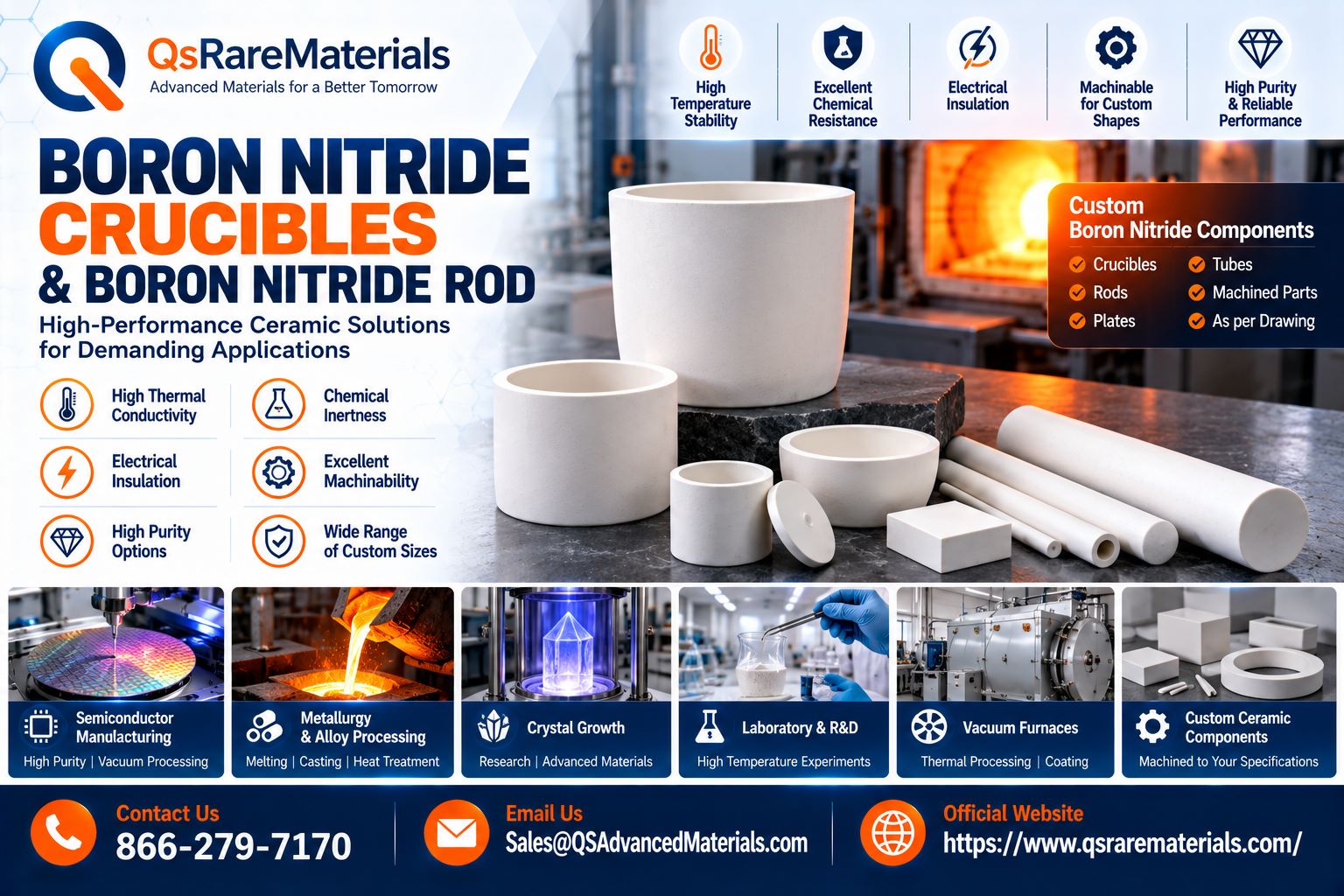
Boron Nitride Crucibles are specialised ceramic containers used in selected high-temperature material processing applications where their thermal and chemical properties are appropriate.
Meanwhile, a Boron Nitride Rod provides machinable ceramic stock for developing customised insulating components, support elements, and technical fixtures.
These materials can support different stages of manufacturing development when properly selected and engineered.
For research institutions, semiconductor material developers, and specialised equipment manufacturers, the focus is on establishing reliable processes that can be repeated beyond initial laboratory trials.
Why Research-to-Production Scale-Up Is Challenging
A process that performs successfully with a small experimental sample may behave differently when production quantities increase.
Larger material volumes can change heat distribution, contact conditions, and processing requirements.
The geometry of containment components may also influence the results.
Consequently, manufacturers should evaluate whether the materials used during experimental development remain suitable for expanded production.
This approach helps researchers identify potential technical challenges before committing to larger production systems.
Understanding Boron Nitride Crucibles
Boron Nitride Crucibles are containers manufactured from suitable boron nitride ceramic materials.
Hexagonal boron nitride is recognised for properties including electrical insulation, useful thermal characteristics, and compatibility with certain processing substances.
Depending on material grade and operating conditions, boron nitride crucibles may be considered for specialised thermal research and material development.
However, not all grades provide identical performance.
Temperature, atmosphere, chemical exposure, and crucible geometry affect suitability.
Engineers must therefore confirm actual operating requirements before selecting these containers for critical manufacturing applications.
What Is a Boron Nitride Rod?
A Boron Nitride Rod is a solid technical ceramic component commonly supplied as stock for machining into application-specific parts.
Depending on its composition, it may be suitable for manufacturing ceramic spacers, locating elements, electrical insulators, and other specialised components.
Machining flexibility can make boron nitride useful during equipment development.
However, ceramic materials have different mechanical characteristics from metals.
Designers should consider brittleness, unsupported lengths, mechanical stress, and handling procedures.
Suitable engineering helps ensure that machined ceramic parts match their intended operating conditions.
Why Crucible Geometry Affects Manufacturing Results
Crucible dimensions can influence material containment and thermal exposure.
A deeper container may behave differently from a wider vessel, even when both hold comparable quantities of material.
Wall thickness and internal geometry may also influence heating and cooling characteristics.
During scale-up, increasing crucible capacity without evaluating these factors can introduce unexpected processing differences.
Manufacturers should consider:
- Internal volume and fill requirements.
- Wall thickness and structural integrity.
- Material contact surfaces.
- Furnace compatibility.
- Safe handling and removal arrangements.
Representative processing trials can help determine whether a proposed design meets production requirements.
Material Grade Selection for Industrial Applications
Boron nitride products can be manufactured using different processing methods and material compositions.
Commercial grades may vary in purity, density, additives, and mechanical properties.
These differences can influence thermal performance, machinability, and chemical compatibility.
A material suitable for an insulating fixture may not be appropriate for direct contact with a particular molten substance.
Manufacturers should request relevant technical specifications rather than relying exclusively on general descriptions.
Material evaluation should reflect the complete application.
Comparing Crucibles and Rods in Manufacturing Development
| Evaluation Factor | Boron Nitride Crucibles | Boron Nitride Rod |
| Primary Function | Containing compatible processing materials | Producing technical ceramic components |
| Typical Geometry | Hollow container | Solid cylindrical stock |
| Main Design Consideration | Capacity and wall geometry | Dimensions and machining features |
| Common Engineering Role | Thermal processing vessel | Insulating or supporting component |
| Quality Requirement | Surface integrity and material compatibility | Dimensional accuracy and structural integrity |
| Scale-Up Consideration | Processing volume and thermal behaviour | Fixture consistency and component replacement |
Both product forms should be evaluated independently.
Managing Processing Atmosphere and Temperature
High-temperature processing conditions influence the performance of technical ceramics.
Boron nitride may offer useful properties in selected vacuum or controlled-atmosphere environments.
However, exposure to oxygen at elevated temperatures can result in oxidation and material degradation.
Chemical compatibility also depends on the substance being processed.
Manufacturers should therefore document operating atmosphere, temperature requirements, and relevant chemical exposure.
A temperature capability advertised for one environment should not automatically be applied to another.
Suitable testing remains essential for critical manufacturing operations.
Developing Repeatable Production Procedures
Moving from experimentation to manufacturing requires consistent operating procedures.
Researchers may initially adjust processing conditions based on observations.
Industrial production generally requires clearer control over material preparation, component placement, and inspection.
Approved ceramic components should be identified through specifications and drawings.
Where appropriate, manufacturers can document loading arrangements, processing conditions, and component inspection criteria.
These records help production teams investigate variations and reproduce approved procedures.
However, documentation should be supported by practical testing rather than used as a substitute for process validation.
Designing Ceramic Parts for Replacement
Specialised thermal equipment may contain components that require inspection or replacement during operation.
Machined ceramic elements can sometimes be designed as individually replaceable parts.
This may simplify maintenance when a particular component becomes worn or damaged.
However, replaceable designs must remain mechanically appropriate for the application.
Engineers should consider component accessibility, positioning accuracy, and safe handling.
For brittle ceramics, excessive clamping forces or poorly designed contact points may create damage.
Thoughtful component design can support equipment maintenance without compromising process reliability.
Quality Control for Advanced Ceramic Components
Consistent ceramic quality is important when processing results depend on component performance.
Relevant inspection procedures may include dimensional measurement, visual examination, and material identification.
For critical applications, additional verification of purity or other material properties may be necessary.
Buyers should establish suitable acceptance criteria before procurement.
Representative samples can help evaluate machining quality and compatibility with existing equipment.
A structured inspection process supports better communication between material suppliers and industrial users.
Choosing a Supplier for Technical Ceramic Components
Businesses evaluating suppliers should consider the following:
- Material Specifications: Confirm available grades and relevant properties.
- Manufacturing Capabilities: Review crucible production and ceramic machining options.
- Dimensional Requirements: Establish practical tolerances and geometries.
- Application Compatibility: Discuss operating atmosphere and chemical exposure.
- Quality Documentation: Request appropriate inspection and material information.
- Custom Component Support: Evaluate options for specialised sizes and designs.
Clear technical communication helps reduce misunderstandings during component development.
Frequently Asked Questions (FAQs)
1. What are Boron Nitride Crucibles?
Boron nitride crucibles are specialised ceramic containers used for selected thermal processing applications where their material properties meet operating requirements.
2. What is a Boron Nitride Rod used for?
A boron nitride rod may be machined into electrical insulators, spacers, supporting components, and other customised ceramic parts.
3. Are boron nitride crucibles suitable for high-temperature processing?
Certain grades are suitable for specialised high-temperature applications, but performance depends on temperature, atmosphere, and chemical compatibility.
4. Can boron nitride rods be customised?
Yes. Suitable grades can be machined into different dimensions and shapes, subject to manufacturing limitations.
5. What should buyers consider when selecting boron nitride ceramics?
Buyers should evaluate material grade, purity, dimensions, operating conditions, mechanical requirements, and supplier documentation.
Media Contact
Department: Advanced Ceramic Materials and Technical Product Enquiries
Phone: 866-279-7170
Email: Sales@QSAdvancedMaterials.com
Official Website: https://www.qsrarematerials.com/