Industrial product development requires more than transforming an engineering drawing into a physical component. Manufacturers must understand how materials behave during assembly, how components respond to operating conditions, and whether the finished design can meet functional requirements.
Aluminum prototype manufacturing provides engineers with an opportunity to evaluate lightweight metal components before committing to more extensive production.
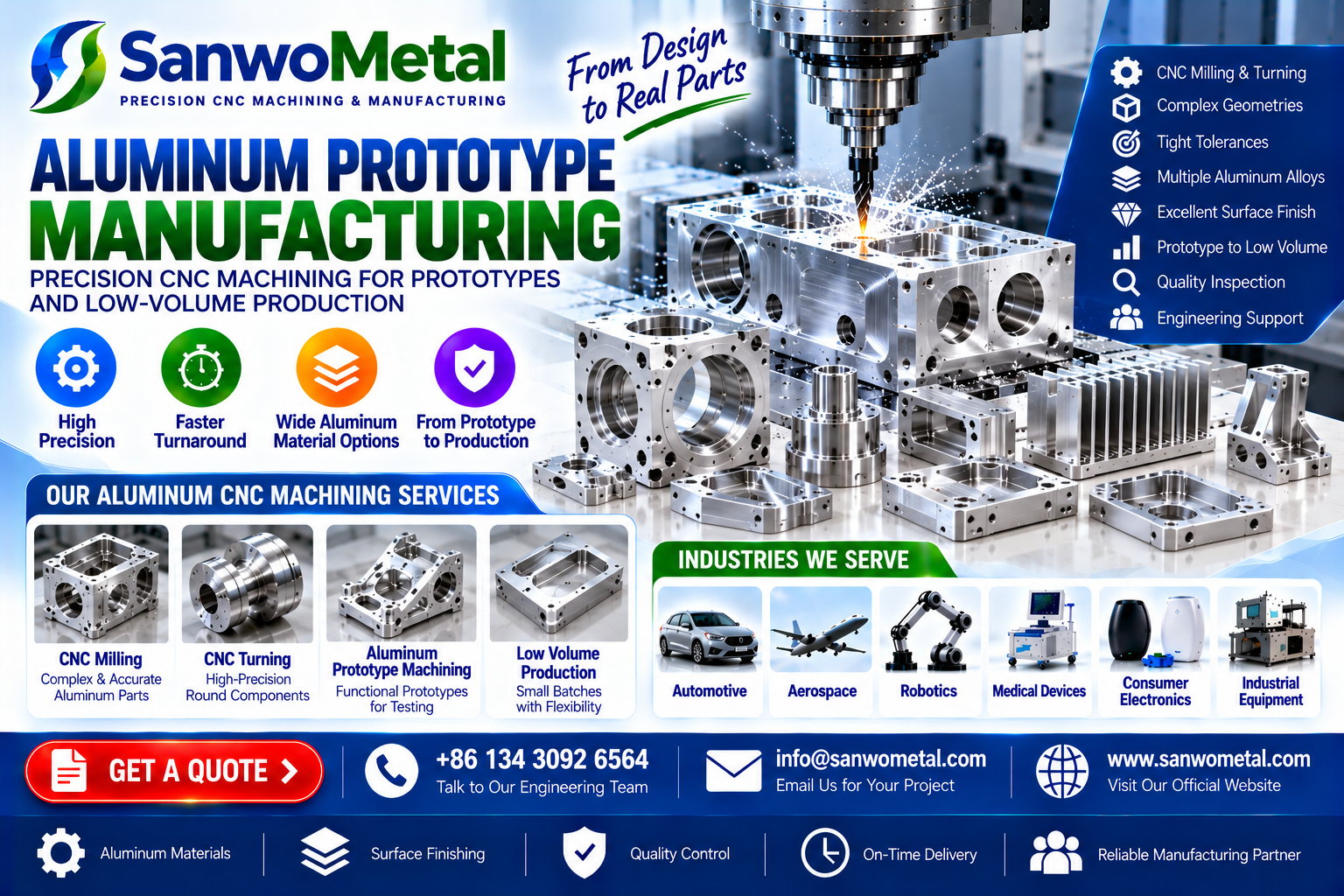
Meanwhile, aluminum prototype machining allows manufacturers to produce detailed components using computer-controlled equipment, making it possible to examine dimensions, surface finishes, mounting arrangements, and thermal performance.
For industries such as electronics, robotics, telecommunications, and industrial automation, aluminum prototypes can play an important role in evaluating product functionality and reducing avoidable design changes.
Why Aluminum Prototypes Matter in Product Engineering
Aluminum is widely used in engineering because selected alloys offer a useful combination of relatively low weight, machinability, and thermal conductivity.
However, these characteristics vary between alloy grades and product designs.
A component that looks suitable in a digital model may reveal practical limitations after manufacturing.
For example, an electronic enclosure may require additional clearance for connectors, while a mechanical housing may need stronger mounting features.
Physical prototypes allow product development teams to identify these concerns through practical evaluation.
What Is Aluminum Prototype Manufacturing?
Aluminum prototype manufacturing is the process of producing sample aluminum components to assess a product’s design, functionality, and manufacturing suitability.
These prototypes may represent individual mechanical parts or complete product assemblies.
Depending on project requirements, components can be manufactured through CNC milling, turning, or other suitable metalworking methods.
Typical applications include electronic housings, heat sinks, equipment brackets, mechanical supports, and specialised industrial components.
The objective is to obtain useful engineering information before approving the final product configuration.
Understanding Aluminum Prototype Machining
Aluminum prototype machining commonly involves removing material from an aluminum workpiece using computer numerical control equipment.
Engineers provide digital models and technical drawings that guide the manufacturing process.
CNC machining can produce complex surfaces, mounting holes, pockets, channels, and precision features.
However, machining accuracy depends on machine capabilities, tooling, part geometry, and inspection procedures.
Manufacturers should review critical dimensions and material specifications before production begins.
A successful prototype must satisfy its intended evaluation requirements rather than merely resemble the digital design.
Testing Thermal Performance With Aluminum Prototypes
Thermal management is an important consideration in electronic and industrial equipment.
Aluminum components are frequently used in heat-transfer applications because many alloys conduct heat effectively.
Examples include electronic heat sinks, power equipment housings, and cooling structures.
However, a material’s thermal conductivity alone does not determine the performance of a complete product.
Engineers must also consider contact resistance, airflow, heat generation, surface geometry, and operating conditions.
An aluminum prototype allows designers to investigate whether the proposed component supports the required thermal behaviour.
Why Alloy Selection Influences Prototype Results
Not all aluminum alloys have identical characteristics.
Some offer better machinability, while others may be selected for particular strength or corrosion-resistance requirements.
Common engineering choices include selected grades from the 5000, 6000, and 7000 alloy series.
However, individual grades can differ considerably.
For accurate functional evaluation, prototype materials should reflect the intended production requirements whenever practical.
Using an alternative alloy without engineering approval may produce misleading test results.
Manufacturers should document the selected alloy and relevant material condition.
Important Applications of Aluminum Prototyping
| Industry | Prototype Component | Engineering Evaluation |
| Consumer Electronics | Device enclosure | Fit, heat dissipation, appearance |
| Industrial Automation | Machine housing | Assembly and mounting accuracy |
| Robotics | Lightweight brackets | Weight and structural suitability |
| Telecommunications | Equipment casing | Thermal and mechanical requirements |
| Power Electronics | Heat sink | Heat-transfer performance |
| Laboratory Equipment | Custom fixtures | Dimensional accuracy and usability |
Each application requires evaluation criteria appropriate to its intended function.
How Surface Finishing Affects Prototype Performance
Surface finishing can influence the appearance and functional characteristics of aluminum components.
Common options include bead blasting, polishing, and anodizing.
Anodizing creates an oxide layer that can improve selected surface characteristics, including corrosion and wear resistance.
However, anodized surfaces may affect dimensional fit and electrical contact requirements.
For example, components requiring conductive metal-to-metal connections may need carefully specified contact areas.
A prototype intended for final product validation should consider the proposed production finish.
Evaluating Assembly Fit and Mechanical Connections
Product assemblies frequently include screws, connectors, brackets, and mating components.
Small dimensional differences can create assembly problems.
An aluminum prototype can help engineers inspect hole alignment, thread specifications, and clearance between connected parts.
Testing the assembled product may reveal interference that was not apparent during digital design.
Engineers should document any required modifications and update technical drawings accordingly.
This process supports better communication between design and manufacturing teams.
Why Design for Machining Matters
Manufacturing efficiency depends partly on component geometry.
Deep pockets, difficult-to-access surfaces, and unnecessarily complex features may require specialised tooling or additional machining operations.
Designers should consider practical tool access and suitable internal corner geometry.
However, manufacturing simplification should not compromise essential product requirements.
Early communication with machining specialists can help identify unnecessary complexity.
The objective is to produce components that satisfy engineering requirements while remaining practical to manufacture.
Quality Inspection Before Product Approval
Prototype inspection should focus on the features most important to product performance.
Depending on the design, verification may include dimensional measurement, surface inspection, material confirmation, and functional testing.
Coordinate measuring equipment may support inspection of complex geometries.
Thermal applications may also require testing under defined operating conditions.
A successful inspection confirms only the requirements actually evaluated.
Engineering teams should record results and unresolved concerns before approving subsequent production.
Choosing an Aluminum Prototype Manufacturer
Businesses should assess manufacturing partners according to their technical capabilities and engineering communication.
Important considerations include:
- Material Expertise: Understanding of relevant aluminum alloys.
- Machining Capabilities: Suitable milling, turning, and precision operations.
- Engineering Review: Ability to identify manufacturing challenges.
- Surface Finishing: Access to appropriate finishing processes.
- Quality Inspection: Suitable dimensional and functional verification.
- Technical Documentation: Clear handling of design revisions and specifications.
The appropriate supplier should match the complexity and performance requirements of the intended component.
Frequently Asked Questions (FAQs)
1. What is aluminum prototype manufacturing?
It is the production of sample aluminum components used to evaluate product design, functionality, and manufacturing suitability before further production.
2. What is aluminum prototype machining?
It is the process of manufacturing aluminum prototype parts through machining operations, commonly using computer-controlled equipment.
3. Why is aluminum used for electronic enclosures?
Selected aluminum alloys offer useful characteristics such as relatively low weight, machinability, and thermal conductivity.
4. Can aluminum prototypes receive anodized finishes?
Yes. Suitable aluminum prototypes can undergo anodizing, although alloy compatibility, dimensional requirements, and electrical contact areas must be considered.
5. How can companies improve aluminum prototype quality?
They should provide accurate drawings, specify suitable materials, identify critical dimensions, review surface finishes, and establish appropriate inspection procedures.
Media Contact
Department: Aluminum Prototyping and Precision CNC Manufacturing Enquiries
Phone: +86 (0755) 2717 0914
Email: info@sanwometal.com
Official Website: https://www.sanwometal.com/