Industrial equipment manufacturers face a common challenge when machinery requires specialised rubber components that are difficult to source through conventional supply channels.
Seals, protective pads, flexible connectors, and custom rubber components may be essential for keeping equipment operational. However, replacement parts for specialised machines are not always available in standard dimensions or large commercial quantities.
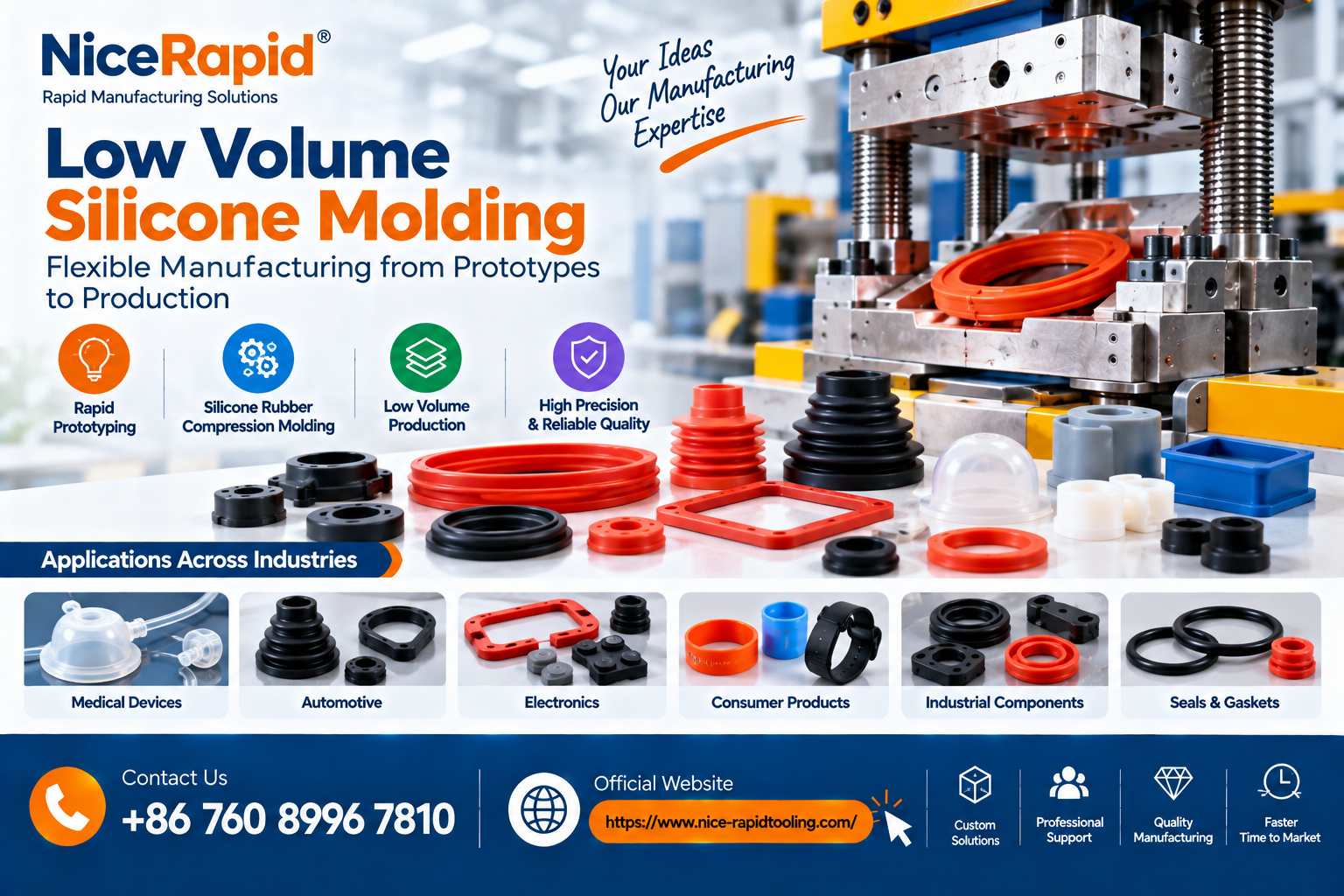
This situation has increased the relevance of low volume silicone molding, a manufacturing approach that allows businesses to produce limited quantities of customised silicone rubber parts according to specific technical requirements.
At the same time, silicone rubber compression molding offers a practical production method for manufacturing selected rubber components using appropriate moulding tools, heat, and pressure.
For industrial maintenance teams, original equipment manufacturers, and engineering businesses, these processes provide opportunities to address specialised replacement needs while maintaining control over material selection and component quality.
Why Industrial Replacement Parts Create Manufacturing Challenges
Industrial machinery often contains rubber components designed for specific operating conditions.
These parts may include unusual dimensions, specialised profiles, or material properties that are not available in standard catalogues.
When an original supplier discontinues a component, maintenance teams may struggle to identify a suitable replacement.
Using an incorrectly sized seal or incompatible material can affect equipment performance and reliability.
Custom manufacturing offers an alternative when commercially available components cannot satisfy established technical requirements.
What Is Low Volume Silicone Molding?
Low volume silicone molding is the production of silicone rubber parts in relatively small quantities rather than through large-scale manufacturing programmes.
It can support specialised replacement components, niche equipment, maintenance requirements, and limited commercial applications.
Instead of manufacturing extensive inventories, businesses can specify the quantities required for a particular project.
The economic suitability of this approach depends on tooling expenses, component geometry, material specifications, and inspection requirements.
Low-volume manufacturing does not automatically mean inexpensive production, but it can offer flexibility when large quantities are unnecessary.
Understanding Silicone Rubber Compression Molding
Silicone rubber compression molding is a process in which a measured quantity of uncured silicone rubber is placed inside a mould.
The mould is closed, and appropriate heat and pressure are applied to shape and cure the material.
The finished component is removed and may require trimming or additional inspection.
Compression molding can be suitable for selected gaskets, seals, flexible pads, and custom rubber profiles.
Its effectiveness depends on proper material selection, mould design, process control, and component requirements.
For small production batches, the process may provide a practical alternative to manufacturing methods involving more complex tooling arrangements.
The Role of Replacement Part Identification
Before manufacturing a replacement silicone component, engineers must establish its actual requirements.
An existing part can provide useful information about shape and approximate dimensions.
However, worn or compressed rubber may no longer reflect its original geometry.
Measurements alone may therefore be insufficient.
Maintenance teams should also evaluate the component’s function, operating conditions, and available technical drawings.
Where original specifications are unavailable, additional engineering assessment may be required.
The goal is to avoid reproducing defects caused by material ageing, deformation, or previous installation problems.
Why Material Compatibility Matters
Silicone rubber is valued for its flexibility and suitability for various environmental conditions.
However, different silicone formulations offer different properties.
A component designed for elevated temperatures may require different material characteristics from one intended for vibration management or electrical insulation.
Engineers should consider:
- Operating Temperature: The expected thermal environment.
- Compression Performance: The ability to maintain function under load.
- Chemical Exposure: Compatibility with relevant fluids and substances.
- Material Hardness: Suitable flexibility and support.
- Environmental Conditions: Exposure to moisture, weathering, or other influences.
Silicone is not universally suitable for every chemical or mechanical application.
Material selection must reflect verified service requirements.
Comparing Standard Parts and Custom Molding
| Evaluation Factor | Standard Rubber Components | Low Volume Custom Silicone Parts |
| Dimensions | Limited to available specifications | Designed around defined requirements |
| Availability | Depends on catalogue inventory | Depends on tooling and production capability |
| Initial Cost | Often avoids custom tooling | May involve tooling investment |
| Material Selection | Limited to offered products | May allow application-specific selection |
| Best Application | Common replacement requirements | Specialised or unusual components |
| Technical Validation | Requires compatibility assessment | Requires design and manufacturing validation |
The most appropriate option depends on the application and overall project economics.
How Small-Batch Production Supports Equipment Maintenance
Unexpected equipment failures can create operational difficulties when replacement components are unavailable.
For machinery using specialised silicone parts, small-batch manufacturing may provide a useful sourcing option.
Maintenance departments can explore producing selected replacement components based on approved engineering specifications.
This may be particularly relevant for older equipment or specialised industrial installations.
However, newly manufactured components must be validated before installation, especially in safety-critical systems.
A carefully evaluated replacement strategy can support maintenance planning and equipment usability.
The Importance of Tooling and Dimensional Accuracy
Mould construction influences the final dimensions and appearance of silicone components.
Inaccurate tooling may create unwanted flash, inconsistent thickness, or unsuitable component geometry.
Silicone shrinkage and material behaviour must also be considered.
A properly designed mould should reflect the intended specifications and practical manufacturing requirements.
For small batches, tooling decisions should balance precision, cost, and expected production quantities.
Excessive cost reduction at the tooling stage may lead to components that fail to meet functional requirements.
Quality Assurance for Custom Replacement Parts
Custom manufacturing requires appropriate inspection even when the production quantity is limited.
Quality checks may include dimensional measurement, visual examination, material verification, and relevant performance testing.
A rubber gasket, for example, may need evaluation for sealing effectiveness under its intended operating conditions.
A vibration-control component may require different functional assessments.
Inspection procedures should reflect the consequences of component failure.
Documentation can help purchasing and maintenance teams understand whether manufactured parts meet agreed requirements.
Small quantities should never be treated as a reason to overlook essential quality controls.
Making Better Procurement Decisions
Purchasing teams evaluating custom silicone manufacturing should consider more than the quoted price per component.
Tooling charges, minimum order quantities, material availability, quality requirements, and delivery arrangements can affect overall value.
A clear technical enquiry should identify the component’s dimensions, intended use, required materials, and inspection expectations.
Businesses should also clarify ownership of tooling and responsibilities for design changes.
Transparent communication between engineering and procurement departments can reduce misunderstandings.
Choosing a manufacturing partner with relevant technical capabilities is important for achieving consistent results.
Frequently Asked Questions (FAQs)
1. What is low volume silicone molding?
It is a manufacturing approach used to produce relatively small quantities of silicone rubber components for specialised products, replacement parts, and limited production requirements.
2. What is silicone rubber compression molding?
It is a process that uses a mould, controlled heat, and pressure to shape and cure silicone rubber into the required component.
3. Can low-volume molding be used for industrial spare parts?
Yes. It can support customised replacement components when the required dimensions, material properties, and functional specifications are established.
4. Is compression molding suitable for complex silicone components?
It can accommodate various geometries, but suitability depends on component complexity, tooling design, tolerances, and manufacturing requirements.
5. What information is needed for custom silicone manufacturing?
Manufacturers typically need technical drawings or suitable dimensional information, material requirements, intended operating conditions, quantities, and relevant quality specifications.
Media Contact
Department: Custom Silicone Manufacturing and Industrial Engineering Enquiries
Enquiry Categories: Low Volume Silicone Molding, Silicone Rubber Compression Molding, Custom Rubber Components, Industrial Replacement Parts, Precision Tooling, and Small Batch Manufacturing.
Contact: +86 760 8996 7810
Email: enquiry@nice-rapidtooling.com
Official Website: https://www.nice-rapidtooling.com/