
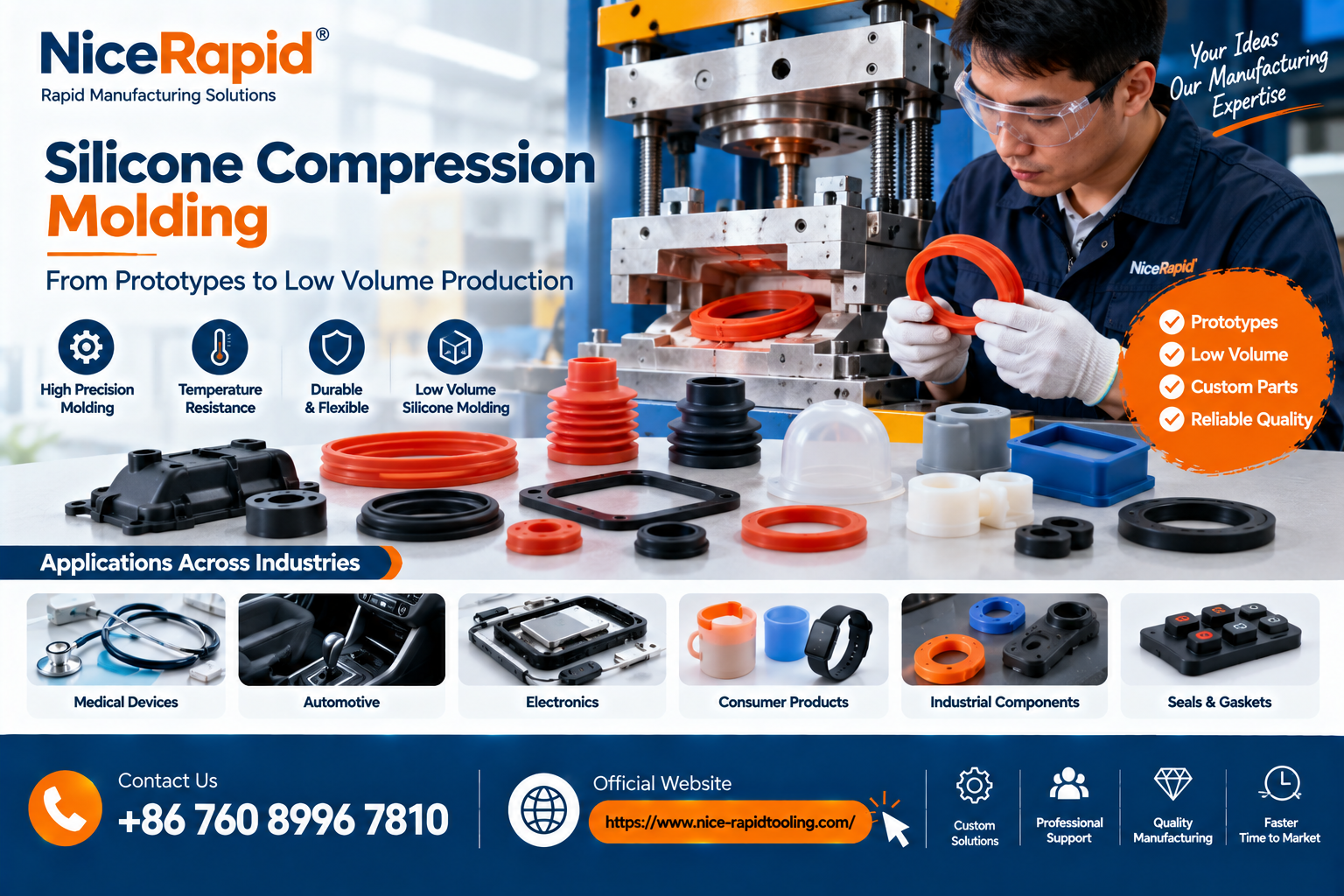
Product innovation depends on more than developing attractive designs. Manufacturers must also understand how components feel, perform, and interact with users before committing to extensive production.
Flexible materials play an important role in this process, particularly for products requiring comfortable grips, protective surfaces, soft-touch controls, and resilient components.
Silicone Compression Molding provides a manufacturing approach for transforming silicone rubber into functional components through controlled moulding processes.
Meanwhile, low volume silicone molding enables businesses to manufacture limited quantities of products for user evaluation, pilot programmes, and specialised market requirements.
For product developers, consumer goods manufacturers, and engineering teams, combining these approaches can help bridge the gap between a promising design concept and a commercially practical finished product.
Why Product Testing Is Changing Manufacturing Decisions
A product may perform well in a computer-generated design but behave differently during physical use.
A handle that appears comfortable may feel too rigid. A protective cover may not fit correctly, while a flexible button may require an adjustment in its tactile response.
These issues become easier to identify when functional components are available for evaluation.
Instead of immediately committing to extensive production, manufacturers can examine limited quantities of parts.
Physical validation can provide valuable feedback for engineering decisions.
What Is Silicone Compression Molding?
Silicone Compression Molding is a manufacturing process used to shape uncured silicone rubber inside a specially designed mould.
A measured quantity of silicone material is placed into the mould cavity.
The mould closes, and suitable heat and pressure are applied to shape and cure the material.
After curing, the component is removed and examined for relevant quality requirements.
The process can produce flexible components such as grips, protective pads, sealing elements, buttons, and customised rubber accessories.
Its suitability depends on material formulation, component geometry, production requirements, and expected performance.
How Low Volume Silicone Molding Supports Product Innovation
Low volume silicone molding involves manufacturing smaller quantities of silicone components rather than committing to extensive production.
This approach can be useful when businesses are evaluating a new product or introducing a specialised variation.
A consumer electronics company, for example, may need a limited batch of protective silicone covers to assess fit and usability.
A product developer may require several variations of a soft-touch component to evaluate comfort.
Producing manageable quantities allows businesses to collect relevant feedback before making further production decisions.
However, manufacturing suitability and costs must still be evaluated carefully.
The Role of Silicone in Ergonomic Product Design
Ergonomics focuses on creating products that accommodate human capabilities and practical usage requirements.
Silicone rubber can be useful in selected ergonomic applications because it offers flexibility and a range of material hardness options.
Potential applications include:
- Hand Grips: Flexible contact surfaces for selected tools.
- Control Buttons: Tactile components for electronic equipment.
- Protective Pads: Cushioning for appropriate product surfaces.
- Wearable Accessories: Flexible components requiring comfortable contact.
- Consumer Products: Customised rubber elements for everyday handling.
Material selection must consider skin-contact requirements, mechanical performance, and any applicable product regulations.
Not every silicone formulation is suitable for every application.
Why Material Hardness Influences User Experience
The hardness of a silicone component affects how it responds to pressure and deformation.
A softer material may provide a different tactile experience from a firmer formulation.
However, softness alone does not determine comfort or durability.
Component thickness, geometry, surface texture, and supporting structures also influence performance.
Manufacturers should consider these characteristics together.
Functional samples can help designers evaluate whether a proposed material provides the intended response.
Comparing Product Development Approaches
| Development Approach | Main Objective | Important Consideration |
| Digital Design | Evaluate geometry and appearance | Cannot fully reproduce physical feel |
| Initial Prototype | Assess component fit and function | May differ from production components |
| Small-Batch Molding | Evaluate multiple functional parts | Requires appropriate process controls |
| User Evaluation | Gather practical usability feedback | Requires representative testing conditions |
| Production Validation | Confirm manufacturing consistency | Needs defined acceptance requirements |
A structured development process can combine these activities to improve product decisions.
Why Surface Texture Matters in Silicone Products
Surface texture can influence how a silicone component looks, feels, and performs.
Smooth surfaces may be suitable for products requiring a refined appearance.
Textured finishes can provide different tactile characteristics or help distinguish functional areas.
However, the suitability of a texture depends on its intended application.
Very detailed surface features may also influence mould design, cleaning requirements, and component release.
Designers should evaluate texture through physical samples rather than relying only on digital renderings.
The objective is to balance user experience with practical manufacturing requirements.
Managing Design Changes During Small-Batch Production
Product testing often identifies opportunities for improvement.
A component may require greater thickness, a different material hardness, or modifications to its shape.
These changes can influence tooling and manufacturing requirements.
For example, changing a grip profile may require modifications to the mould cavity.
Businesses should document proposed changes and assess their technical implications before approval.
Clear revision control helps ensure that the correct design is manufactured and evaluated.
This is especially important when several component variations are being compared.
Understanding Tooling Decisions for Limited Production
Tooling is an important part of compression molding.
The mould must create the required shape while accounting for material behaviour, curing characteristics, and component removal.
For smaller production quantities, tooling investment should be considered alongside expected product demand.
Simpler component geometries may support more straightforward mould construction.
However, highly detailed features or demanding tolerances can increase complexity.
Compression molding may offer economic advantages for suitable applications, but it is not automatically the lowest-cost process.
Engineering evaluation helps determine whether the method is appropriate.
Quality Assurance in Functional Product Testing
Even limited production batches require appropriate quality controls.
A component intended for user evaluation should represent the specified design as accurately as practical.
Relevant checks may include dimensional inspection, material verification, visual assessment, and functional testing.
For tactile components, testing may examine the response to repeated pressing or deformation.
For protective products, fit and mechanical behaviour may be important.
Quality assurance helps distinguish genuine design concerns from manufacturing defects.
Reliable testing depends on components being produced under suitable and documented conditions.
Moving From Product Feedback to Manufacturing Decisions
Feedback gathered through functional evaluation can inform the next stage of product development.
Manufacturers may identify preferred material characteristics, suitable dimensions, or improvements to the component’s appearance.
However, favourable user feedback does not automatically establish manufacturing readiness.
Engineering teams must also consider quality consistency, production economics, regulatory requirements, and material availability.
The objective is to translate useful feedback into controlled design decisions.
This approach helps businesses evaluate products more systematically before committing additional resources.
Frequently Asked Questions (FAQs)
1. What is Silicone Compression Molding?
It is a manufacturing process that uses controlled heat and pressure to shape and cure silicone rubber inside a mould.
2. What is low volume silicone molding used for?
It is used for producing limited quantities of custom silicone parts for functional testing, specialised applications, product development, and pilot manufacturing.
3. Can silicone compression molding produce ergonomic components?
Yes. It can manufacture selected flexible grips, buttons, protective pads, and other components designed for specific ergonomic requirements.
4. What affects silicone compression molding costs?
Tooling complexity, component dimensions, material selection, quantity, production requirements, and inspection specifications can influence costs.
5. Can manufacturers modify silicone components after prototype evaluation?
Yes. Designs can be revised, although modifications may require tooling changes and additional manufacturing validation.
Media Contact
Department: Silicone Molding and Product Development Enquiries
Enquiry Categories: Silicone Compression Molding, Low Volume Silicone Molding, Custom Silicone Components, Functional Prototyping, Precision Tooling, and Product Development.
Contact: +86 760 8996 7810
Email: enquiry@nice-rapidtooling.com
Official Website: https://www.nice-rapidtooling.com/