
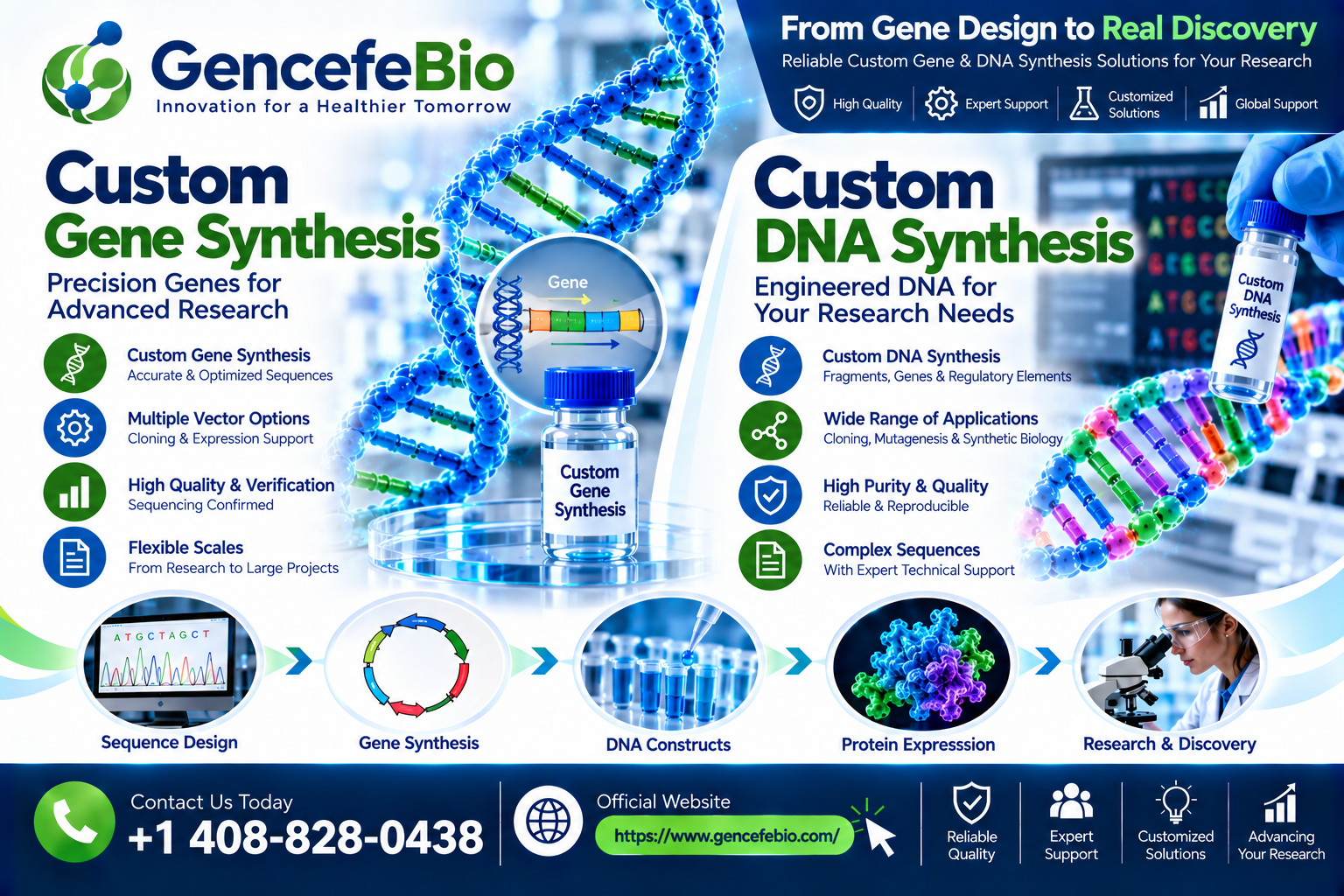
As biotechnology, pharmaceutical development, synthetic biology, diagnostics, and academic research become increasingly sequence-driven, demand for precisely engineered genetic material continues to grow. Two important services supporting this shift are custom gene synthesis and custom DNA synthesis, which allow researchers to move from a digital sequence design to a physical DNA construct tailored to a specific scientific objective.
These technologies can support cloning, protein expression, assay development, pathway engineering, biomarker research, and other molecular biology workflows. While the terms are closely related, gene synthesis typically refers to producing a complete coding sequence or gene construct, whereas custom DNA work may also include shorter fragments, regulatory regions, variants, and other designed DNA elements.
What Is Custom Gene Synthesis?
Custom gene synthesis is the laboratory production of a gene according to a researcher-defined nucleotide sequence.
Instead of isolating a gene from a natural biological source, researchers can submit a digital sequence and receive a synthesized construct for downstream research.
Common applications include:
- Recombinant protein expression
- Molecular cloning
- Synthetic biology
- Functional genetics
- Assay development
- Reporter studies
- Pathway engineering
- Antibody research
This can simplify projects that would otherwise require multiple rounds of cloning, mutation, or sequence assembly.
Why Custom Gene Synthesis Is Valuable
A major advantage of custom gene synthesis is the ability to control the sequence from the beginning.
Researchers may use it to create:
Exact Coding Sequences
A gene can be synthesized according to a specific research design.
Sequence Variants
Different versions of a gene can be produced for comparison.
Optimized Constructs
A coding sequence may be adjusted for a particular experimental expression system, where appropriate.
Difficult-to-Source Genes
Synthetic production may eliminate the need to obtain a natural DNA template first.
What Is Custom DNA Synthesis?
Custom DNA synthesis refers more broadly to producing DNA according to specified nucleotide sequences.
The requested material may include:
- Gene fragments
- Complete genes
- Regulatory sequences
- Promoters
- DNA controls
- Mutated sequences
- Research standards
- Synthetic biology components
This flexibility makes custom DNA useful in a wide range of molecular research programs.
Difference Between Custom Gene Synthesis and Custom DNA Synthesis
The two services overlap considerably, but they are not always identical.
Custom gene synthesis usually focuses on complete genes or coding sequences designed for expression or functional research.
Custom DNA synthesis can include a broader range of DNA constructs, including non-coding and shorter sequence elements.
A project may therefore involve both.
For example:
DNA Fragment Design → Gene Assembly → Cloning → Protein Expression → Functional Analysis
Applications in Recombinant Protein Research
One of the most common uses of custom gene synthesis is recombinant protein production.
A typical workflow may involve:
- Selecting a target protein.
- Designing the corresponding gene.
- Synthesizing the DNA.
- Cloning it into an appropriate vector.
- Introducing the construct into an expression system.
- Evaluating protein production.
The quality of the gene design can influence downstream expression and experimental efficiency.
Applications in Synthetic Biology
Synthetic biology combines computational design with biological engineering.
Researchers may use custom DNA synthesis to build DNA components for studying:
- Gene regulation
- Metabolic pathways
- Biological circuits
- Protein engineering
- Cell-based systems
- Functional genomics
The ability to design DNA before entering the laboratory can make research workflows more systematic.
Sequence Optimization
Some projects may require sequence optimization for experimental purposes.
This can involve adjusting a coding sequence while preserving the intended protein sequence.
Potential considerations may include:
- Codon usage
- Repetitive sequences
- GC content
- Unwanted restriction sites
- Secondary structure concerns
Optimization should always be aligned with the intended expression system and research objective.
A sequence that performs well in one system may not necessarily be ideal in another.
Sequence Verification and Quality Control
Accuracy is critical in custom gene synthesis and custom DNA synthesis.
A single nucleotide difference can potentially alter:
- Protein sequence
- Gene expression
- Primer binding
- Regulatory behaviour
- Experimental results
Depending on the service and project, quality-control documentation may include:
- Sequence verification
- DNA quantity
- Construct identity
- Delivery format
- Concentration
Researchers should define their quality requirements before manufacturing begins.
Custom DNA Synthesis for Assay Development
Molecular assays frequently require precisely defined DNA materials.
Synthetic DNA may serve as:
- Positive controls
- Reference materials
- Calibration sequences
- Target templates
- Assay-development reagents
Because the sequence is known, researchers can create controlled materials for evaluating assay performance.
This can be especially useful when natural samples are difficult to obtain or vary between batches.
Gene Synthesis for Antibody and Protein Studies
Gene synthesis can also support antibody and protein research.
For example, a synthesized gene may encode:
- A full protein
- A specific protein domain
- An antibody fragment
- A recombinant antigen
- A protein variant
Researchers can then use the resulting construct in expression studies.
This creates a direct connection between sequence design and downstream biological experiments.
Supporting Research Reproducibility
Reproducibility is a major concern in modern biological research.
Sequence-defined materials can help improve consistency because the exact genetic construct can be documented and recreated.
Research teams should maintain records of:
- Final DNA sequence
- Construct version
- Batch information
- Vector details
- Storage conditions
- Experimental use
Good documentation can reduce confusion when a project continues over months or years.
Choosing a Custom Gene Synthesis Provider
Researchers should evaluate more than turnaround time and price.
Important considerations include:
- Supported sequence length
- Sequence complexity
- Cloning options
- Verification methods
- Technical support
- Delivery format
- Scalability
- Quality documentation
Difficult sequences may require additional review before production begins.
Choosing a Custom DNA Synthesis Provider
For custom DNA synthesis, research teams may want to clarify:
- Required sequence length
- Desired DNA format
- Whether cloning is needed
- Required quantity
- Quality-control expectations
- Downstream application
Clear communication at the beginning helps prevent mismatches between the synthesized material and the intended experimental workflow.
Data Accuracy Before Ordering
Researchers should carefully review submitted sequences.
Common problems can include:
- Incorrect reading frames
- Missing start or stop codons
- Unintended mutations
- Incorrect orientation
- Vector incompatibility
A synthesis provider can manufacture the sequence supplied, but responsibility for the scientific design still begins with the research team.
Frequently Asked Questions
What is custom gene synthesis?
Custom gene synthesis is the production of a complete gene or coding sequence based on a researcher-defined nucleotide design.
What is custom DNA synthesis?
Custom DNA synthesis is the broader production of designed DNA fragments, genes, regulatory elements, or other nucleotide sequences.
What can synthesized genes be used for?
They may support protein expression, cloning, functional studies, synthetic biology, assay development, and antibody research.
Can custom DNA include mutations?
Yes. Researchers can request defined sequence variants when supported by the provider.
Is custom gene synthesis the same as DNA sequencing?
No. Sequencing reads an existing DNA molecule, while synthesis creates a new DNA molecule according to a specified sequence.
Can synthesized DNA be delivered in a vector?
Depending on the service, DNA may be provided as a fragment or cloned into a selected vector.
Why is sequence verification important?
Verification helps confirm that the synthesized construct matches the intended design.
Can genes be optimized for expression?
In some projects, coding sequences can be redesigned for a specific expression system while preserving the encoded protein sequence.
What information is needed for a synthesis project?
Researchers typically need to provide the nucleotide sequence, preferred format, quantity, cloning requirements, and downstream application.
How should a provider be selected?
Technical capability, sequence verification, cloning support, quality documentation, scientific communication, and scalability are important factors.
Media Contact
Research & Business Enquiries
Contact: +1 408-828-0438
Official Website: https://www.gencefebio.com/