
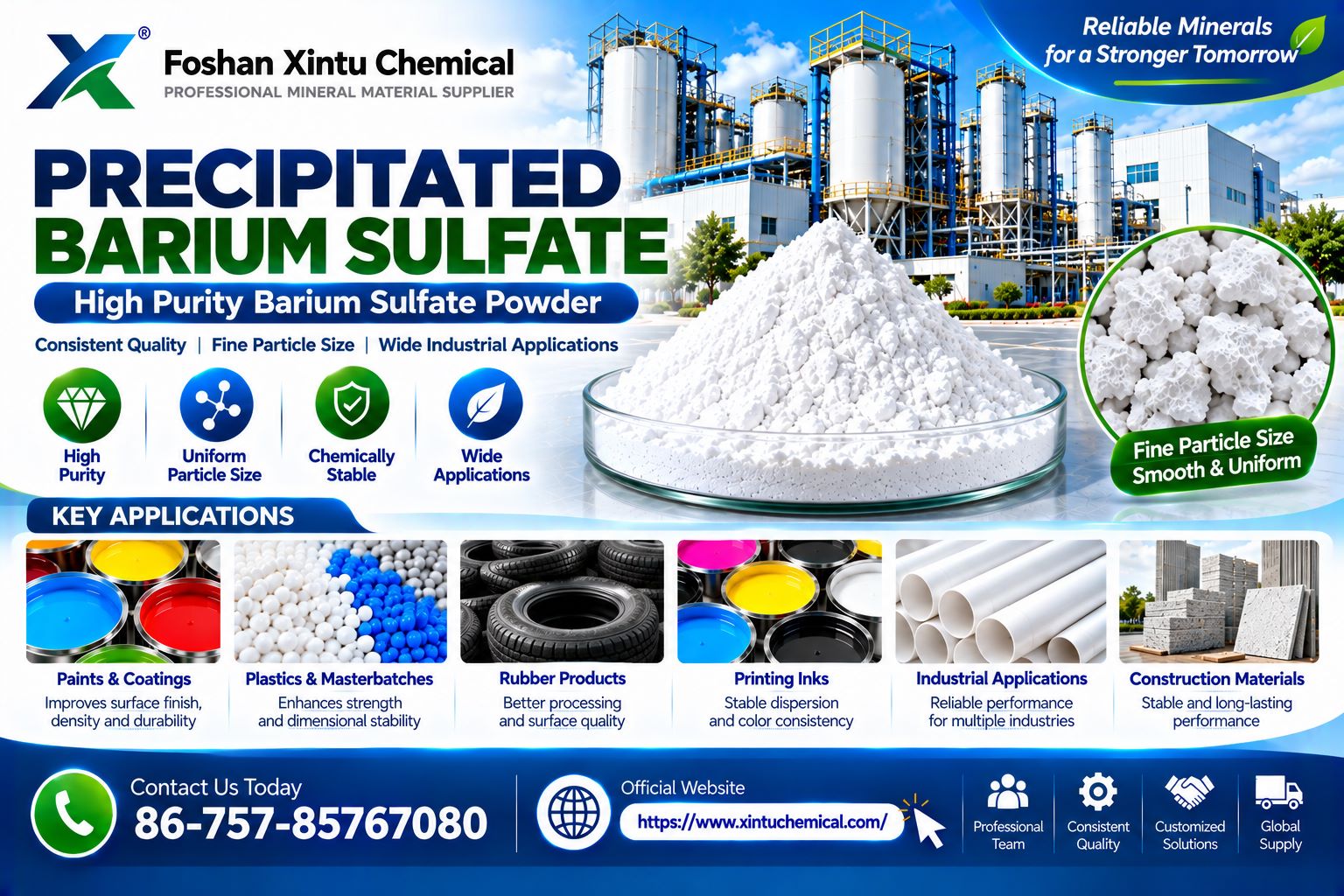
Manufacturers across coatings, plastics, rubber, inks, adhesives, powder coatings, and specialty industrial compounds are placing greater emphasis on raw materials that offer reliable purity, controlled particle size, good dispersion, and consistent processing behavior. This shift is increasing demand for Precipitated Barium Sulfate and high-quality Barium Sulfate Powder, particularly in formulations where surface finish, density, stability, whiteness, and repeatability are important.
Although barium sulfate has long been used as a mineral filler, modern industrial requirements are changing how buyers evaluate it. Instead of focusing only on cost, formulators are paying closer attention to particle distribution, impurity levels, oil absorption, whiteness, and compatibility with resins and polymers.
What Is Precipitated Barium Sulfate?
Precipitated Barium Sulfate is a synthetically manufactured form of barium sulfate produced through a controlled chemical precipitation process.
The process allows manufacturers to achieve more carefully managed physical properties than are typically available from naturally mined barite.
Common characteristics may include:
- High purity
- Fine particle size
- Narrow particle-size distribution
- High whiteness
- Low soluble impurities
- Stable chemical behavior
- Consistent dispersion
These properties make precipitated grades useful in applications where appearance and formulation control are critical.
How Precipitated Barium Sulfate Is Produced
The manufacturing process generally involves a chemical reaction that forms insoluble barium sulfate particles.
A simplified production sequence may include:
Reaction → Precipitation → Washing → Filtration → Drying → Milling → Classification → Packaging
Each stage affects the final product.
Washing can help reduce soluble impurities, while drying, milling, and classification influence particle size and consistency.
For industrial customers, controlled processing is especially important because changes in particle characteristics may alter viscosity, dispersion, surface appearance, and mechanical properties.
Understanding Barium Sulfate Powder
Barium Sulfate Powder is a white mineral material primarily composed of BaSO₄.
It is known for several valuable industrial characteristics, including:
- High specific gravity
- Low chemical reactivity
- Very low water solubility
- Good thermal stability
- Neutral coloration
- Strong chemical resistance
- Good weather stability
These properties allow it to function as a useful filler in formulations where stability and density are required.
Depending on the production route, barium sulfate may be supplied as either a processed natural material or a chemically precipitated grade.
Why Particle Size Matters
Particle size is one of the most important specifications when selecting Precipitated Barium Sulfate.
Fine and uniform particles can support:
- Smooth surfaces
- Better dispersion
- Consistent appearance
- Reduced visible texture
- Predictable processing
However, extremely fine materials may influence viscosity or handling.
This means formulators should not automatically choose the smallest available particle size. The most suitable grade depends on the binder, resin, polymer, processing equipment, and final product requirements.
Applications in Paints and Coatings
Paint and coating manufacturers commonly use Barium Sulfate Powder as a functional mineral filler.
Potential applications include:
- Architectural coatings
- Industrial paints
- Protective coatings
- Automotive-related coatings
- Specialty finishes
Depending on formulation design, barium sulfate may contribute to:
- Surface smoothness
- Film density
- Mechanical stability
- Controlled gloss
- Formulation balance
Because it is chemically stable, it can be useful in systems where low reactivity is desirable.
Use in Powder Coatings
Precipitated Barium Sulfate is particularly relevant to powder-coating formulations that require controlled particle size and strong whiteness.
Possible advantages may include:
- Smooth film appearance
- Stable processing
- Improved hardness
- Consistent filler distribution
- Balanced flow characteristics
The actual effect depends on the resin system, loading level, curing conditions, and other ingredients.
Formulation testing remains essential before large-scale production.
Applications in Plastics
In plastics, Barium Sulfate Powder may be used as a functional filler for:
- Polypropylene
- Polyethylene
- PVC
- Engineering plastics
- Masterbatches
- Molded products
Possible benefits can include increased density, improved dimensional stability, and enhanced surface quality.
The grade must disperse properly within the polymer matrix to avoid agglomeration or visible defects.
Role in Rubber Compounds
Rubber manufacturers may also incorporate barium sulfate into certain formulations.
Potential applications include:
- Sealing products
- Industrial rubber components
- Molded parts
- Automotive-related rubber goods
Its high density and chemical stability can be useful where formulation balance and process consistency are important.
Proper dispersion remains critical because uneven filler distribution can affect surface appearance and mechanical performance.
Printing Inks and Pigment Systems
Fine Precipitated Barium Sulfate can be used in selected printing-ink and pigment formulations.
Depending on the system, it may influence:
- Rheology
- Pigment distribution
- Surface properties
- Print consistency
- Color stability
Its neutral color is beneficial because it can minimize unwanted interference with the primary pigment.
Importance of Whiteness and Purity
Whiteness is important in light-colored coatings, plastics, and inks.
A high-quality Barium Sulfate Powder with controlled impurities can help maintain a clean visual appearance.
Purity can also affect:
- Batch consistency
- Processing behavior
- Customer specifications
- Product quality
Industrial buyers should review technical specifications before approving a material for production.
Quality Specifications Buyers Should Check
Typical parameters may include:
- BaSO₄ content
- Particle-size distribution
- Whiteness
- Moisture
- Oil absorption
- Specific gravity
- pH
- Soluble impurities
Not every parameter carries the same importance for every application.
For coatings, whiteness and particle size may receive more attention, while plastics manufacturers may focus more heavily on density, dispersion, and dimensional performance.
Batch Consistency and Supply Reliability
Industrial manufacturers often need the same grade over long production cycles.
Inconsistent raw material may lead to changes in:
- Viscosity
- Surface finish
- Color
- Processing conditions
- Finished-product performance
For this reason, stable manufacturing and reliable supply are important parts of material selection.
Cost alone should not be the deciding factor if lower-priced material results in higher process variation or waste.
Storage and Handling
Barium sulfate should generally be kept in clean, dry storage conditions.
Good industrial practices include:
- Keeping packaging sealed
- Preventing moisture contamination
- Avoiding mixing with foreign materials
- Following supplier recommendations
- Applying suitable dust-control measures
Users should also review relevant technical and safety documentation before handling industrial powders.
Frequently Asked Questions
What is Precipitated Barium Sulfate?
Precipitated Barium Sulfate is a synthetic form of BaSO₄ produced through controlled chemical precipitation to achieve high purity and carefully managed particle properties.
What is Barium Sulfate Powder used for?
Barium Sulfate Powder is commonly used in coatings, plastics, rubber, inks, adhesives, powder coatings, and industrial compounds.
Is precipitated barium sulfate different from natural barite?
Yes. Natural barite is mined and processed, while precipitated barium sulfate is produced chemically.
Why is particle size important?
Particle size affects dispersion, surface quality, viscosity, processing, and appearance.
Is barium sulfate soluble in water?
It has extremely low water solubility.
Why is it used in coatings?
It can support density, smoothness, stability, hardness, and formulation control.
Can it be used in plastics?
Yes. Appropriate grades may serve as functional fillers in several polymer systems.
Why does whiteness matter?
High whiteness can help prevent unwanted color influence in white or light-colored formulations.
How should buyers choose the right grade?
Buyers should evaluate purity, particle size, whiteness, dispersion, oil absorption, density, and application compatibility.
What documents should buyers request?
Technical data sheets, quality specifications, and safety documentation are useful for evaluating industrial suitability.
Media Contact
Industrial Materials & Business Enquiries
Contact: 86-757-85767080
Official Website: https://www.xintuchemical.com/