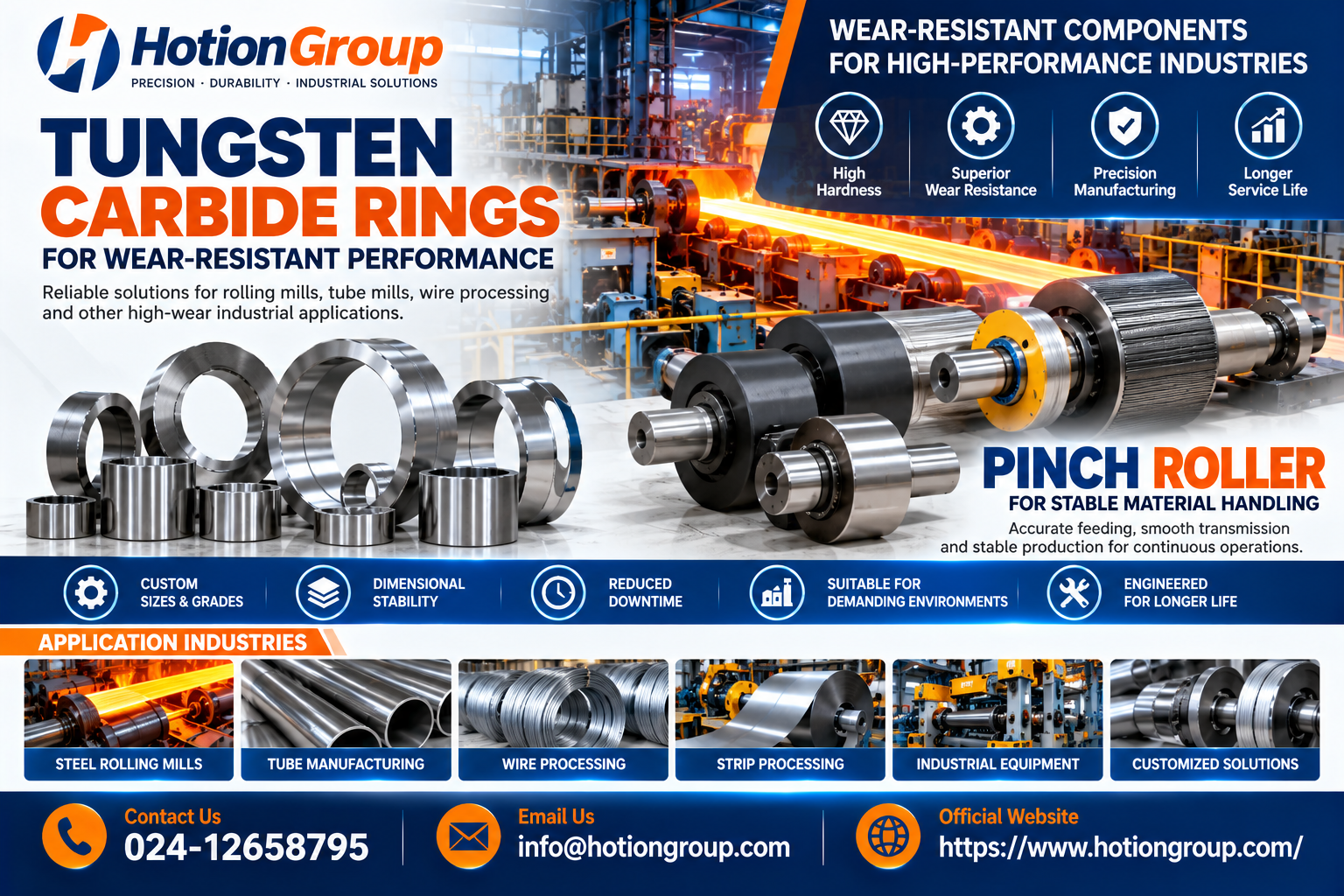
As steel mills, tube production facilities, wire-processing plants, and heavy engineering operations demand higher productivity and longer component life, interest in durable wear-resistant parts continues to rise. Two important components in this environment are Tungsten Carbide Rings and the Pinch Roller, both of which help support stable material movement, controlled processing, dimensional consistency, and reduced downtime.
Although they perform different functions, these components often operate in demanding environments involving high loads, continuous production, heat, friction, and repeated mechanical contact. Their performance therefore depends on correct material selection, precise manufacturing, proper installation, and routine inspection.
What Are Tungsten Carbide Rings?
Tungsten Carbide Rings are precision-engineered components manufactured from tungsten carbide-based materials known for exceptional hardness and wear resistance.
Industrial carbide rings may be used in:
- Steel rolling mills
- Wire rod production
- Tube and pipe manufacturing
- Guide systems
- Forming equipment
- Sizing operations
- High-wear mechanical assemblies
The purpose of using carbide rather than conventional steel is often to extend service life and maintain dimensional accuracy under abrasive or high-load conditions.
Why Tungsten Carbide Is Used in Industrial Applications
Tungsten carbide combines hard carbide particles with a metallic binder to create a material capable of operating in demanding environments.
Key characteristics include:
High Hardness
Carbide can resist surface wear even under repeated contact.
Strong Wear Resistance
This makes it suitable for high-volume production where conventional components may wear quickly.
Dimensional Stability
The material can help maintain consistent geometry throughout long production cycles.
High Compressive Strength
Tungsten carbide performs well where components are subjected to significant pressure.
Importance of Carbide Grade Selection
Not all Tungsten Carbide Rings are identical.
Different carbide grades may provide different balances of:
- Hardness
- Toughness
- Impact resistance
- Wear resistance
- Thermal performance
A very hard grade may perform well under abrasive conditions, while a tougher grade may be more suitable where impact or vibration is significant.
This makes application analysis important before selecting a carbide ring.
Tungsten Carbide Rings in Rolling Applications
Rolling equipment often operates continuously at high speeds.
Carbide rings may be used where the component surface regularly contacts steel rod, wire, strip, or tubular products.
Potential advantages include:
- Reduced surface wear
- Longer service intervals
- Better dimensional control
- Consistent product finish
- Lower replacement frequency
Longer component life can also reduce downtime associated with frequent roll changes.
Precision Manufacturing Matters
For Tungsten Carbide Rings, dimensional accuracy is critical.
Important parameters may include:
- Outside diameter
- Inside diameter
- Ring width
- Surface finish
- Concentricity
- Roundness
Even small dimensional errors can influence alignment or product quality in high-speed production environments.
Precision grinding and finishing are therefore important manufacturing stages.
What Is a Pinch Roller?
A Pinch Roller is a mechanical roller assembly designed to grip, guide, feed, or control moving material within an industrial production line.
Pinch rollers are widely used in:
- Steel rolling lines
- Tube mills
- Strip-processing lines
- Wire production
- Cut-to-length lines
- Forming systems
- Material handling equipment
The roller applies controlled pressure to the material so that it can be transported, positioned, or stabilized as it moves through the line.
Why Pinch Rollers Are Important
A Pinch Roller can perform several critical functions.
Material Feeding
It can help move strip, tube, sheet, or other products through processing equipment.
Tension Control
Consistent grip can help maintain controlled material movement.
Positioning
The roller may help align the material before it enters another process.
Speed Synchronization
Pinch rollers can help coordinate material speed between different sections of a production line.
Stable Handling
Properly controlled pressure reduces unwanted slipping or movement.
Pinch Roller Design Considerations
A reliable Pinch Roller system should be designed according to actual operating conditions.
Important factors include:
- Material thickness
- Material width
- Surface condition
- Line speed
- Required gripping force
- Operating temperature
- Drive method
- Roller diameter
Applying too little pressure may cause slipping, while excessive pressure can damage the material surface or increase component wear.
Roller Surface Material Matters
The roller surface must provide suitable grip without causing unnecessary marking.
Depending on the application, rollers may use:
- Alloy steel
- Hardened steel
- Special coatings
- Wear-resistant materials
The correct material depends on the product being handled and the expected operating life.
For high-wear environments, surface treatment and hardness can significantly influence maintenance intervals.
Tungsten Carbide Rings and Pinch Roller Systems in Steel Production
Tungsten Carbide Rings and a Pinch Roller may both be found within the same steel-processing line.
For example, carbide rings may perform rolling, sizing, or guiding functions while pinch rollers manage material movement between process stages.
Together they can support:
- Stable feeding
- Accurate positioning
- Reduced wear
- Better dimensional control
- Continuous production
This combination becomes particularly valuable in high-speed manufacturing environments where production interruptions can be costly.
Applications in Tube and Pipe Manufacturing
Tube mills often require accurate material handling from coil entry through forming, welding, sizing, and cutting.
A Pinch Roller may help:
- Feed steel strip
- Maintain tension
- Control product movement
- Support synchronized processing
At later production stages, wear-resistant carbide components may help guide, size, or process the finished product.
Reliable components can help maintain both line speed and tube consistency.
Maintenance of Tungsten Carbide Rings
Although carbide provides excellent wear resistance, it still requires inspection.
Operators should monitor for:
- Surface cracks
- Chipping
- Uneven wear
- Dimensional changes
- Mounting damage
Correct handling is important because tungsten carbide is extremely hard but can be damaged by severe impact.
Proper storage and installation can help prevent unnecessary failure.
Maintenance of Pinch Rollers
Routine inspection of a Pinch Roller may include:
- Checking roller surface condition
- Inspecting bearings
- Monitoring alignment
- Checking drive systems
- Verifying pressure settings
- Lubricating moving components
- Monitoring vibration
Uneven roller wear can affect material tracking and grip.
Preventive maintenance helps reduce unexpected downtime.
Manufacturing Quality and Material Consistency
Industrial buyers should evaluate more than component dimensions.
Quality considerations may include:
- Material grade
- Hardness
- Surface finish
- Dimensional tolerance
- Heat treatment
- Wear resistance
- Mechanical strength
- Production repeatability
- Technical documentation
- Application support
Consistent manufacturing quality is particularly important when components are replaced repeatedly over the life of industrial equipment.
Frequently Asked Questions
What are Tungsten Carbide Rings?
Tungsten Carbide Rings are wear-resistant industrial components manufactured from carbide materials for applications involving friction, pressure, and continuous mechanical contact.
Where are carbide rings used?
They are commonly used in rolling mills, wire production, tube manufacturing, guides, forming systems, and other high-wear applications.
Why is tungsten carbide preferred over conventional steel?
It generally provides higher hardness and superior wear resistance in suitable applications.
What is a Pinch Roller?
A Pinch Roller is a roller assembly used to grip, guide, feed, or control moving material in industrial production lines.
Where are pinch rollers used?
They are commonly used in steel-processing lines, tube mills, wire production, strip handling, and forming equipment.
Why is roller pressure important?
Correct pressure helps maintain material grip without creating excessive wear or surface damage.
Can Tungsten Carbide Rings be customized?
Yes. Dimensions, carbide grade, hardness, and surface finish can be selected according to application requirements.
Can Pinch Roller dimensions be customized?
Yes. Roller diameter, width, shaft configuration, surface treatment, and mounting can be adapted to the production line.
What causes carbide rings to fail?
Potential causes include impact, improper mounting, unsuitable grade selection, misalignment, or excessive operating stress.
What information should buyers provide when requesting a quotation?
Useful information includes drawings, dimensions, material being processed, operating speed, load, application, quantity, and required material grade.
Media Contact
Industrial Components & Engineering Enquiries
Contact: 024-12658795
Email: info@hotiongroup.com
Official Website: https://www.hotiongroup.com/