
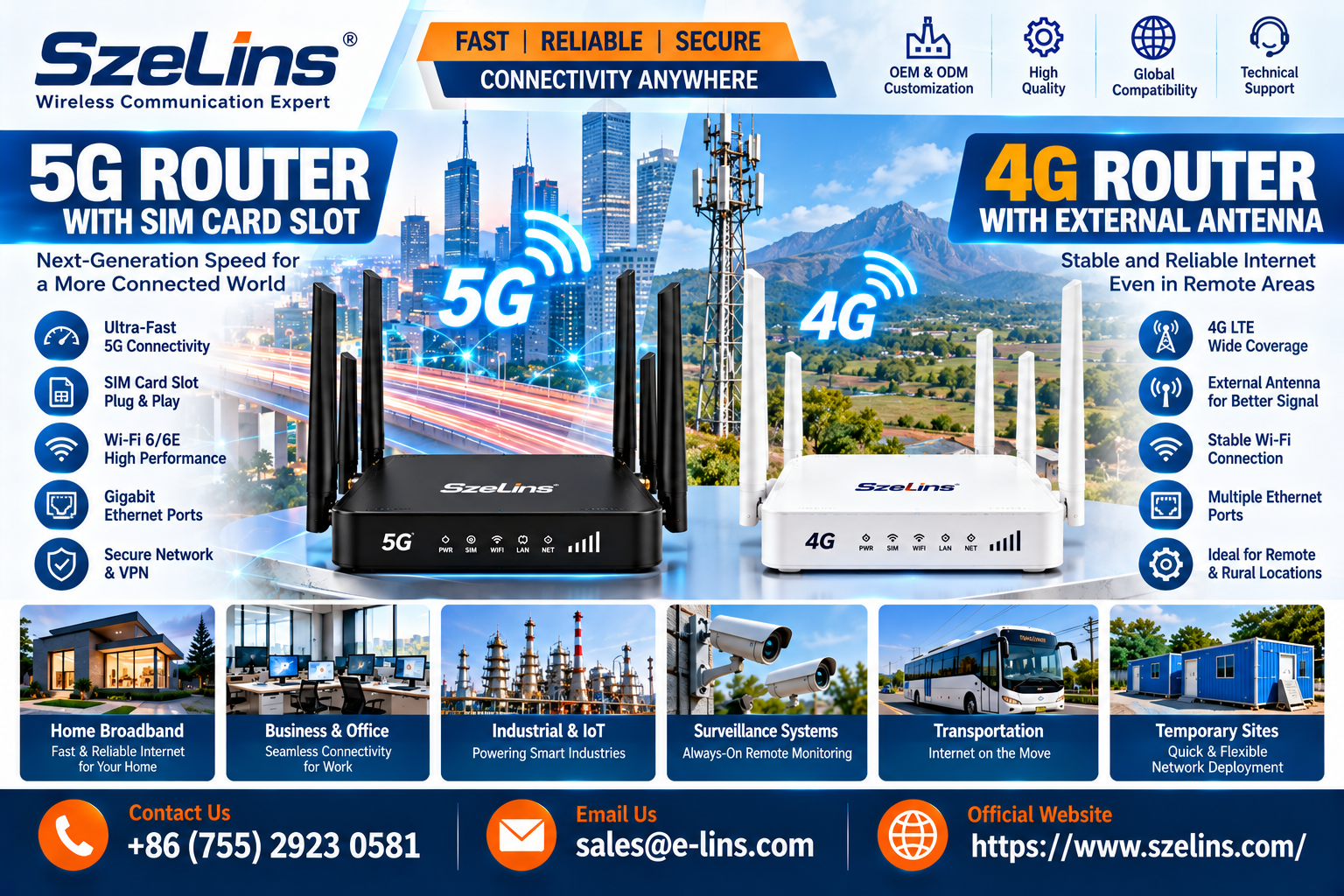
Internet access is becoming a major consideration for businesses, remote facilities, rural properties, and industrial operations. While faster cellular networks create new connectivity opportunities, equipment performance depends heavily on signal conditions, antenna design, and network compatibility.
A 5g router with sim card slot provides access to compatible fifth-generation mobile networks through a cellular subscription. Meanwhile, a 4g router with external antenna can offer a practical solution for locations where improving signal reception is more important than achieving the highest theoretical connection speed.
These networking options highlight an important shift in equipment selection: choosing technology according to actual coverage conditions rather than advertised performance alone.
Why Cellular Signal Quality Matters More Than Router Speed
Wireless routers depend on the quality of the mobile network signal available at their installation location.
Even a technically advanced router may struggle to deliver consistent connectivity when placed inside a building with thick walls, metal structures, or other obstacles.
Signal strength, interference, network congestion, and antenna positioning all influence performance.
For businesses planning cellular internet installations, understanding the physical networking environment can prevent unsuitable equipment purchases.
What Is a 5G Router With SIM Card Slot?
A 5g router with sim card slot is a networking device that uses a compatible SIM card to authenticate with a mobile operator and establish a cellular broadband connection.
The router can then share internet access through supported Wi-Fi or Ethernet interfaces.
Important Features
- SIM Connectivity: Enables access through a compatible mobile subscription.
- 5G Network Support: Provides connectivity where supported coverage is available.
- Wi-Fi Distribution: Connects suitable wireless devices.
- Ethernet Interfaces: Supports compatible wired equipment.
- Network Management: Allows configuration and monitoring.
- 4G Fallback: Available on many models when supported by the router and operator.
Performance depends on supported frequency bands, the mobile service, and the installation environment.
Understanding a 4G Router With External Antenna
A 4g router with external antenna connects to a compatible LTE network while supporting an antenna installed outside the router enclosure.
An external cellular antenna can provide flexibility in positioning the receiving equipment where network conditions are more favorable.
For example, a router may need to remain inside a protected equipment room, while its antenna can be installed at a suitable location with better reception.
Potential Benefits
Flexible Antenna Placement: Allows installation away from signal-blocking obstacles.
Improved Reception: Suitable antennas may improve performance in challenging coverage areas.
Installation Adaptability: Supports selected commercial and industrial environments.
Established Network Compatibility: Uses available compatible LTE infrastructure.
Practical Cost Management: May meet connectivity requirements without upgrading to 5G equipment.
External antennas do not guarantee better performance. Antenna type, placement, cable losses, and network conditions must be considered.
5G SIM Router vs. 4G External Antenna Router
| Feature | 5G SIM Card Router | 4G External Antenna Router |
| Cellular technology | Compatible 5G networks | Compatible 4G LTE networks |
| SIM requirement | Compatible cellular subscription | Compatible cellular subscription |
| Main advantage | Potentially higher network capacity | Flexible cellular antenna placement |
| Coverage dependency | Requires suitable 5G coverage | Requires suitable LTE coverage |
| Antenna options | Model-dependent | Supports external antenna connections |
| Ideal consideration | Higher-demand applications | Challenging signal environments |
Some 5G routers also offer external antenna connections, so the two features are not mutually exclusive.
How External Antennas Influence Network Performance
Cellular antennas receive and transmit radio-frequency signals between the router and the mobile network.
A properly selected antenna may support improved connectivity by providing suitable gain or more favorable placement.
However, antenna gain is only one factor.
Key Technical Considerations
Frequency Compatibility: The antenna must support the cellular bands used by the router and operator.
MIMO Configuration: Multiple-input, multiple-output systems may require multiple correctly connected antenna paths.
Cable Quality: Long or unsuitable cables introduce signal losses.
Antenna Direction: Directional antennas require appropriate alignment.
Environmental Protection: Outdoor installations need suitable mounting and weather protection.
Professional installation may be appropriate for complex or exposed locations.
When Should Businesses Choose 5G?
A 5G router may be appropriate when suitable coverage is available and applications require greater bandwidth or lower network latency.
Potential applications include temporary business offices, commercial broadband, video communication, and connected equipment installations.
However, actual performance depends on the network and the device.
A 5g router with sim card slot should be evaluated through practical connection testing rather than theoretical speed figures.
Where 5G coverage is weak, a stable 4G connection may deliver more consistent results.
When Is a 4G External Antenna Router More Practical?
A 4g router with external antenna may be useful for remote buildings, agricultural facilities, warehouses, and selected industrial locations.
These environments may experience weak indoor signals despite usable outdoor coverage.
An appropriately positioned external antenna can sometimes improve network reception without changing the underlying mobile technology.
The installation should be based on signal measurements, supported frequency bands, and the equipment’s antenna specifications.
Common Installation Mistakes to Avoid
Cellular networking performance can suffer because of avoidable configuration problems.
Frequent Problems
- Selecting antennas that do not support the required frequency bands.
- Using excessively long or unsuitable antenna cables.
- Installing equipment behind large metallic structures.
- Overlooking router and operator compatibility.
- Confusing cellular antennas with Wi-Fi antennas.
- Ignoring equipment grounding and lightning protection requirements.
- Evaluating performance without testing the actual installation location.
Correcting these issues can be more valuable than replacing equipment unnecessarily.
Security and Business Network Management
Reliable connectivity must also be supported by appropriate security controls.
Businesses should configure strong administrative credentials, supported encryption, firewall settings, and firmware maintenance.
Organizations operating multiple routers may benefit from centralized management when the equipment supports it.
Network monitoring can help identify connection interruptions, data consumption patterns, and equipment faults.
Security requirements should be considered during equipment selection rather than after installation.
How to Evaluate Cellular Router Suppliers
Commercial buyers should request clear technical specifications covering cellular bands, antenna connections, SIM compatibility, supported network technologies, and available management features.
Important procurement considerations include hardware quality, firmware support, regulatory compliance, product documentation, and sample testing.
Where external antennas are involved, buyers should also verify connector types and installation requirements.
Selecting compatible equipment helps reduce unnecessary deployment problems.
Frequently Asked Questions (FAQs)
1. What is a 5g router with sim card slot?
It is a router that uses a compatible SIM card to access a 5G cellular network and share internet connectivity.
2. What is a 4g router with external antenna?
It is an LTE router supporting external cellular antenna connections for suitable reception arrangements.
3. Can an external antenna improve 4G internet speed?
It may improve performance when signal conditions are the limiting factor, but results are not guaranteed.
4. Does a 5G router require a SIM card?
Most cellular models require a compatible physical SIM or supported eSIM arrangement.
5. Can a 5G router work on 4G networks?
Many models support compatible 4G fallback connections.
Media Contact
Department: Cellular Router Technology and Wireless Communications
Email: sales@e-lins.com
Contact: +86 (755) 2923 0581
Official Website: https://www.szelins.com/