
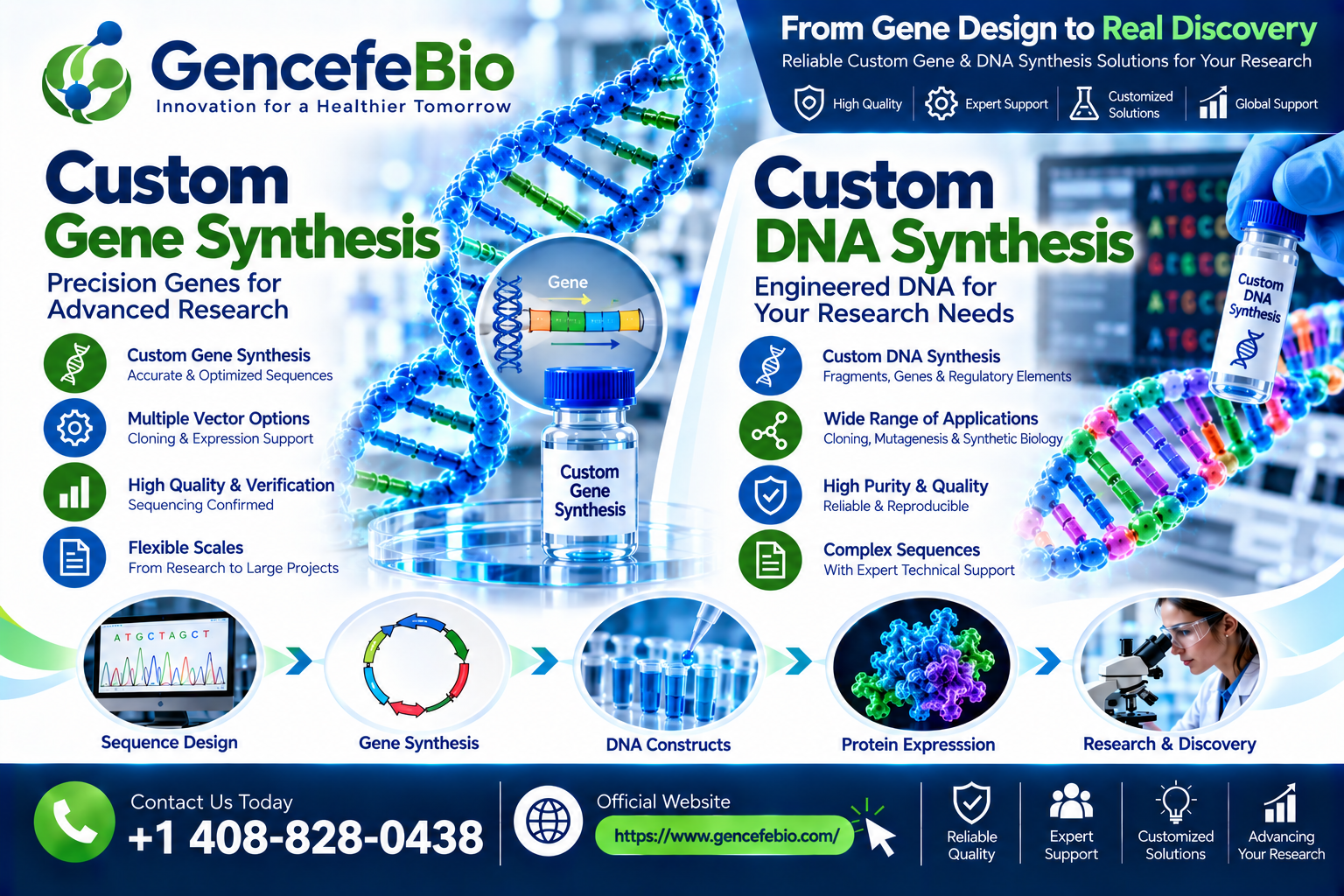
As scientists investigate increasingly complex biological systems, the ability to obtain accurately designed genetic materials has become an important consideration for research institutions and biotechnology organisations.
Custom gene synthesis enables researchers to develop defined genetic sequences for specialised molecular investigations, recombinant expression studies, and synthetic biology applications.
Meanwhile, custom DNA synthesis offers broader opportunities to manufacture specified DNA molecules, including genetic fragments, research constructs, and other sequence-defined materials.
Although these services are closely connected, their applications can differ depending on the research objective.
The central challenge for laboratories is no longer simply obtaining synthetic DNA, but ensuring that every designed sequence contributes meaningfully to reliable experimental results.
Why Genetic Research Is Moving Towards Design-Based Solutions
Molecular researchers frequently require genetic materials that are difficult to obtain directly from biological samples.
Traditional approaches may involve isolating existing DNA and adapting it for subsequent laboratory applications.
Synthetic DNA manufacturing provides another option by allowing laboratories to request specifically designed sequences.
This approach supports greater flexibility in research planning and enables scientists to investigate selected genetic variations.
However, successful outcomes still depend on suitable design, product verification, and laboratory validation.
What Is Custom Gene Synthesis?
Custom gene synthesis is the manufacturing of a defined DNA sequence representing a gene or another specified genetic element.
Researchers can request sequences developed for suitable experimental purposes, including investigations of gene function and recombinant protein expression.
Unlike approaches requiring an existing physical DNA template, synthetic manufacturing begins with defined sequence information.
Common Research Applications
- Gene Function Research: Investigating the biological roles of selected genetic sequences.
- Recombinant Expression Studies: Providing suitable genetic constructs for experimental protein production.
- Genetic Variation Research: Comparing designed sequence variants.
- Synthetic Biology: Supporting the investigation of engineered biological systems.
- Molecular Assays: Developing appropriately characterised genetic research materials.
The required DNA format depends on the experimental application and manufacturing capabilities.
Understanding Custom DNA Synthesis
Custom DNA synthesis refers to the production of DNA molecules according to specified nucleotide sequences.
The term covers a broader range of products than gene synthesis alone.
Depending on project requirements, researchers may need short DNA sequences, larger fragments, or assembled genetic constructs.
For example, a laboratory developing molecular research controls may require a defined DNA fragment rather than a complete gene.
Another research programme may need a designed coding sequence for expression-related investigations.
Consequently, the most suitable service depends on the intended product rather than terminology alone.
The Relationship Between Gene Synthesis and DNA Synthesis
Both services involve manufacturing designed genetic materials, but their scope can differ.
Gene synthesis generally focuses on producing defined genetic sequences associated with particular genes or functional constructs.
DNA synthesis includes these applications while also covering other DNA molecules used in laboratory research.
| Research Consideration | Custom Gene Synthesis | Custom DNA Synthesis |
| Main Focus | Defined genetic sequences | Broad range of DNA sequences |
| Typical Product | Gene or related construct | DNA fragments and other constructs |
| Research Application | Gene function and expression studies | Molecular analysis and genetic research |
| Design Requirement | Gene-specific sequence specifications | Application-specific DNA design |
| Quality Priority | Sequence identity and construct suitability | DNA identity and product quality |
The two terms therefore describe overlapping capabilities rather than completely separate technologies.
Why Sequence Verification Matters
DNA manufacturing accuracy is essential because unintended sequence changes may influence experimental outcomes.
Even when a product appears suitable in quantity and physical form, its sequence identity requires appropriate evaluation.
Different DNA products may need different analytical approaches.
Researchers should establish acceptance criteria before ordering customised genetic materials.
For relevant constructs, sequence verification can help confirm that the delivered material corresponds to the intended design.
This principle encourages laboratories to consider sequence identity as a fundamental quality requirement.
Moving Beyond DNA Delivery Towards Research Readiness
One important consideration in biotechnology procurement is whether the delivered material is ready for its intended experiment.
A correctly synthesised DNA fragment may still require additional preparation before use in a particular research workflow.
For example, researchers may need a specific construct format or supporting documentation.
Product compatibility can depend on the experimental system and the molecular characteristics required.
Therefore, laboratories should define expected deliverables before production begins.
This helps align purchasing decisions with actual laboratory requirements.
How Custom Genetic Materials Support Comparative Research
Designed genetic materials can support experiments comparing selected molecular characteristics.
Researchers may investigate whether different sequence variants influence a measurable biological outcome.
Synthetic manufacturing can provide defined starting materials for these comparisons.
However, observed differences must be interpreted carefully.
Biological systems introduce variables that cannot be controlled through DNA sequence selection alone.
Appropriate experimental controls, analytical methods, and independent verification remain necessary.
The value of custom synthesis lies in supporting controlled research questions rather than guaranteeing a particular biological result.
Research Documentation and Traceability
Documentation is increasingly important in collaborative biotechnology projects.
Multiple laboratories may work with related genetic materials, making accurate identification essential.
Useful records can include requested sequence information, product identifiers, analytical results, and agreed specifications.
Traceability helps research teams distinguish materials and investigate unexpected experimental outcomes.
It can also improve communication between researchers, procurement departments, and external service providers.
These benefits depend on appropriate laboratory recordkeeping and should not be assumed to result automatically from purchasing synthetic DNA.
Choosing a Custom Genetic Manufacturing Partner
Research organisations should evaluate service providers according to scientific requirements and technical capabilities.
Important considerations include:
- Sequence Specifications: Confirm the intended genetic information.
- Product Format: Define the required DNA fragment or construct.
- Manufacturing Feasibility: Review potential technical limitations.
- Quality Documentation: Establish appropriate analytical expectations.
- Research Compatibility: Confirm suitability for the intended application.
- Information Security: Discuss confidentiality and responsible handling of proprietary sequence data.
Clear communication can help reduce specification errors and improve project coordination.
Responsible Synthetic Biology Research
Synthetic genetic materials support valuable investigations in molecular biology, biotechnology, and experimental genetic engineering.
However, custom DNA products intended for research should not automatically be considered suitable for clinical or therapeutic use.
Regulated applications may require additional manufacturing controls, validation, and regulatory review.
Researchers and service providers should also follow relevant biosafety, biosecurity, and sequence-screening requirements.
Responsible research practices remain essential regardless of the intended scientific application.
Frequently Asked Questions (FAQs)
1. What is custom gene synthesis used for?
It is used to manufacture defined genetic sequences for gene function studies, recombinant expression research, and suitable synthetic biology applications.
2. What is custom DNA synthesis?
It is the manufacturing of specified DNA molecules, including suitable fragments and genetic constructs, for molecular research.
3. Are gene synthesis and DNA synthesis the same?
They overlap, but DNA synthesis is broader. Gene synthesis typically focuses on specific genes or related genetic constructs.
4. Why is sequence verification important?
Sequence verification helps establish whether a manufactured DNA product matches the intended genetic design.
5. What should researchers check before ordering synthetic genetic materials?
Researchers should confirm sequence specifications, DNA format, intended application, analytical requirements, documentation, and manufacturing feasibility.
Media Contact
Department: Custom Genetic Research and DNA Synthesis Enquiries
Contact: +1 408-828-0438
Email: gene@gencefebio.com
Official Website: https://www.gencefebio.com/