In this environment, selecting appropriate extrusion components is becoming an important engineering decision rather than a routine machinery purchase.
A bimetallic barrel can provide a specialised internal working surface designed to withstand demanding processing conditions, while a screw element helps establish the conveying and mixing characteristics of suitable modular extrusion systems.
Together, these components influence material processing, equipment compatibility, and manufacturing flexibility.
For plastic compounders, masterbatch producers, machinery manufacturers, and industrial procurement teams, understanding their individual functions can support better equipment investment and process planning.
Why Modern Polymer Processing Requires Specialised Components
Plastic extrusion involves more than melting raw materials.
Different formulations require particular combinations of temperature control, mechanical mixing, pressure development, and material residence.
For example, a polymer compound containing abrasive mineral fillers may create different processing demands from an unfilled thermoplastic.
Similarly, temperature-sensitive formulations may require carefully controlled mechanical energy.
Manufacturers should therefore evaluate extrusion equipment according to the materials being processed.
Matching component characteristics with production requirements can contribute to stable operation and more predictable product quality.
What Is a Bimetallic Barrel?
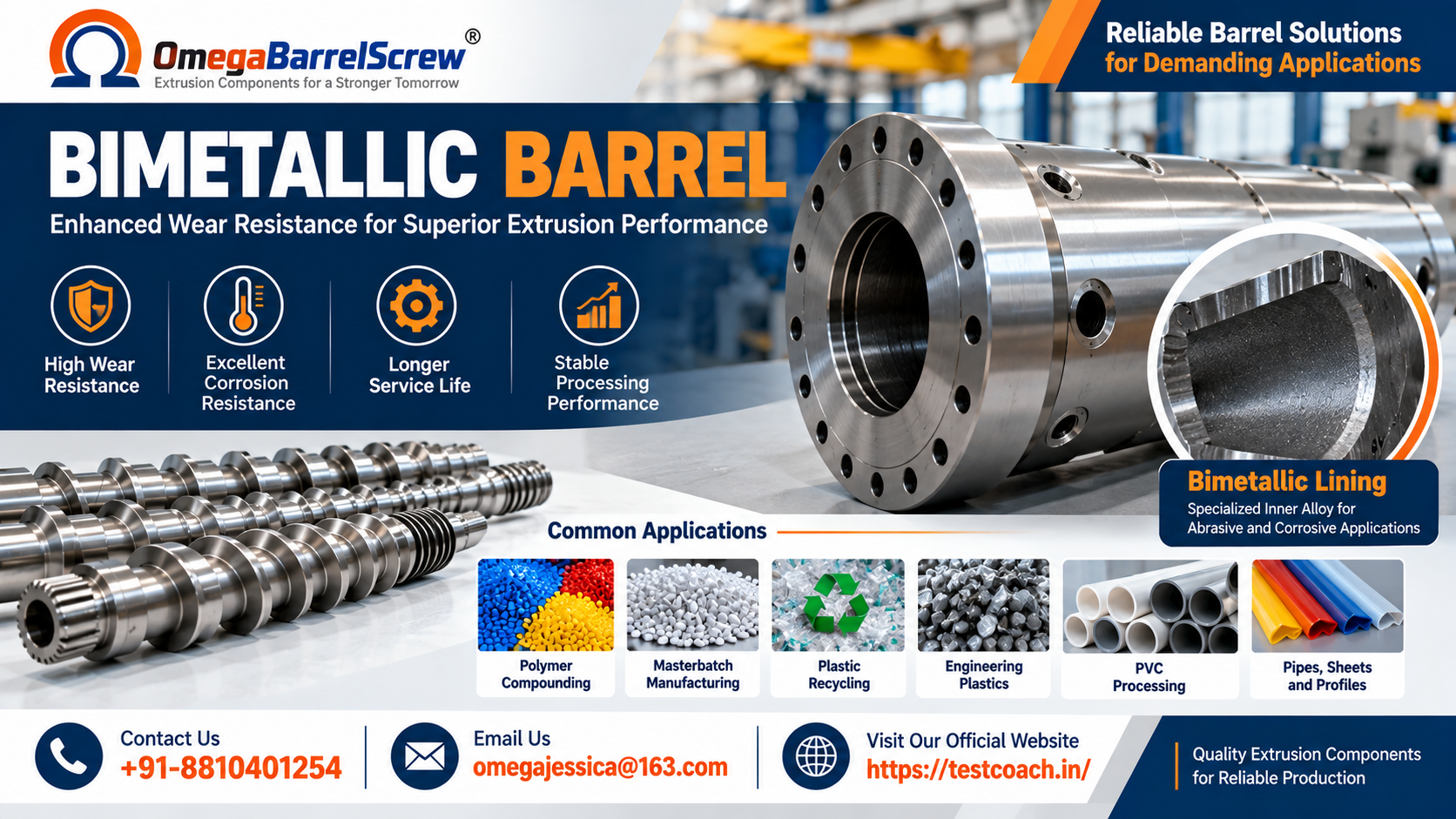
A bimetallic barrel is an extrusion barrel constructed using different metallic materials to achieve specific performance characteristics.
Typically, it combines a structural backing material with an internally bonded or applied alloy layer.
The internal surface is selected to provide appropriate resistance to wear, corrosion, or other specified processing conditions.
Different manufacturing technologies may be used to produce the working layer, depending on the barrel design.
The material composition and bonding quality influence performance.
However, not every bimetallic construction offers the same capabilities.
Buyers should verify the actual alloy specifications and intended applications instead of assuming that all bimetallic barrels provide identical protection.
Understanding Screw Elements in Extrusion Machinery
A screw element is an individual processing component commonly used in modular twin-screw extruders.
Different element geometries perform different functions within the extrusion system.
Conveying elements transport polymer material through the processing sections.
Kneading elements contribute to melting and mixing, while specialised configurations may provide additional processing functions.
Their arrangement influences how materials move and respond to mechanical energy.
This modular approach can provide flexibility when manufacturers develop different polymer formulations.
However, screw configurations must be designed for the intended material, equipment, and processing conditions.
Why Barrel and Screw Compatibility Matters
The barrel and screw system must function as an integrated processing assembly.
Selecting a high-performance internal barrel lining does not eliminate the need for appropriate screw geometry and material selection.
Incorrect clearances or incompatible component specifications may contribute to undesirable mechanical contact or unstable processing.
Engineering teams should consider component dimensions, thermal behaviour, operating conditions, and material characteristics.
Precise compatibility becomes particularly important when manufacturers replace components or modify an existing production line.
Processing Abrasive and Filled Polymer Materials
Mineral-filled and fibre-reinforced formulations can introduce additional mechanical demands.
Materials containing glass fibres, calcium carbonate, or other fillers may increase abrasion depending on their characteristics and processing conditions.
A suitable bimetallic internal lining may help address certain wear-related challenges.
Meanwhile, screw configuration affects the conveying and mixing of fillers throughout the polymer.
Excessive mixing intensity can sometimes create unwanted material degradation or changes in reinforcing-fibre characteristics.
Manufacturers must balance mixing requirements with acceptable processing conditions.
Material trials and application-specific engineering remain important when selecting components.
Different Components, Different Engineering Responsibilities
| Evaluation Factor | Bimetallic Barrel | Screw Element |
| Primary Purpose | Provides the processing chamber and internal working surface | Controls specific conveying or mixing actions |
| Construction | Structural barrel with specialised metallic lining | Individual modular metallic component |
| Design Focus | Surface durability and dimensional suitability | Geometry, material flow, and processing function |
| Main Application | Suitable extrusion machinery | Primarily modular screw systems |
| Selection Priority | Alloy compatibility and barrel specifications | Element design and configuration |
| Performance Consideration | Internal surface condition and thermal behaviour | Mixing, shear, and conveying characteristics |
Both components require application-specific evaluation.
The correct selection depends on the extruder design and the material being processed.
How Component Selection Affects Production Flexibility
Manufacturers increasingly process different product grades using the same equipment platform.
Changing formulations can introduce new requirements for mixing, temperature control, or material handling.
In suitable modular extrusion systems, screw elements may be rearranged to create different processing configurations.
This can provide flexibility during product development or manufacturing adjustments.
However, component changes should follow approved engineering procedures.
Barrel characteristics must also remain appropriate for the intended processing environment.
Equipment flexibility is most valuable when it supports production requirements without compromising mechanical compatibility or product consistency.
Evaluating the Total Cost of Extrusion Components
The initial purchase price is only one part of extrusion equipment economics.
Component selection can also influence maintenance requirements, replacement planning, production interruptions, and processing performance.
A more expensive component may be economically justified when it provides appropriate advantages in a demanding application.
However, premium materials do not automatically guarantee lower operating costs.
Manufacturers should consider:
- Material Requirements: Identify the polymers, fillers, and additives being processed.
- Component Specifications: Verify dimensions, alloy composition, and design compatibility.
- Operating Conditions: Evaluate relevant pressure, temperature, and mechanical demands.
- Maintenance Planning: Review inspection and replacement requirements.
- Production Flexibility: Consider anticipated changes in material formulations.
- Technical Support: Assess the availability of reliable engineering documentation.
A structured evaluation helps businesses make purchasing decisions based on operating needs rather than price alone.
The Importance of Manufacturing Precision
Accurate component manufacturing is essential for reliable extrusion equipment.
The internal dimensions of the barrel must correspond to the intended screw arrangement.
Similarly, modular screw components require suitable geometry and connection compatibility.
Manufacturing inconsistencies can influence mechanical clearances and assembly performance.
Quality evaluation may therefore include dimensional inspection, material verification, and appropriate surface examination.
Suppliers should provide technical specifications relevant to the purchasing requirements.
Clear documentation helps equipment manufacturers and maintenance teams confirm that replacement components are suitable.
Frequently Asked Questions (FAQs)
1. What is a bimetallic barrel used for?
A bimetallic barrel provides a specialised internal processing surface in suitable extrusion equipment, often selected for demanding wear or corrosion-related requirements.
2. What is a screw element in a twin-screw extruder?
A screw element is a modular component designed to perform conveying, kneading, mixing, or other specified processing functions.
3. Is a bimetallic barrel suitable for abrasive plastic compounds?
Certain bimetallic constructions are designed for abrasive applications. Suitability depends on the alloy, polymer formulation, and operating conditions.
4. Can screw elements improve polymer mixing?
Appropriately configured elements can influence distributive and dispersive mixing. The correct arrangement depends on material characteristics and processing objectives.
5. How should manufacturers select extrusion replacement components?
They should verify equipment compatibility, material specifications, dimensions, operating requirements, quality documentation, and relevant technical support.
Media Contact
Department: Extrusion Components and Industrial Machinery Enquiries
Contact: +86-15021464410
Email: omegajessica@163.com
Alternative Email: 965425705@qq.com
Official Website: https://www.omegabarrelscrew.com/
Read More:-