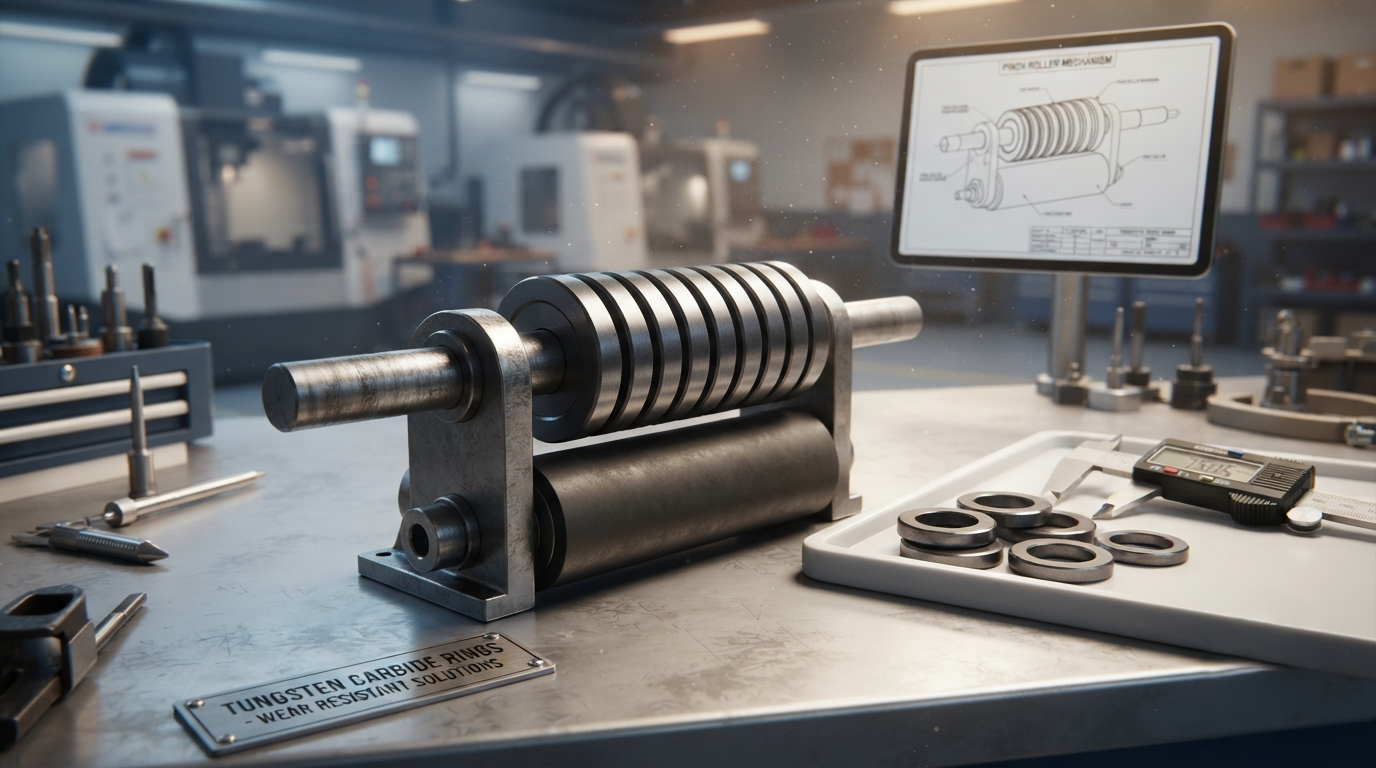
Among these critical industrial components, Tungsten Carbide Rings and Pinch Roller systems are widely used where durability, dimensional accuracy, and reliable material handling are essential.
From steel rolling mills and wire production lines to tube mills and metal-processing plants, these components help manufacturers maintain consistent product quality while reducing maintenance interruptions. Understanding their materials, applications, advantages, and selection criteria can help businesses improve productivity and control operating costs.
What Are Tungsten Carbide Rings?
Tungsten Carbide Rings are high-performance industrial rings manufactured primarily from tungsten carbide particles bonded with metals such as cobalt or nickel. Tungsten carbide is known for exceptional hardness, wear resistance, compressive strength, and stability under demanding conditions.
Unlike conventional steel rolls or rings that may wear rapidly during continuous operation, carbide rings maintain their working profile for considerably longer periods when used correctly.
Important Properties of Tungsten Carbide Rings
The major characteristics include:
- Excellent resistance to abrasive wear
- High hardness and compressive strength
- Reliable dimensional stability
- Resistance to deformation under pressure
- Long operating life
- Consistent surface performance
- Ability to work in demanding rolling conditions
These properties make Tungsten Carbide Rings particularly useful in high-speed production environments where accuracy and uninterrupted operation are priorities.
Material Composition Matters
Not every carbide ring performs identically. Performance depends on carbide grain size, binder percentage, manufacturing quality, finishing accuracy, operating temperature, cooling conditions, and the application itself.
Choosing an appropriate carbide grade is therefore essential rather than selecting components based only on hardness.
What Is a Pinch Roller?
A Pinch Roller is a mechanical roller used to grip, guide, feed, control, or transport material through an industrial processing line. Two rollers generally apply controlled pressure to the material passing between them, creating sufficient traction for stable movement.
Pinch rollers are commonly found in:
- Steel rolling mills
- Wire and rod production
- Tube manufacturing
- Sheet-metal processing
- Coil handling systems
- Straightening lines
- Feeding equipment
- Cutting and finishing lines
The correct Pinch Roller arrangement helps maintain material speed, direction, tension, and alignment throughout the production process.
How Tungsten Carbide Rings and Pinch Rollers Work Together
In many metal-processing applications, Tungsten Carbide Rings provide the wear-resistant working surface while the Pinch Roller mechanism controls material movement.
This combination becomes valuable when conventional roller surfaces experience rapid deterioration because of friction, pressure, scale, or continuous operation.
The typical working process includes:
- Material enters the processing line.
- Pinch rollers grip it using controlled pressure.
- Roller rotation moves or guides the material forward.
- Carbide working surfaces resist friction and wear.
- Stable traction helps maintain controlled material flow.
- The processed material continues toward the next production stage.
Correct pressure is important because excessive force can damage material or equipment, while insufficient pressure may cause slipping.
Tungsten Carbide Rings vs Conventional Steel Rings
| Feature | Tungsten Carbide Rings | Conventional Steel Rings |
| Hardness | Very high | Moderate to high |
| Wear resistance | Excellent | Application dependent |
| Dimensional stability | Excellent | Gradually decreases with wear |
| Service intervals | Potentially longer | Usually more frequent |
| Initial investment | Higher | Generally lower |
| Precision retention | High | Can decrease faster |
| Best application | High-wear production | Standard-duty operations |
Although Tungsten Carbide Rings usually have a higher initial cost, their longer usable life can reduce replacement frequency and production interruptions in suitable applications.
Major Advantages of Tungsten Carbide Rings
Manufacturers increasingly use carbide components because they can provide several operational benefits.
Improved Wear Resistance
Rolling and guiding components experience continuous contact with processed materials. Carbide offers superior resistance to abrasive wear compared with many traditional materials.
Better Product Consistency
When roller dimensions remain stable, manufacturers can maintain more consistent processing conditions and finished-product dimensions.
Reduced Maintenance Frequency
Longer-lasting working surfaces can decrease component replacement and maintenance frequency.
Higher Production Reliability
Reliable rings and rollers help reduce interruptions caused by premature component wear or inconsistent material handling.
Key Benefits of an Efficient Pinch Roller
A properly engineered Pinch Roller provides more than simple material movement. Its performance can influence the efficiency of the entire production line.
Important benefits include:
- Accurate material feeding
- Stable grip and traction
- Controlled line speed
- Improved alignment
- Reduced slipping
- Consistent material tension
- Better synchronization between machines
Roller diameter, surface condition, pressure, alignment, bearing quality, drive system, and material characteristics all affect performance.
Applications Across Different Industries
Tungsten Carbide Rings and Pinch Roller systems are particularly important in metal manufacturing.
Common applications include wire rod rolling, reinforcement bar production, seamless and welded tube processing, steel strip handling, wire drawing, finishing lines, straightening equipment, and high-speed rolling operations.
Industries processing abrasive or high-strength materials may gain additional value from carbide because component wear can otherwise become a significant maintenance issue.
How to Select the Right Components
Selecting suitable components requires an application-specific approach.
Consider these factors:
- Material being processed
- Production speed
- Required roller pressure
- Operating temperature
- Expected wear level
- Ring dimensions and tolerances
- Surface finish requirements
- Cooling and lubrication conditions
- Machine configuration
- Desired service interval
The hardest carbide grade is not automatically the best. A balance between hardness, toughness, binder composition, and operating conditions is necessary.
Maintenance Tips for Longer Service Life
Even premium Tungsten Carbide Rings require correct operation and maintenance.
Inspect roller surfaces regularly for cracks, abnormal wear, contamination, or dimensional changes. Ensure the roller assembly remains properly aligned and avoid unnecessary impact during installation.
Cooling systems should also remain clean and effective where required. Improper cooling, excessive pressure, poor alignment, or vibration can shorten component life despite excellent material quality.
FAQ About Tungsten Carbide Rings and Pinch Roller
1. What are Tungsten Carbide Rings used for?
They are commonly used in rolling, forming, guiding, sizing, and other high-wear industrial operations.
2. Why is tungsten carbide preferred?
Its combination of hardness, wear resistance, strength, and dimensional stability makes it suitable for demanding environments.
3. What is the function of a Pinch Roller?
A Pinch Roller grips and moves material through industrial processing equipment while controlling direction and speed.
4. Can carbide rings replace steel rings?
Yes, in many applications, although machine conditions and operating requirements should be evaluated first.
5. Are carbide rings brittle?
Carbide is extremely hard but can be more sensitive to impact than certain steels, making correct handling important.
6. How long do Tungsten Carbide Rings last?
Service life depends on material grade, load, speed, cooling, alignment, processed material, and maintenance.
7. What causes pinch roller slipping?
Incorrect pressure, surface contamination, worn rollers, poor alignment, or unsuitable roller surfaces can cause slipping.
8. Can Pinch Rollers handle high-speed production?
Yes. Properly engineered rollers are widely used in high-speed manufacturing systems.
9. How should carbide rings be maintained?
Regular inspection, correct cooling, proper alignment, careful installation, and controlled operating pressure are recommended.
10. How do I choose the correct carbide grade?
Evaluate wear conditions, impact loads, processing speed, temperature, required toughness, and manufacturer recommendations.