
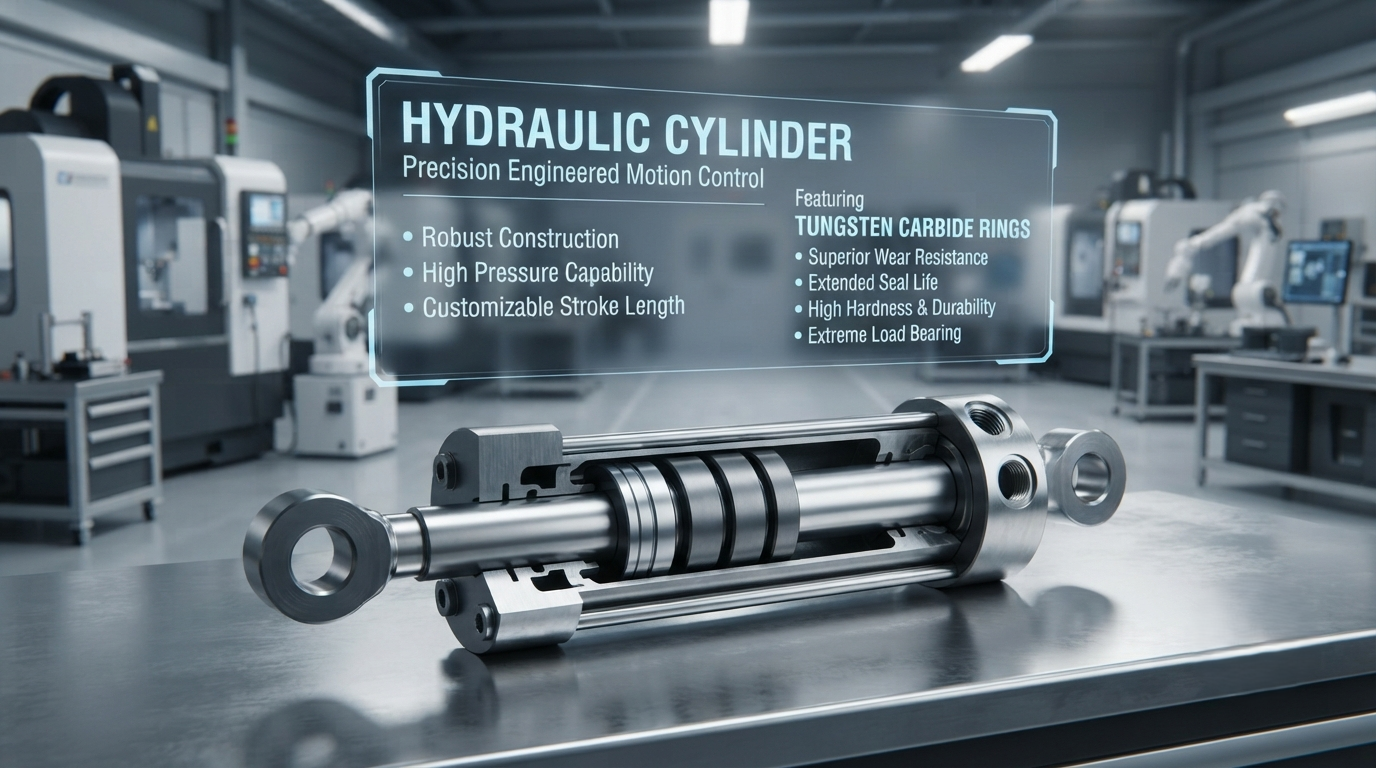
For this reason, manufacturers need components that offer strength, accuracy, durability, and dependable service life. Two important components used in modern engineering applications are the Hydraulic Cylinder and Tungsten Carbide Rings.
A Hydraulic Cylinder is responsible for generating controlled linear force, while Tungsten Carbide Rings are mainly used to resist wear, abrasion, and dimensional changes. Both components support industrial productivity in different ways and are widely used in sectors such as steel manufacturing, construction, mining, automotive production, heavy engineering, material handling, and industrial automation.
This article explains their working principles, benefits, applications, selection factors, and maintenance requirements.
Role of Hydraulic Cylinders in Industrial Systems
A Hydraulic Cylinder is a mechanical device that transforms hydraulic pressure into linear motion. It uses pressurized fluid to move a piston inside a cylindrical barrel.
The piston is connected to a rod that transfers movement to machinery. This allows the cylinder to perform operations such as pushing, lifting, clamping, pressing, pulling, and positioning.
A typical hydraulic cylinder contains:
- Cylinder barrel
- Piston
- Piston rod
- End cover
- Sealing system
- Hydraulic ports
- Guide and wear rings
The simplicity of this design makes hydraulic cylinders suitable for machines requiring powerful and repetitive movement.
How Hydraulic Pressure Creates Mechanical Force
The operating principle of a Hydraulic Cylinder is based on pressurized fluid acting on the surface of a piston.
When hydraulic oil enters the cylinder, pressure forces the piston to move. The movement of the piston pushes or pulls the connected piston rod. Hydraulic valves control the flow direction, allowing the system to manage speed and movement.
The operating process normally includes:
- Hydraulic fluid is pumped from the reservoir.
- Pressure is directed toward the cylinder.
- Fluid pushes against the piston.
- The piston rod produces mechanical movement.
- Returning oil flows back through the hydraulic circuit.
This process allows machines to move heavy loads smoothly and with precise control.
Main Advantages of Hydraulic Cylinders
Hydraulic technology is popular because it provides high power without requiring excessively large mechanical components.
Important benefits include:
- Excellent force-to-size ratio
- Smooth linear movement
- Accurate positioning
- Reliable heavy-load operation
- Adjustable operating speed
- Flexible mounting options
- Easy integration into industrial equipment
- Long service life with proper maintenance
A correctly specified Hydraulic Cylinder can perform thousands of operating cycles while maintaining consistent force and motion.
Different Hydraulic Cylinder Designs
Different industrial applications require different cylinder configurations.
Single-acting hydraulic cylinders use pressure for movement in one direction. Springs, gravity, or external forces are normally responsible for the return stroke.
Double-acting cylinders use hydraulic pressure on both sides of the piston, allowing powered extension and retraction.
Telescopic cylinders use multiple nested sections and are suitable for machines requiring long stroke lengths with limited installation space.
Tie-rod cylinders are commonly used in industrial machinery because they are relatively easy to service.
Welded hydraulic cylinders provide compact construction and are frequently used in mobile equipment, construction machinery, and agricultural systems.
Understanding Tungsten Carbide Rings
Tungsten Carbide Rings are precision-engineered wear components made primarily from tungsten carbide combined with metallic binder materials such as cobalt or nickel.
Tungsten carbide is valued for its outstanding hardness and resistance to abrasive wear. These properties help the rings retain their dimensions and surface quality even when exposed to continuous contact, high pressure, or rapidly moving materials.
Compared with many conventional steel components, Tungsten Carbide Rings can offer a significantly longer wear life when correctly selected for the application.
Why Tungsten Carbide Rings Are Used in Industry
Industrial components that experience continuous friction can gradually lose their shape and accuracy. This can reduce production quality and increase machine downtime.
Tungsten Carbide Rings help minimize these problems because of their strong material characteristics.
Their major advantages include:
- Extremely high hardness
- Excellent abrasion resistance
- Strong compressive strength
- Good dimensional stability
- Long wear life
- Resistance to surface deformation
- Consistent performance
- Reduced replacement frequency
These characteristics are particularly valuable in continuous-production environments.
Typical Applications of Tungsten Carbide Rings
Carbide rings are used wherever precision and wear resistance are important.
Typical applications include:
- Steel rolling mills
- Wire rod production
- Tube manufacturing
- High-speed rolling systems
- Mechanical seals
- Guide assemblies
- Metal forming equipment
- Precision manufacturing
- Wear-resistant machine parts
- Industrial processing systems
In rolling applications, maintaining ring dimensions is particularly important because even small changes can affect the finished product.
Hydraulic Cylinder and Tungsten Carbide Rings: Key Differences
| Factor | Hydraulic Cylinder | Tungsten Carbide Rings |
| Primary Function | Generates controlled linear force | Resists wear and abrasion |
| Working Basis | Hydraulic pressure | Material hardness and strength |
| Main Application | Motion and load handling | Wear protection and precision |
| Common Industries | Construction, mining, automation | Steel, wire, tube manufacturing |
| Main Benefit | High force and controlled movement | Long wear life |
| Maintenance | Seals, fluid and rod inspection | Surface and dimensional inspection |
These components have different purposes, but both help improve the reliability of industrial machines.
How to Select a Hydraulic Cylinder
Selecting the correct Hydraulic Cylinder requires detailed evaluation of machine requirements.
Important factors include:
- Required force
- Maximum pressure
- Bore size
- Rod diameter
- Stroke length
- Mounting arrangement
- Working temperature
- Operating speed
- Duty cycle
- Environmental conditions
The quality of seals, piston rods, and barrel surfaces should also be considered.
Choosing an undersized cylinder can result in poor performance, while an oversized cylinder may increase system costs unnecessarily.
Choosing the Correct Tungsten Carbide Rings
Selecting Tungsten Carbide Rings requires attention to more than just hardness.
Buyers should consider:
- Tungsten carbide grade
- Binder percentage
- Ring dimensions
- Dimensional tolerance
- Surface finish
- Operating speed
- Working pressure
- Temperature
- Impact conditions
- Type of material being processed
Different carbide grades offer different combinations of hardness and toughness.
A grade designed for extreme abrasion may not always be ideal for applications involving heavy impact. Therefore, ring material should be matched carefully with operating conditions.
Importance of Precision Manufacturing
Both hydraulic cylinders and carbide rings require accurate manufacturing.
In hydraulic cylinders, poor dimensional accuracy can result in seal damage, leakage, uneven wear, or piston movement problems.
In Tungsten Carbide Rings, incorrect dimensions can create alignment problems, vibration, and inconsistent material processing.
Precision machining, controlled tolerances, proper surface finishing, and careful quality inspection are therefore essential for long-term performance.
Maintenance Tips for Better Performance
Regular maintenance can significantly improve component life.
For hydraulic cylinders:
- Check for oil leakage.
- Inspect rod surfaces.
- Maintain clean hydraulic fluid.
- Replace worn seals.
- Monitor pressure levels.
- Check mounting alignment.
For Tungsten Carbide Rings:
- Inspect for cracks and chips.
- Check wear patterns.
- Monitor dimensions.
- Verify proper alignment.
- Inspect working surfaces.
- Replace damaged rings before major failure.
Preventive maintenance can reduce downtime and avoid expensive machine repairs.
Frequently Asked Questions
1. What is the purpose of a Hydraulic Cylinder?
A Hydraulic Cylinder converts hydraulic pressure into linear movement for lifting, pressing, pulling, pushing, and positioning.
2. Which industries use hydraulic cylinders?
They are commonly used in construction, mining, agriculture, manufacturing, material handling, and automation.
3. What are Tungsten Carbide Rings mainly used for?
They are used in applications requiring excellent wear resistance, hardness, and dimensional stability.
4. Why is tungsten carbide better for wear applications?
Its high hardness and abrasion resistance allow it to maintain its shape for longer periods.
5. What can damage a hydraulic cylinder?
Contaminated oil, seal failure, excessive pressure, rod corrosion, and poor alignment can cause damage.
6. Can hydraulic cylinders be customized?
Yes. Bore, rod, stroke, mounting style, seals, and pressure ratings can be customized.
7. Do carbide rings require maintenance?
Yes. Regular inspection helps identify cracking, chipping, misalignment, and abnormal wear.
8. What determines carbide ring life?
Material grade, operating speed, contact pressure, alignment, temperature, and application conditions affect service life.
9. Why is clean hydraulic oil important?
Contaminated oil can damage seals, score internal surfaces, and reduce hydraulic system efficiency.
10. How can manufacturers reduce component failure?
Correct product selection, proper installation, regular inspection, and preventive maintenance help reduce failure.