
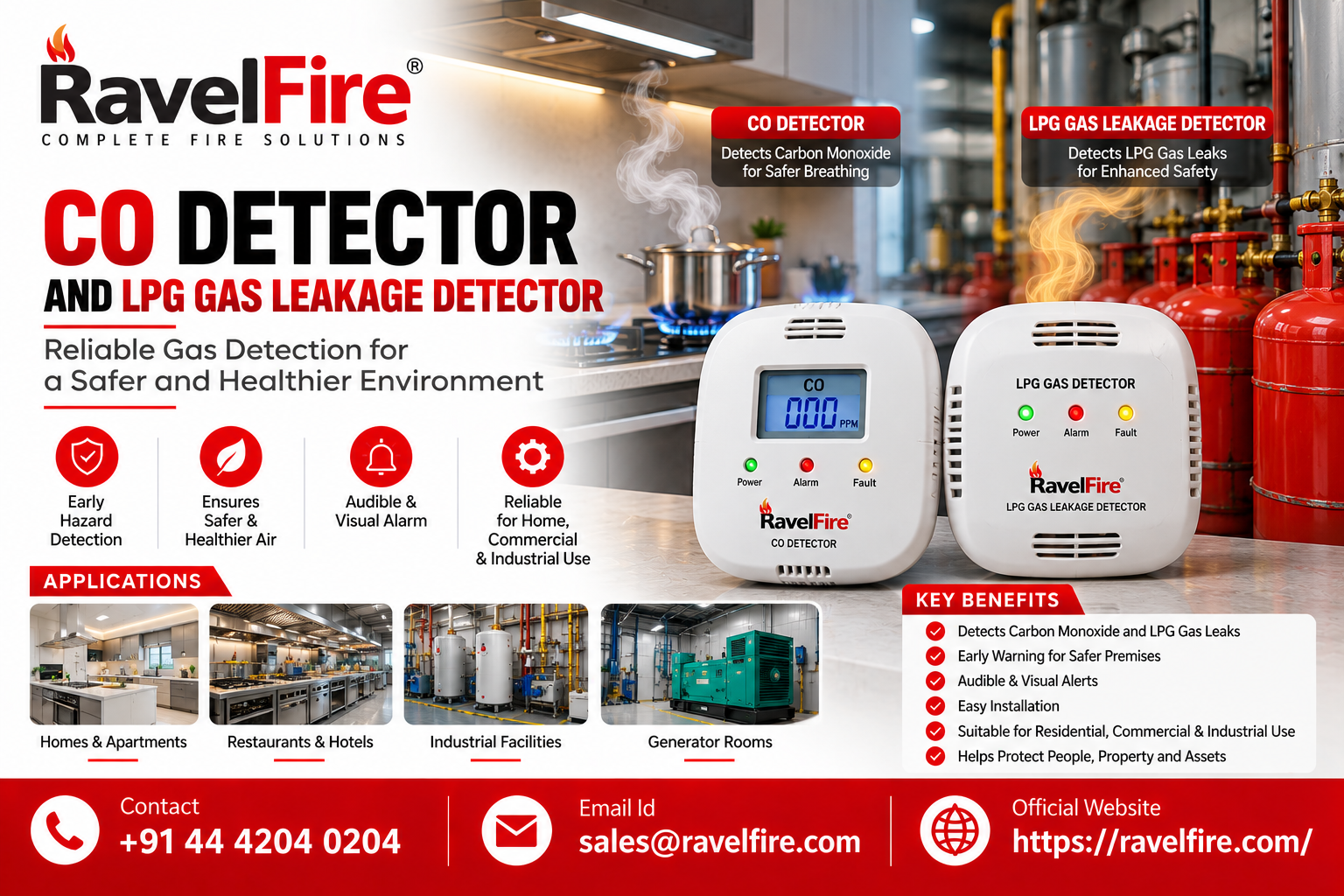
Gas safety is becoming an increasingly important part of building management as homes, hotels, commercial kitchens, factories and utility areas rely on fuel-burning appliances and gas-powered equipment. In this changing safety landscape, the co detector and lpg gas leakage detector are playing important roles in helping occupants and facility teams identify potentially hazardous conditions before they become more serious.
Carbon monoxide and LPG present different risks, but both require dependable monitoring. Carbon monoxide is difficult to detect without a sensor because it is colourless and odourless, while LPG leaks can create fire and explosion hazards if gas accumulates in enclosed spaces.
Industry professionals increasingly view dedicated gas detection as an essential layer of modern building safety.
What Is a CO Detector?
A co detector is a safety device designed to monitor the air for carbon monoxide.
Carbon monoxide can be produced when fuels such as gas, wood, coal or oil do not burn completely. It may be associated with malfunctioning boilers, generators, heating systems, fireplaces or other combustion equipment.
Because the gas cannot be reliably identified by sight or smell, electronic monitoring is important.
A modern detector continuously samples the surrounding environment and activates an alarm when carbon monoxide reaches a predefined level according to its design and configuration.
Typical applications include:
- Boiler rooms
- Hotels
- Residential buildings
- Commercial kitchens
- Generator rooms
- Utility areas
- Parking facilities
- Industrial spaces
The correct detector location should be determined according to the installation environment and applicable safety guidance.
What Is an LPG Gas Leakage Detector?
An lpg gas leakage detector is designed to identify liquefied petroleum gas in the surrounding air.
LPG is widely used in commercial kitchens, restaurants, hotels, industrial facilities and residential properties.
A leak may result from damaged pipes, loose connections, faulty regulators, valves or gas appliances.
When LPG is detected above the device’s configured threshold, the detector can activate an audible warning, visual indicator or connected alarm output.
In some systems, the detector may also communicate with a central control panel.
This creates an additional layer of monitoring in areas where LPG is used regularly.
CO and LPG Detection Address Different Hazards
A co detector and an LPG detector are not interchangeable.
They monitor different gases and should be selected according to the actual risk in the environment.
Carbon monoxide is commonly associated with incomplete combustion.
LPG detection focuses on identifying leaked fuel gas before it reaches a dangerous concentration.
A facility using gas-fired appliances may therefore require more than one type of detection technology.
This distinction is important when designing a comprehensive safety system.
Commercial Kitchens Need Reliable Gas Monitoring
Commercial kitchens are among the environments where gas detection can be especially valuable.
Restaurants, hotels, canteens and institutional kitchens may operate several gas appliances for many hours each day.
An lpg gas leakage detector can help identify leaks from pipelines, valves or appliances.
At the same time, a co detector may be relevant where combustion equipment could generate carbon monoxide under abnormal operating conditions.
Detection technology should complement, not replace, other essential measures such as:
- Proper ventilation
- Routine appliance maintenance
- Gas line inspection
- Staff training
- Emergency shut-off procedures
Layered safety measures provide stronger protection than relying on a single device.
Detector Placement Plays a Major Role
Gas detector performance depends heavily on correct placement.
Different gases behave differently in air.
LPG is heavier than air and may collect at lower levels, while carbon monoxide mixes readily with surrounding air.
This means an lpg gas leakage detector and a co detector may require different mounting positions.
Installation planning should consider:
- Gas source
- Potential leak points
- Air movement
- Ventilation
- Room dimensions
- Equipment layout
- Obstructions
- Access for maintenance
Professional installation helps ensure that the detector is positioned where it can respond effectively.
Industrial Facilities Require More Complex Monitoring
Industrial buildings may contain boilers, furnaces, generators, gas-powered equipment and process machinery.
These environments can require more sophisticated gas monitoring because multiple hazards may exist in different areas.
A co detector can support monitoring near combustion equipment, while an lpg gas leakage detector can be used where LPG is stored, supplied or consumed.
In larger facilities, detectors may also be connected to a central monitoring system.
This allows operators to identify which location has generated the alarm and respond more quickly.
Centralised monitoring can be particularly useful where equipment is spread across several rooms or buildings.
Audible and Visual Alerts Improve Awareness
A detector is most useful when its alarm is easy to recognise.
Many modern gas detection devices include both audible and visual indication.
An alarm sound can attract immediate attention, while LEDs or display indicators can help users understand device status.
In larger buildings, detector signals may also be transmitted to an alarm panel.
This combination can improve alarm visibility.
A co detector may alert occupants to a dangerous combustion-related condition, while an lpg gas leakage detector can provide warning of a fuel gas leak.
Clear indication helps users distinguish normal operation from fault and alarm states.
Maintenance Is Essential for Reliable Gas Detection
Gas sensors do not remain reliable indefinitely without attention.
Environmental conditions, dust, contamination and sensor ageing may affect performance.
Routine testing should therefore be part of the safety programme.
Maintenance may include checking:
- Sensor response
- Alarm sound
- LED indicators
- Wiring
- Power supply
- Panel communication
- Device condition
- Calibration requirements
A co detector should be maintained according to manufacturer instructions and applicable safety requirements.
The same applies to an lpg gas leakage detector.
Facilities should also replace devices or sensor modules when they reach the end of their recommended service life.
Gas Detection Can Support Smarter Building Safety
Modern buildings are moving toward connected monitoring.
Fire alarms, gas detectors, security systems and building management platforms are increasingly being integrated.
Gas detection can become part of this wider safety ecosystem.
When a detector identifies a hazardous condition, the event may be communicated to a control panel or monitoring interface.
This helps facility managers gain greater visibility across the building.
For example, a connected lpg gas leakage detector can help identify a leak location, while a connected co detector can provide warning from boiler or generator areas.
The goal is to make safety information easier to understand and act upon.
Applications Beyond Commercial Buildings
Gas detection is relevant across many types of properties.
Hotels may require monitoring in kitchens, boiler rooms and service areas.
Hospitals and institutions may use gas-fired equipment that requires supervision.
Residential properties may benefit from dedicated carbon monoxide detection near fuel-burning appliances.
Industrial sites may require multiple detectors across production and utility zones.
Parking facilities and generator rooms may also require carbon monoxide monitoring depending on the environment.
The correct solution always depends on the actual gas risk.
Choosing the Right Detector
Selecting the right detector requires more than choosing a device labelled for gas detection.
Facility teams should consider:
- Gas type
- Sensor technology
- Detection threshold
- Installation location
- Operating temperature
- Alarm outputs
- Control panel compatibility
- Maintenance requirements
A co detector should be selected specifically for carbon monoxide monitoring.
Likewise, an lpg gas leakage detector should be designed specifically for LPG detection.
Using the correct technology helps improve reliability and reduces the risk of inappropriate detector placement.
Future Trends in Gas Detection
Gas detection technology is becoming increasingly intelligent.
Newer systems may provide improved diagnostics, easier integration and better maintenance visibility.
Facility operators are also looking for devices that can communicate status information rather than only providing a local alarm.
Connected monitoring may become more common in commercial and industrial environments.
As technology develops, the combination of dedicated gas sensors and centralised management can support a more proactive approach to risk reduction.
Media Contact
Media & Business Enquiries
Contact: +91 44 4204 0204
Email: sales@ravelfire.com
Official Website: https://ravelfire.com/