
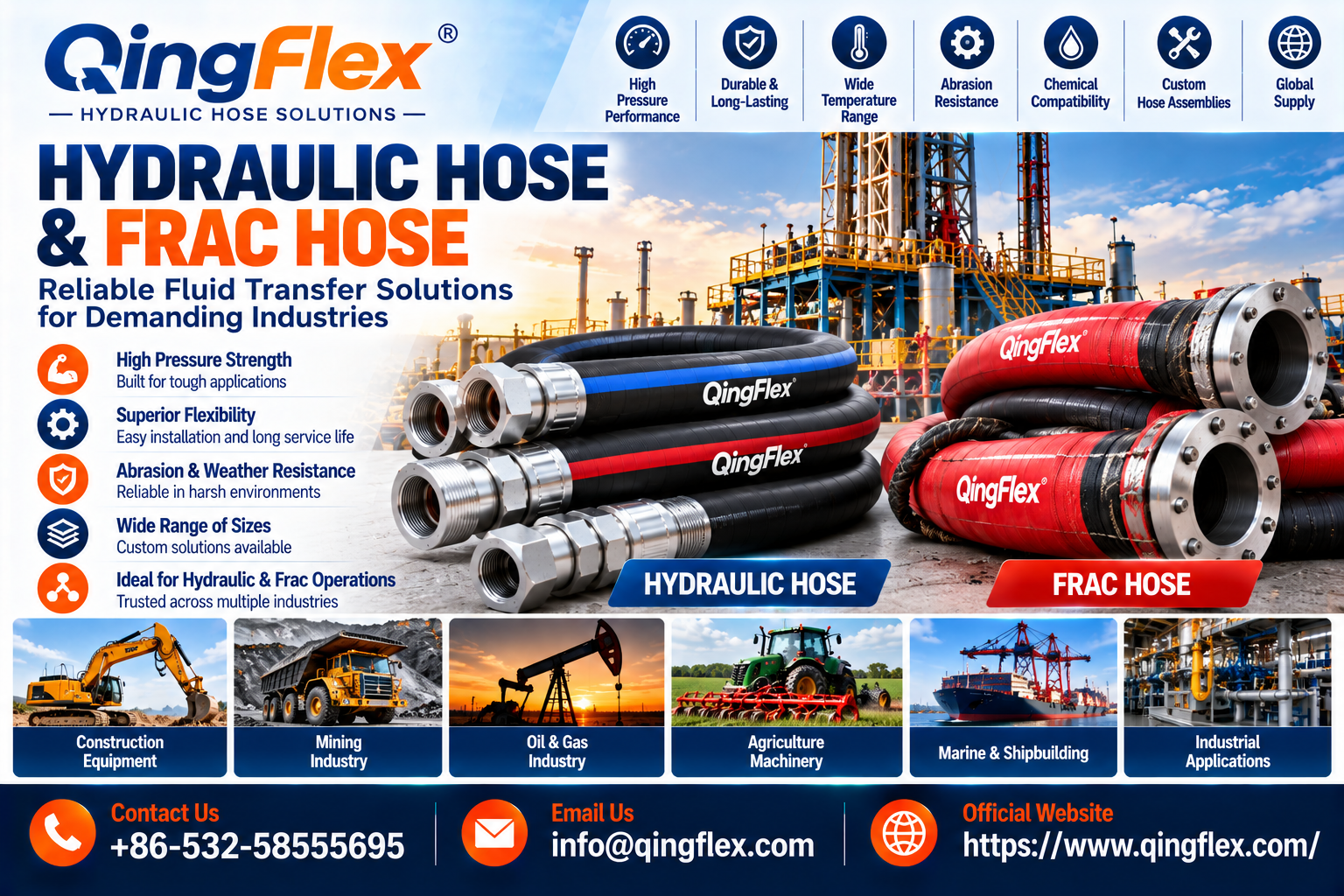
Industrial operators are reassessing hose management as hydraulic equipment and oilfield systems face demanding duty cycles, complex routing, repeated movement, and challenging working environments. The Hydraulic Hose remains a critical connection in fluid-power equipment, while the frac hose serves specialized fluid-transfer needs associated with hydraulic fracturing operations.
The latest focus is not simply on finding a hose that fits. Engineering and maintenance teams are increasingly considering how application data, hose construction, installation quality, connection compatibility, inspection practices, and storage affect the complete hose lifecycle.
Hydraulic Hose Selection Starts With System Data
A Hydraulic Hose provides a flexible connection for transferring hydraulic fluid between appropriate system components. Its flexibility makes it valuable for machinery where rigid piping may not accommodate the required movement or installation geometry.
Applications range from construction and mining machinery to manufacturing equipment, agricultural systems, material handling, and drilling operations.
However, different machines place different demands on hoses.
Before selecting a product, engineers should identify relevant operating information, including:
- Intended application and transferred fluid
- Working pressure and operating temperature
- Hose dimensions and connection requirements
- Equipment movement and routing
- External abrasion and environmental exposure
- Manufacturer and equipment specifications
This information creates a stronger basis for selection than simply matching an old hose by appearance.
Frac Hose Requires Application-Focused Specification
A frac hose operates in a specialized oilfield environment and should be selected according to the requirements of its intended service.
Hydraulic fracturing operations can involve intensive equipment activity, demanding fluid-transfer conditions, outdoor exposure, vibration, and complex site layouts. The specific requirements vary by application, which makes accurate technical information essential.
A hose appropriate for one installation should not automatically be assumed suitable for another.
The intended media, pressure, temperature, connection arrangement, movement, and environmental conditions should all be evaluated against the hose manufacturer’s documentation and applicable equipment requirements.
Hose Construction Has Multiple Responsibilities
Industrial hose construction generally involves components designed to perform different functions.
The inner tube contains the specified medium. Reinforcement supports the hose’s structural and pressure-related requirements. The outer cover helps protect the assembly from relevant external conditions according to the product design.
Different Hydraulic Hose constructions are therefore available for different applications.
The same principle applies to a frac hose. Its suitability comes from the complete design and specification, not simply its external diameter or visual appearance.
Temperature and Media Compatibility Matter
Pressure often receives the most attention during hose selection, but it is only one part of the process.
Temperature can influence hose materials and operating suitability. The transferred medium must also be compatible with the relevant hose components.
For a Hydraulic Hose, engineers should consider both fluid temperature and surrounding environmental conditions where applicable.
A frac hose should similarly be evaluated against the media and temperature conditions expected in its intended operation.
Where compatibility is uncertain, technical guidance should be obtained before installation.
Connection Integrity Influences the Complete Assembly
A hose is only one component of a fluid-transfer assembly.
Fittings, couplings, adapters, and connection methods also require careful consideration. These components should be compatible with the selected hose and appropriate for the intended system.
Improvised or unverified component combinations can introduce unnecessary risk.
For both Hydraulic Hose and frac hose assemblies, connections should follow the relevant manufacturer’s recommendations and applicable technical requirements.
Correct assembly by qualified personnel can also help ensure that the hose and fittings function as an intended system.
Better Routing Can Reduce Unnecessary Stress
Routing is one of the most practical areas where equipment operators can improve hose management.
A hose that is twisted during installation, bent too tightly, repeatedly rubbed against machinery, or stretched during equipment movement can experience unnecessary mechanical stress.
The Hydraulic Hose should therefore be routed according to specified bend requirements and equipment movement.
For a frac hose, routing should reflect site configuration while minimizing avoidable contact and mechanical interference where practical.
Clamps, supports, and protective measures may be appropriate in certain installations, provided they are used according to relevant requirements and do not restrict necessary movement.
Inspection Programs Are Becoming More Systematic
Industrial maintenance teams are moving away from purely reactive hose replacement.
Routine visual inspection can help identify developing conditions such as abrasion, cracking, deformation, leaks, fitting damage, or unexpected hose movement.
Inspection frequency should be determined by factors including operating severity, manufacturer recommendations, equipment requirements, applicable standards, and site maintenance procedures.
A heavily used Hydraulic Hose may require a different inspection strategy from a hose operating under less demanding conditions.
Likewise, a frac hose used in intensive oilfield service should be managed according to the requirements of its specific application.
Hose Identification Improves Maintenance Planning
One practical improvement is better hose documentation.
Maintenance records can include hose type, application, installation location, relevant specification, installation date, inspection history, and replacement information.
This approach can be particularly useful at large industrial and oilfield sites with numerous hose assemblies.
Clear records help teams identify which Hydraulic Hose belongs to which machine and what replacement specifications are required.
For frac hose management, documentation can also improve communication among field personnel, maintenance teams, engineers, procurement departments, and suppliers.
Storage Before Installation Also Matters
Hose management begins before a product enters service.
Poor storage can expose unused hoses to unnecessary environmental conditions or physical damage. Products should therefore be stored according to the manufacturer’s recommendations.
Inventory systems should also make hose identification straightforward.
For operations holding replacement Hydraulic Hose assemblies, organized storage can reduce the risk of selecting an incorrect product during urgent maintenance.
The same discipline is valuable when keeping replacement frac hose products or assemblies for planned field operations.
Frequently Asked Questions
What is a Hydraulic Hose?
A Hydraulic Hose is a flexible component designed to transfer hydraulic fluid between suitable parts of a hydraulic system.
What is a frac hose?
A frac hose is a specialized hose intended for suitable fluid-transfer applications associated with hydraulic fracturing operations.
Are hydraulic hoses used only on mobile machinery?
No. They can be used in both mobile and stationary hydraulic equipment where flexible fluid transfer is required.
Is a frac hose the same as a standard hydraulic hose?
Not necessarily. Product construction, intended service, pressure requirements, connections, media, and other specifications can differ.
What information is important when selecting hydraulic hose?
Pressure, temperature, media, dimensions, connections, movement, routing, environmental conditions, and equipment requirements should be considered.
Why is hose bend radius important?
Bending a hose more tightly than specified can create unnecessary stress and may affect its suitability in service.
Can different hose and fitting brands be combined?
Compatibility should never be assumed. Components should be used according to manufacturer guidance and verified assembly requirements.
What are common signs that a hose needs inspection?
Visible leaks, abrasion, cracks, deformation, damaged fittings, unusual movement, or changes in the outer cover should receive attention.
How should a frac hose be maintained?
Maintenance should follow product documentation, applicable requirements, operating severity, inspection findings, and site procedures.
Why are hose maintenance records useful?
Records can improve traceability, replacement planning, specification accuracy, inspection scheduling, and communication between departments.
Media Contact
Hydraulic & Oilfield Hose Enquiries
Contact: +86-532-58555695
Email: info@qingflex.com
Website: https://www.qingflex.com/