
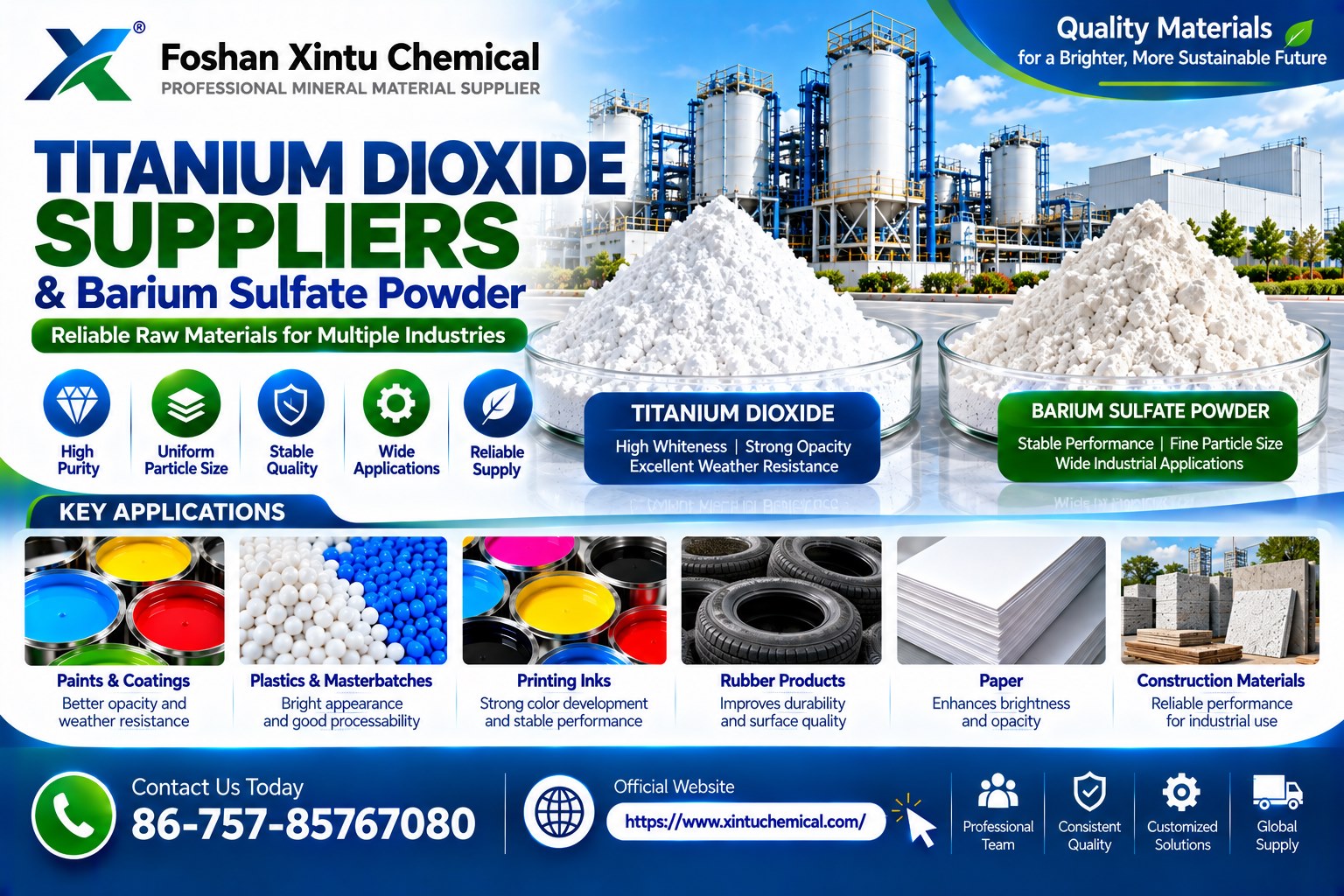
Industrial manufacturers increasingly recognize that raw material quality directly influences production consistency, product appearance, and manufacturing efficiency. In paints, coatings, plastics, and printing inks, the careful selection of pigments and functional fillers is essential for achieving dependable results.
Professional Titanium Dioxide Suppliers support manufacturers seeking white pigments with consistent brightness, opacity, and dispersion characteristics.
Similarly, Barium Sulfate Powder provides important functional properties for industrial formulations, particularly where density, particle distribution, and chemical stability influence product performance.
Although these materials serve different purposes, they can complement each other in selected formulations. Understanding their properties, application requirements, and quality parameters helps industrial buyers make informed sourcing decisions.
Why Titanium Dioxide Suppliers Are Important for Industrial Manufacturing
Titanium dioxide, chemically represented as TiO₂, is an inorganic compound widely used as a white pigment.
Its high refractive index and light-scattering properties make it useful for producing bright, opaque finishes.
Reliable Titanium Dioxide Suppliers provide access to pigment grades designed for different manufacturing applications.
Major industries using titanium dioxide include:
- Architectural paints and decorative coatings.
- Industrial protective coatings.
- Plastic compounds and masterbatches.
- Printing inks and specialty coatings.
- Paper and selected packaging materials.
- Rubber and industrial polymer formulations.
The suitability of any pigment depends on the formulation and intended application.
Understanding the Industrial Properties of Titanium Dioxide
Titanium dioxide is commercially available in different crystalline forms, mainly rutile and anatase.
Rutile Titanium Dioxide
Rutile grades are commonly selected for applications requiring strong opacity and, in suitably treated grades, improved outdoor durability.
Anatase Titanium Dioxide
Anatase grades are used in selected coating, paper, and specialty applications depending on formulation requirements.
Surface-Treated Pigments
Manufacturers may apply specialized surface treatments to influence dispersibility, weatherability, and compatibility with resins.
The correct grade should be determined through technical evaluation and laboratory testing.
What Is Barium Sulfate Powder?
Barium Sulfate Powder is a fine inorganic material with the chemical formula BaSO₄.
It is recognized for its relatively high density, low water solubility, and chemical stability.
Commercial barium sulfate materials may originate from natural barite minerals or controlled chemical precipitation processes.
Important characteristics include:
- High chemical stability.
- Suitable whiteness in selected grades.
- Different available particle sizes.
- Good density-modifying properties.
- Low water solubility.
- Application-specific dispersion characteristics.
The material is widely used as a functional filler and extender in industrial manufacturing.
Major Applications of Barium Sulfate Powder
Paints and Coatings
Suitable barium sulfate grades can influence surface appearance, filler loading, and other physical characteristics in coating formulations.
Plastic Manufacturing
The material may be incorporated into compatible polymers to adjust density, appearance, and selected processing properties.
Printing Inks
Fine-particle grades can support particular ink formulation requirements.
Rubber Products
Barium sulfate is used in selected rubber compounds where its density and chemical properties are suitable.
Powder Coatings
Appropriate grades may contribute to formulation consistency, surface characteristics, and processing behavior.
Titanium Dioxide vs Barium Sulfate Powder: Technical Comparison
Although both materials can be used in industrial coatings, their principal functions differ.
| Feature | Titanium Dioxide | Barium Sulfate Powder |
| Chemical formula | TiO₂ | BaSO₄ |
| Primary function | White pigment | Functional filler |
| Key property | Strong light scattering | High density and chemical stability |
| Available grades | Rutile and anatase | Natural and precipitated |
| Main applications | Coatings, plastics, inks | Coatings, rubber, plastics, inks |
| Selection focus | Opacity and dispersibility | Particle size and filler performance |
These materials should not be considered interchangeable simply because both are commonly supplied as light-colored powders.
How Titanium Dioxide and Barium Sulfate Work Together
In certain coating and polymer formulations, manufacturers use titanium dioxide alongside mineral extenders.
A suitable combination may help adjust pigment concentration, coating appearance, formulation density, or processing behavior.
However, replacing too much titanium dioxide with an extender can reduce hiding power.
The outcome depends on particle characteristics, pigment volume concentration, dispersion, and interactions with other ingredients.
Formulators should carry out controlled trials to identify suitable proportions.
How to Choose Reliable Titanium Dioxide Suppliers
Selecting professional Titanium Dioxide Suppliers requires evaluating technical documentation and commercial capabilities.
A practical purchasing checklist includes:
- Product Identity: Confirm the correct pigment grade and crystal structure.
- Purity Specifications: Review chemical composition and relevant impurities.
- Particle Characteristics: Evaluate size distribution and dispersion performance.
- Whiteness: Verify color specifications.
- Quality Documentation: Request Certificates of Analysis and Safety Data Sheets.
- Supply Consistency: Assess batch traceability and repeat-order reliability.
- Packaging: Confirm suitable moisture protection and transportation arrangements.
- Commercial Terms: Review order quantities, pricing, and delivery conditions.
Sample testing is advisable before approving new suppliers for commercial production.
Essential Quality Tests for Industrial Pigments and Fillers
Quality assessment helps manufacturers identify raw materials that meet application requirements.
For titanium dioxide, important tests may include whiteness, tinting strength, dispersibility, and particle-size analysis.
For Barium Sulfate Powder, buyers may evaluate chemical composition, moisture content, particle distribution, oil absorption, and whiteness.
Finished-product trials can also reveal differences that are not obvious from a raw material specification sheet.
Consistent testing helps reduce avoidable manufacturing variations.
Managing Industrial Raw Material Supply
Chemical sourcing involves more than identifying an appropriate product.
Manufacturers should establish clear agreements covering material specifications, acceptance criteria, packaging, transportation, and delivery schedules.
For repeat purchases, documented quality requirements and batch traceability support more predictable production.
Businesses should also assess the overall cost of sourcing, including transportation, inspection, storage, and potential material rejection.
A transparent supplier relationship helps purchasing teams manage these requirements effectively.
Safety and Environmental Considerations
Industrial powders require appropriate workplace handling.
Facilities should control airborne dust through suitable ventilation and protective measures.
Employees should follow the relevant Safety Data Sheets and applicable occupational safety procedures.
Environmental considerations may include packaging waste, transportation efficiency, and manufacturing resource use.
Any sustainability claims should be supported by relevant evidence.
Frequently Asked Questions (FAQs)
1. What do Titanium Dioxide Suppliers provide?
They supply titanium dioxide pigment grades for coatings, plastics, inks, and other industrial applications.
2. What is Barium Sulfate Powder?
It is an inorganic material commonly used as a functional filler and extender in industrial formulations.
3. What is the main difference between these materials?
Titanium dioxide primarily provides whiteness and opacity, while barium sulfate functions mainly as a filler.
4. Which titanium dioxide grade is suitable for outdoor coatings?
Selected surface-treated rutile grades are commonly used, subject to application testing.
5. Can barium sulfate improve plastic formulations?
Suitable grades can modify density and other characteristics in compatible polymer systems.
6. Can titanium dioxide and barium sulfate be combined?
Yes. They may be combined in selected formulations after evaluating technical compatibility and performance.
7. What is precipitated barium sulfate?
It is synthetic barium sulfate produced through a controlled chemical precipitation process.
8. What determines titanium dioxide prices?
Grade, specifications, production conditions, order quantity, packaging, and transportation influence pricing.
9. What documents should chemical buyers request?
Relevant documents include product specifications, Certificates of Analysis, Safety Data Sheets, and batch information.
10. How can manufacturers select reliable chemical suppliers?
They should compare material quality, sample performance, technical documentation, supply consistency, and transparent commercial terms.
Media Contact
Industry: Inorganic Chemicals, Industrial Pigments & Functional Fillers
Service Enquiries: Titanium Dioxide, Rutile Titanium Dioxide, Barium Sulfate Powder, Industrial Coating Materials & Specialty Chemical Products
Email: sales@xintuchemical.com
Contact Number: +86-757-85791959
Official Website: https://www.xintuchemical.com/