The plastics manufacturing industry continues to explore extrusion technologies that support efficient production, consistent material quality, and improved processing flexibility. From plastic pipes and sheets to advanced polymer compounds, extrusion equipment plays an essential role in modern industrial manufacturing.
A twin extruder is commonly considered for applications requiring intensive mixing, material compounding, and controlled processing of specialized polymer formulations.
Meanwhile, a single extruder remains an important solution for continuous melting and shaping of many plastic materials.
As manufacturers evaluate equipment investments, understanding the differences between these technologies can help improve production planning, material handling, and long-term operational efficiency.
What Is a Twin Extruder?
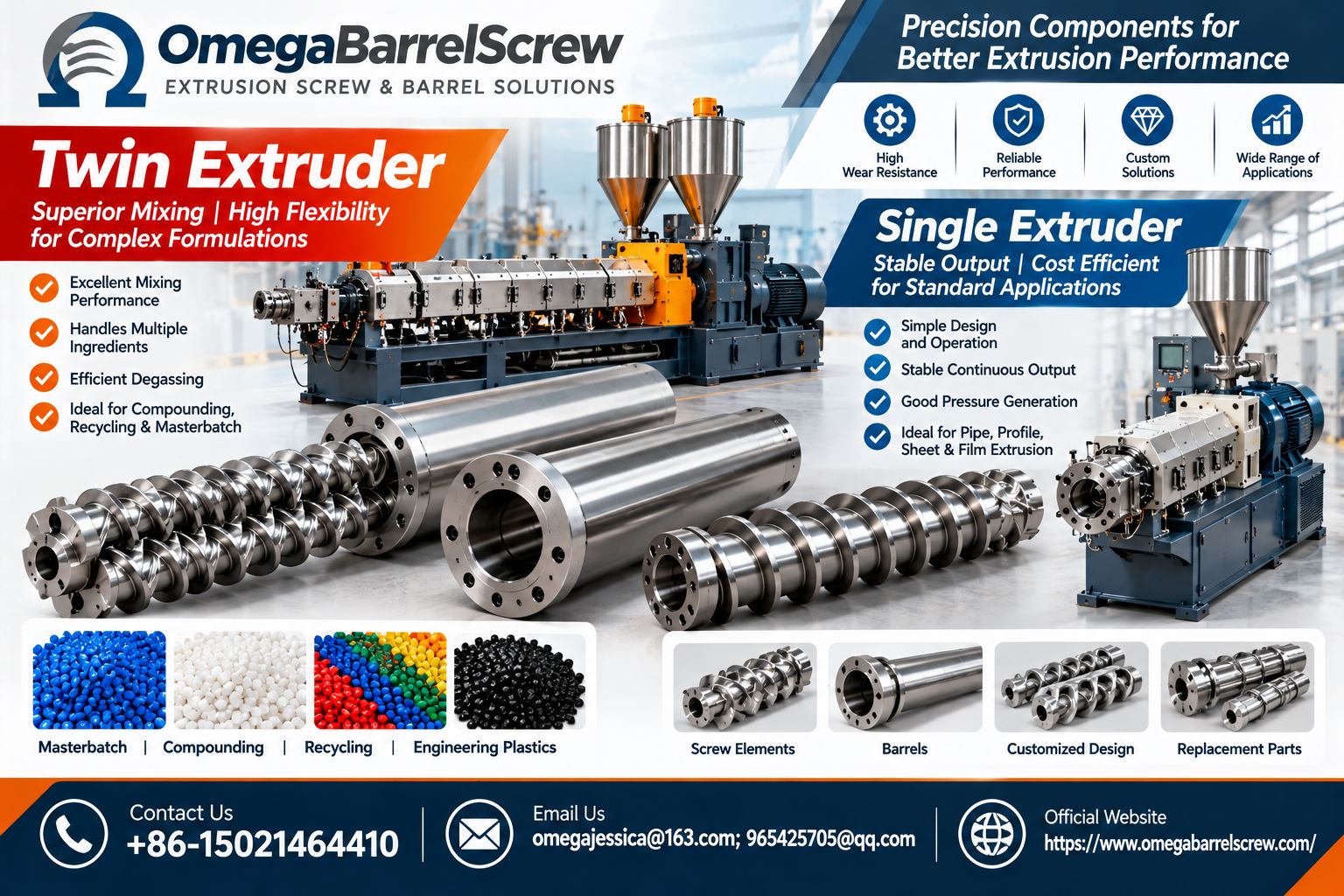
A twin extruder, also called a twin-screw extruder, is an industrial machine that uses two rotating screws inside a barrel to process polymer materials.
Depending on the equipment design, the screws may rotate in the same direction or in opposite directions.
Twin-screw systems are widely used in polymer compounding, additive mixing, masterbatch production, and specialized plastic processing applications.
Common applications include:
- Polymer compounding.
- Color masterbatch manufacturing.
- Plastic recycling and reprocessing.
- Filler and additive incorporation.
- Engineering plastic formulations.
- PVC processing.
- Polymer blending and modification.
The suitability of a twin-screw system depends on material characteristics and manufacturing objectives.
What Is a Single Extruder?
A single extruder, commonly known as a single-screw extruder, uses one rotating screw inside a heated barrel to convey, melt, and process suitable materials.
The screw moves material through different processing zones before the molten polymer passes through a die.
Single-screw extrusion is widely used for continuous production involving materials that do not require extensive compounding inside the extruder.
Typical applications include:
Plastic Pipe Manufacturing: Producing suitable pipes and tubing.
Film Extrusion: Processing polymers into plastic films.
Sheet Production: Manufacturing plastic sheets for industrial applications.
Profile Extrusion: Creating continuous plastic shapes.
Reprocessing: Melting prepared plastic materials under suitable conditions.
The machine’s performance depends on screw design, material properties, temperature control, and operating conditions.
Twin Extruder vs Single Extruder: Key Differences
Both technologies process polymer materials, but their operating characteristics differ.
| Feature | Twin Extruder | Single Extruder |
| Screw configuration | Two rotating screws | One rotating screw |
| Mixing capability | Often more intensive and controllable | Generally more limited |
| Typical application | Compounding and specialized processing | Continuous melt extrusion |
| Material feeding | Suitable for complex formulations | Suitable for many prepared materials |
| Equipment complexity | Generally higher | Generally simpler |
| Maintenance | More components and potentially greater complexity | Often simpler maintenance |
| Investment | Often higher for comparable capacity | Often more economical |
The most effective choice depends on the formulation, desired output, product requirements, and total operating cost.
How Twin-Screw Extrusion Technology Works
A twin-screw extrusion system processes material through coordinated screw rotation and controlled barrel heating.
The screws convey material while applying mechanical energy through specially designed processing elements.
In suitable systems, the process may involve feeding, melting, mixing, venting, and pressure development.
Material Feeding
Polymers, additives, and fillers enter the barrel through appropriately designed feeding systems.
Melting and Mixing
Mechanical action and controlled heating help melt the polymer and distribute ingredients.
Venting and Degassing
Where supported, venting zones may help remove moisture or volatile components.
Final Extrusion
Processed material exits through a suitable die, often followed by downstream cooling or pelletizing equipment.
Co-rotating intermeshing screws are commonly used for compounding, while some counter-rotating systems are used for PVC and profile applications.
Advantages of Single-Screw Extrusion
A single extruder can provide several practical benefits for suitable production requirements.
Simpler Design: Fewer screw components can make certain maintenance tasks more straightforward.
Continuous Operation: Well-configured machines support stable melt delivery during ongoing production.
Lower Equipment Complexity: Single-screw systems are often easier to operate and maintain.
Cost Considerations: Initial machinery investment may be lower than that of a comparable specialized twin-screw system.
Production Flexibility: Appropriate screw and die configurations support various extrusion applications.
Why Screw and Barrel Design Matters
Extrusion performance depends heavily on screw geometry and barrel construction.
Important design factors include screw diameter, length-to-diameter ratio, flight geometry, wear resistance, and temperature-control capability.
For twin-screw equipment, screw element configuration also influences mixing intensity, residence time, and material movement.
Poorly matched components may contribute to excessive wear, unstable processing, or inconsistent output.
Manufacturers should therefore evaluate screw and barrel specifications alongside their selected polymer formulations.
Selecting Extrusion Equipment for Different Materials
Material properties influence machinery selection.
Heat-sensitive polymers may require carefully controlled residence time and processing temperatures.
Filled compounds may need improved additive distribution and abrasion-resistant components.
Recycled plastics can introduce additional challenges involving contamination, moisture, and inconsistent feedstock.
Before investing, manufacturers should examine:
- Polymer type and formulation.
- Required production capacity.
- Mixing and dispersion requirements.
- Temperature sensitivity.
- Product quality specifications.
- Energy consumption.
- Maintenance requirements.
- Downstream equipment compatibility.
Material trials are particularly valuable when processing unfamiliar formulations.
Energy Efficiency and Production Costs
Extrusion equipment should be evaluated according to its complete operating cost.
Important factors include motor efficiency, heating requirements, production throughput, material waste, and maintenance.
A twin-screw system may offer processing advantages for complex formulations, but it is not automatically more energy-efficient in every application.
Similarly, a single-screw machine may be economical for suitable continuous production without being appropriate for demanding compounding operations.
Manufacturers should compare energy consumption per kilogram of acceptable output under representative operating conditions.
Maintenance and Operational Reliability
Regular inspection helps maintain extrusion performance and reduce unexpected interruptions.
Important maintenance activities include checking screw wear, barrel condition, heating systems, drive components, and feeding equipment.
Operators should follow appropriate shutdown, isolation, and lockout procedures before accessing machinery.
Consistent maintenance records can support timely replacement planning and improved production reliability.
Frequently Asked Questions (FAQs)
1. What is a twin extruder?
It is an extrusion machine that uses two rotating screws to process polymer materials through a barrel.
2. What is a single extruder?
It is a machine that uses one rotating screw to convey, melt, and extrude suitable materials.
3. Which extruder is better for plastic compounding?
Twin-screw extrusion is often preferred for demanding polymer compounding and additive dispersion applications.
4. Is a single extruder suitable for pipe manufacturing?
Yes. Single-screw machines are widely used for suitable plastic pipe and tubing production.
5. Why are twin-screw extruders used for masterbatch production?
Their mixing capabilities can help distribute pigments and additives throughout polymer materials.
6. Which extrusion machine costs less?
Single-screw equipment often has a lower initial cost, although prices depend on specifications and production capacity.
7. Can twin-screw extruders process recycled plastics?
Yes. Suitable configurations can support certain recycling and polymer reprocessing applications.
8. What is the purpose of an extruder barrel?
The barrel contains and supports the screw system while helping maintain controlled processing conditions.
9. How does screw design affect extrusion quality?
Screw geometry influences material conveying, melting, mixing, pressure development, and processing stability.
10. How should manufacturers select an extruder?
They should compare materials, production capacity, mixing requirements, equipment specifications, maintenance, and overall operating costs.
Media Contact
Industry: Plastic Processing Machinery, Polymer Extrusion & Industrial Manufacturing
Service Enquiries: Twin-Screw Extrusion, Single-Screw Extrusion, Extruder Screws, Barrel Components & Polymer Processing Solutions
Contact Number: +86-15021464410
Email: omegajessica@163.com
Official Website: https://www.omegabarrelscrew.com/