
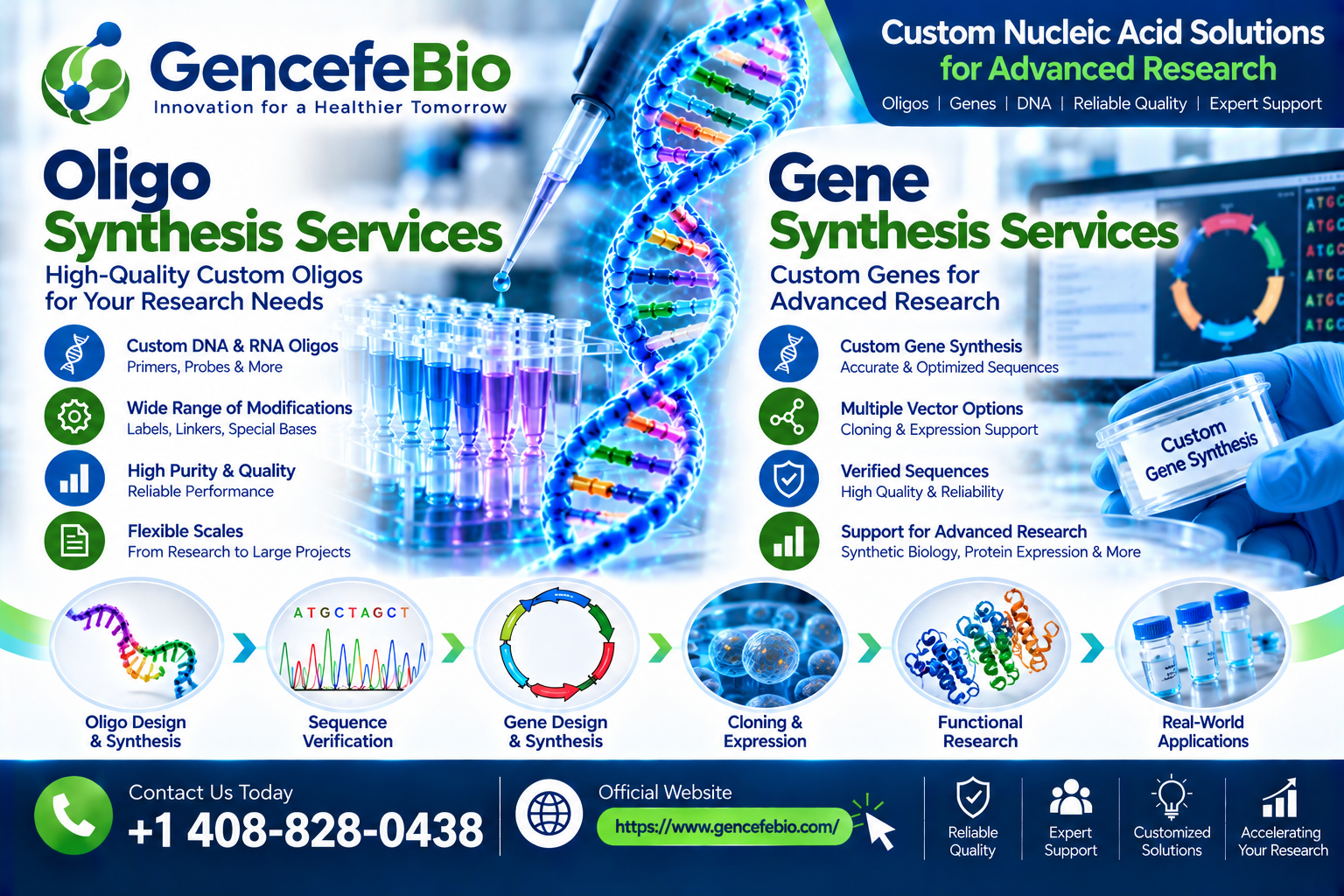
As biotechnology, pharmaceutical development, and molecular research continue to evolve, scientists are placing greater emphasis on accurate, customizable genetic materials. Oligo synthesis services provide researchers with precisely designed short nucleotide sequences, while gene synthesis services support the development of longer DNA sequences and customized genetic constructs for specialized laboratory applications.
From molecular diagnostics and drug discovery to synthetic biology and recombinant protein research, both technologies are important components of modern scientific development.
For research institutions and biotechnology companies, selecting appropriate synthesis solutions requires careful consideration of sequence accuracy, product purity, customization capabilities, and analytical documentation.
Growing Importance of Oligo Synthesis Services in Molecular Biology
Oligo synthesis services involve the chemical production of short DNA or RNA sequences according to specified nucleotide requirements.
These molecules, known as oligonucleotides, are essential tools in genetic analysis, molecular detection, and biological research.
Researchers use customized oligonucleotides to investigate specific genetic regions, design molecular assays, and prepare components for more complex experiments.
Major Applications of Oligonucleotide Synthesis
- PCR Analysis: Producing customized primers for amplifying selected DNA sequences.
- DNA Sequencing: Preparing primers for genetic characterization.
- Molecular Diagnostics: Developing sequence-specific probes for research assays.
- Gene Expression Research: Supporting RNA analysis and genetic regulation studies.
- Synthetic Biology: Creating nucleotide components for designed genetic systems.
- Pharmaceutical Research: Investigating molecular targets and nucleic acid interactions.
Understanding Gene Synthesis Services and Their Applications
Gene synthesis services involve manufacturing designed DNA sequences that may encode proteins or serve other specific biological functions.
Unlike conventional approaches that rely entirely on extracting DNA from biological samples, synthetic gene production allows researchers to obtain sequences created according to experimental specifications.
These services support projects requiring customized genetic fragments, coding sequences, or assembled DNA constructs.
Important applications include:
Recombinant Protein Development: Preparing genes that encode selected proteins for expression research.
Synthetic Biology: Supporting investigations involving designed genetic elements and biological systems.
Enzyme Engineering: Developing DNA sequences associated with selected enzyme variants.
Vaccine Research: Preparing suitable antigen-encoding sequences for experimental studies.
Drug Discovery: Supporting investigations involving genes associated with therapeutic targets.
Academic Research: Examining protein functions, gene regulation, and genetic variation.
The success of gene synthesis projects depends on appropriate sequence design, manufacturing feasibility, and reliable verification.
How Oligo Synthesis Services Work
Many DNA oligonucleotides are manufactured through automated solid-phase phosphoramidite synthesis.
This chemical approach allows nucleotides to be assembled sequentially according to a predefined sequence.
A typical production workflow includes:
- Sequence Submission: Researchers provide the required nucleotide sequence.
- Technical Evaluation: The sequence, length, and requested modifications are reviewed.
- Chemical Synthesis: Nucleotides are assembled using an appropriate synthesis method.
- Product Recovery: The synthesized material undergoes necessary chemical processing.
- Purification: Suitable techniques remove selected manufacturing impurities.
- Quality Assessment: Analytical methods evaluate product identity and purity.
- Final Preparation: The material is supplied according to agreed research specifications.
Depending on experimental requirements, customized oligonucleotides may incorporate fluorescent labels, biotin, modified nucleotides, or terminal modifications.
Gene Synthesis Services: From Sequence Design to Verification
The production of longer synthetic DNA sequences often involves assembling shorter DNA components into larger constructs.
Researchers begin by defining their desired genetic sequence and intended experimental application.
Suitable DNA synthesis and assembly methods are then selected according to sequence length, complexity, and product requirements.
Following assembly, quality-control procedures help verify the resulting genetic material.
Sequence verification is particularly important because unintended nucleotide changes may influence the function of a research construct.
Oligo Synthesis Services vs. Gene Synthesis Services
Although closely related, these services address different molecular research requirements.
| Feature | Oligo Synthesis Services | Gene Synthesis Services |
| Primary product | Short DNA or RNA sequences | Longer designed DNA sequences |
| Production method | Primarily chemical synthesis | DNA synthesis and assembly |
| Common applications | PCR, probes, sequencing | Protein expression, synthetic biology |
| Customization | Labels and nucleotide modifications | Designed genes and construct features |
| Quality focus | Identity, purity, modification accuracy | Sequence accuracy and construct integrity |
Oligonucleotide synthesis can also contribute to the production of longer synthetic genes.
Therefore, both services may be integrated within a broader molecular biology workflow.
Why Quality Control Matters in Genetic Research
Reliable experimental results depend on obtaining nucleotide materials that meet defined specifications.
For oligo synthesis services, analytical methods such as high-performance liquid chromatography and mass spectrometry may be used to evaluate purity and molecular identity.
For gene synthesis services, sequencing helps confirm that assembled DNA matches its intended design.
Other important quality considerations include:
- Nucleotide sequence accuracy
- Appropriate purification methods
- Molecular concentration and integrity
- Product stability
- Batch documentation and traceability
- Suitable storage and transportation conditions
Quality requirements should be selected according to the intended research application.
Selecting a Reliable Nucleic Acid Synthesis Provider
Choosing a suitable biotechnology service provider requires more than comparing manufacturing prices.
Researchers should evaluate technical capabilities, supported sequence lengths, available modifications, analytical documentation, and project communication.
For oligonucleotide projects, buyers should specify sequence requirements, purification grade, quantity, and intended application.
For synthetic gene projects, important considerations include construct design, sequence verification, delivery format, and project-specific acceptance criteria.
Professional suppliers should also have suitable procedures for protecting confidential sequence information and conducting responsible sequence screening.
Clear requirements can help prevent misunderstandings and improve research planning.
Emerging Opportunities in Biotechnology
Customized nucleic acid technologies continue to create opportunities across molecular biology and life science research.
Synthetic oligonucleotides support increasingly specialized genetic investigations, while longer synthetic DNA constructs help researchers examine gene functions and engineered biological systems.
Combining these approaches can support drug discovery, molecular diagnostics, recombinant protein research, and synthetic biology.
Continued progress will depend on reliable manufacturing, precise analytical methods, and appropriate experimental validation.
Frequently Asked Questions (FAQs)
1. What are oligo synthesis services?
They are laboratory services that manufacture customized short DNA or RNA sequences for molecular biology and related research applications.
2. What are gene synthesis services?
They involve producing designed DNA sequences, including selected genes and genetic constructs, according to research specifications.
3. What is the main difference between oligo synthesis and gene synthesis?
Oligo synthesis generally produces short nucleotide sequences, while gene synthesis focuses on longer designed DNA sequences.
4. Which industries use oligo synthesis?
Biotechnology, pharmaceutical research, molecular diagnostics, academic laboratories, and genetic research organizations use synthetic oligonucleotides.
5. Can oligonucleotides be chemically modified?
Yes. Depending on feasibility, modifications may include fluorescent labeling, biotinylation, and selected nucleotide changes.
6. How are synthetic genes produced?
Synthetic genes can be assembled from shorter DNA components using suitable synthesis and assembly technologies.
7. Why is sequence verification important?
It helps confirm that synthesized genetic material matches the intended design and reduces uncertainty in downstream experiments.
8. Can gene synthesis support recombinant protein production?
Yes. Appropriately designed synthetic genes can provide coding sequences for compatible protein expression systems.
9. What factors influence nucleic acid synthesis costs?
Sequence length, complexity, modifications, purification requirements, production quantity, and analytical testing can affect pricing.
10. How should researchers choose a synthesis service provider?
Researchers should evaluate technical capabilities, customization options, quality documentation, sequence verification, and research support.
Media Contact
Department: Biotechnology Research and Business Communications
Email: gene@gencefebio.com
Contact: +1 408-828-0438
Official Website: https://www.gencefebio.com/