
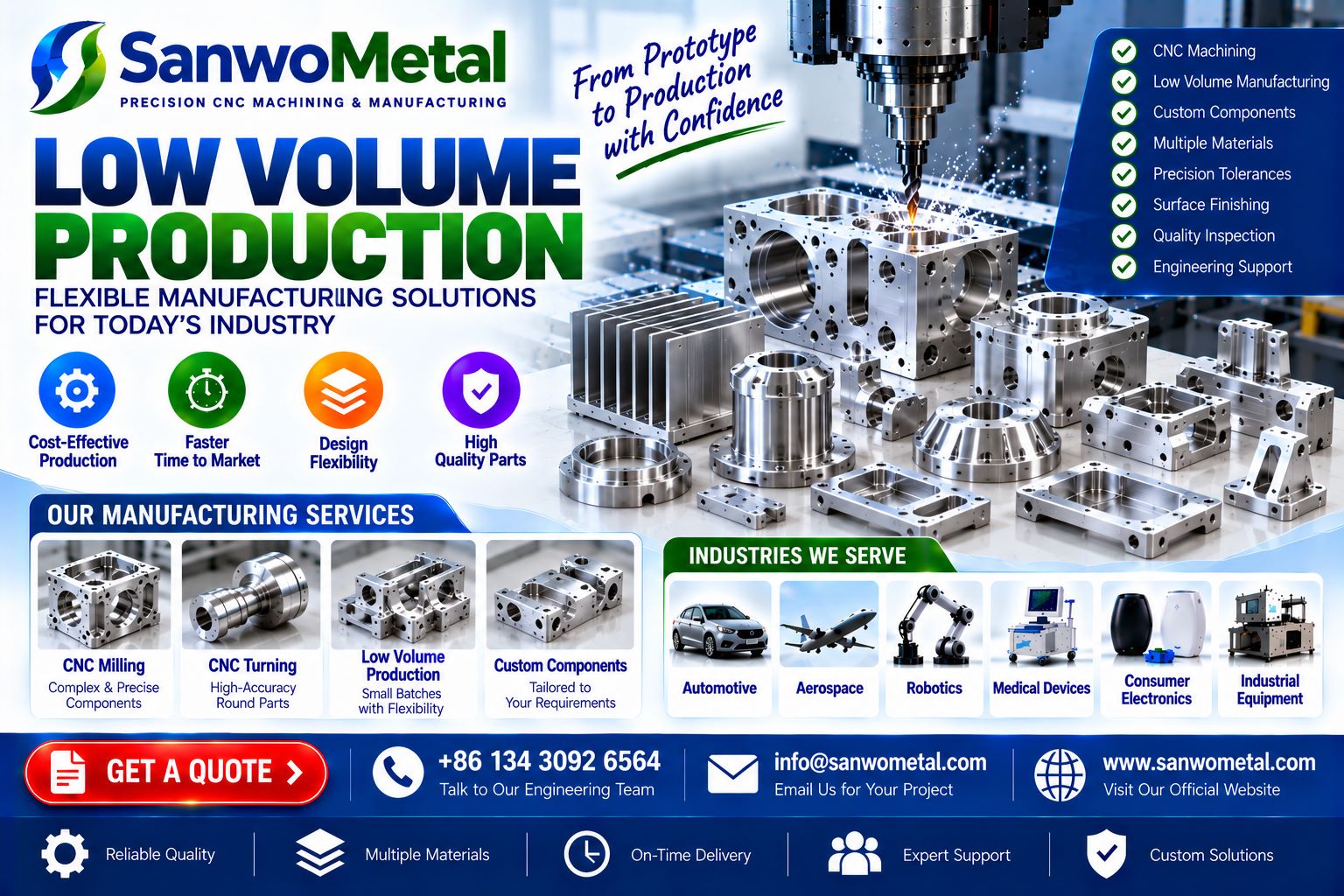
Industrial businesses are rethinking how they manage production quantities, inventory risks, and changing customer requirements. Rather than committing immediately to large manufacturing runs, many product developers are considering smaller batches that provide greater control over investment and product availability.
Low volume production offers a practical approach for companies seeking to manufacture limited quantities while maintaining flexibility in design, materials, and product specifications.
Meanwhile, low volume manufacturing supports customized engineering, specialized equipment components, and controlled production strategies across different industrial sectors.
For original equipment manufacturers (OEMs), startups, and industrial procurement teams, smaller production runs can help balance market demand, manufacturing costs, and operational efficiency.
Why Flexible Production Is Important for Modern Businesses
Traditional high-volume manufacturing works well when product designs are stable and demand is predictable.
However, manufacturing large quantities without reliable demand information can create excess inventory, unnecessary storage expenses, and financial pressure.
Smaller production batches provide an alternative.
Businesses can manufacture quantities aligned with immediate requirements while evaluating customer feedback and product performance.
This approach is particularly valuable for specialized industrial components and products with uncertain demand.
What Is Low Volume Production?
Low volume production refers to manufacturing products in relatively small quantities compared with conventional mass-production operations.
There is no universal quantity that defines low-volume production. The classification depends on the industry, component complexity, and manufacturing technology.
For example, a small batch of precision mechanical components may have different production requirements from a batch of customized electronic housings.
Key Characteristics
- Smaller manufacturing quantities.
- Greater flexibility for design modifications.
- Reduced exposure to excessive inventory.
- Support for customized product requirements.
- More manageable product validation.
- Potentially lower initial tooling investment.
The method is especially useful when demand does not justify dedicated mass-production infrastructure.
Understanding Low Volume Manufacturing
Low volume manufacturing describes the broader manufacturing activities, technologies, and operational processes used to produce smaller quantities of components or finished products.
Depending on the application, suitable processes may include CNC machining, sheet metal fabrication, casting, injection molding, and additive manufacturing.
The selection depends on product geometry, material requirements, desired finish, production quantity, and available equipment.
Unlike a single manufacturing technique, low-volume manufacturing is an approach that can incorporate multiple production methods.
How Smaller Batches Reduce Inventory Risks
Excess inventory represents a major concern for businesses managing specialized products.
Materials and completed components require storage space, tracking, handling, and financial investment.
Products may also become obsolete when customer requirements change.
Smaller batches allow organizations to align purchasing decisions more closely with actual demand.
Important Inventory Advantages
Reduced Stock Exposure: Businesses can avoid manufacturing unnecessarily large quantities.
Improved Product Adaptability: Design modifications can be introduced between batches.
Better Capital Allocation: Less money may be committed to unsold inventory.
Simplified Storage Planning: Smaller quantities can reduce certain warehousing requirements.
These benefits depend on balancing inventory savings against setup costs, purchasing prices, and supplier capacity.
The Role of CNC Machining in Low Volume Manufacturing
Computer numerical control machining is an important production option for custom mechanical components.
CNC machines manufacture parts by removing material from metal or plastic workpieces according to programmed instructions.
The process can produce precise components without requiring dedicated molding tools for every new design.
Common Applications
- Custom aluminum brackets.
- Precision machine housings.
- Industrial mounting components.
- Mechanical connectors.
- Automation equipment parts.
- Specialized metal fittings.
CNC machining is particularly useful when component designs require dimensional accuracy and may undergo modifications.
However, machining cost depends on geometry, setup requirements, material utilization, and inspection needs.
Comparing Low Volume Production and Mass Production
Both approaches have advantages depending on business requirements.
| Evaluation Factor | Low Volume Production | Mass Production |
| Manufacturing quantity | Smaller batches | Large quantities |
| Design flexibility | Generally greater | Often more restricted |
| Initial investment | Can be lower | May require substantial tooling |
| Unit cost | Often higher | Can decrease with scale |
| Inventory requirements | More manageable quantities | Larger stock commitments |
| Best suited for | Customized or uncertain demand | Stable, predictable demand |
Companies should evaluate total costs rather than comparing component prices alone.
Why Design Changes Are Easier to Manage
Product development frequently involves modifications to dimensions, materials, or functional features.
Large production commitments can make engineering changes expensive because existing tooling, inventory, and manufacturing instructions may require modification.
With suitable low volume manufacturing methods, adjustments can sometimes be introduced between smaller production batches.
This makes the approach useful for evolving products and specialized industrial applications.
Nevertheless, every engineering revision should undergo appropriate review and approval.
Industries Benefiting from Smaller Production Runs
Automotive Engineering
Specialized brackets, fixtures, and mechanical components can support development and limited-quantity applications.
Aerospace Manufacturing
Suitable precision components may be manufactured in smaller batches under applicable quality requirements.
Medical Equipment
Customized equipment parts can support specialized product configurations when appropriate controls are applied.
Industrial Automation
Manufacturers may require limited quantities of machine components, mounting systems, and customized fittings.
Electronics Manufacturing
Enclosures, heat sinks, and specialized mechanical accessories can be produced according to defined project requirements.
Across these sectors, manufacturing suitability depends on technical specifications rather than production volume alone.
Quality Control in Small-Batch Manufacturing
Smaller production quantities do not eliminate the need for reliable quality assurance.
Each manufactured component should meet approved design and performance requirements.
Important inspection activities may include:
- Dimensional measurement.
- Material verification.
- Surface-finish inspection.
- Assembly compatibility checks.
- Functional testing where applicable.
- Manufacturing documentation review.
Appropriate quality procedures help ensure consistency between production batches.
Cost Planning and Supplier Selection
One challenge associated with low volume production is balancing production flexibility with manufacturing cost.
Small quantities may involve higher unit costs because setup, programming, and inspection expenses are distributed across fewer products.
Businesses should assess minimum order quantities, material costs, manufacturing methods, and expected repeat orders.
A suitable supplier should communicate technical limitations, pricing assumptions, quality requirements, and production responsibilities clearly.
This transparency supports better procurement decisions.
Frequently Asked Questions (FAQs)
1. What is low volume production?
It is the manufacture of relatively small quantities of products or components, typically for specialized demand, customization, or controlled market requirements.
2. What is low volume manufacturing?
It is a manufacturing approach using suitable production technologies to produce smaller batches of finished products or industrial components.
3. Is low volume production more affordable than mass production?
It may require less initial investment, but per-unit costs can be higher. Overall affordability depends on quantity, tooling, materials, and inventory expenses.
4. Which manufacturing processes support smaller production batches?
Common processes include CNC machining, sheet metal fabrication, additive manufacturing, and suitable molding methods.
5. How can businesses select a low-volume manufacturing supplier?
They should evaluate technical capabilities, material expertise, quality inspection, production flexibility, pricing transparency, and experience with customized components.
Media Contact
Department: Precision Manufacturing and Custom Metal Production Enquiries
Email: info@sanwometal.com
Contact: +86 134 3092 6564
Official Website: https://www.sanwometal.com/