
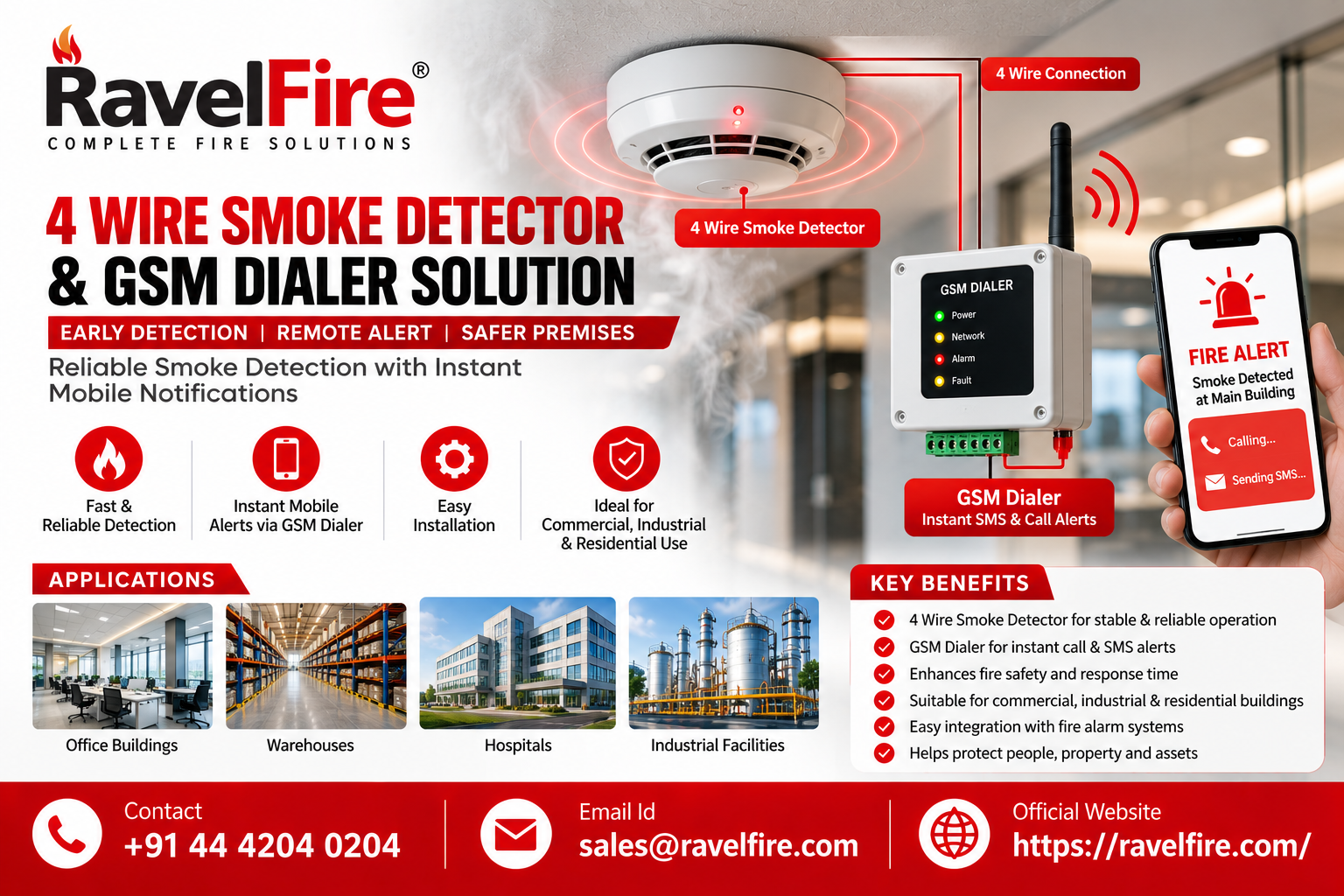
While conventional fire alarm systems provide local warning signals, certain facilities also require supplementary communication with authorized personnel outside the building.
A 4 wire smoke detector offers a fire detection arrangement with separate power and alarm signaling connections, making it suitable for selected compatible alarm systems.
Meanwhile, a gsm dialer can transmit notifications through a cellular network when connected and configured with appropriate alarm equipment.
Together, these technologies highlight the importance of reliable smoke detection and supplementary remote communication in modern building safety planning.
Why Remote Fire Alarm Communication Matters
Some commercial and industrial properties operate with limited on-site supervision.
Storage facilities, equipment rooms, and selected commercial premises may benefit from supplementary notifications that inform designated personnel about an alarm condition.
However, remote communication does not replace essential on-site fire detection, occupant notification, or required emergency monitoring arrangements.
A properly designed system must continue performing its primary life safety functions even when external communication becomes unavailable.
What Is a 4 Wire Smoke Detector?
A 4 wire smoke detector is a smoke detection device that commonly uses separate electrical connections for power supply and alarm signaling.
Unlike some two-wire detector arrangements, which combine power and signaling through a compatible circuit, four-wire detectors generally provide independent power connections and alarm relay contacts.
Important Operating Characteristics
Separate Power Supply: The detector receives electrical power through a dedicated pair of connections.
Alarm Relay Contacts: Another pair of connections is commonly used to communicate an alarm condition.
Panel Compatibility: The detector must be suitable for the intended fire alarm or security control equipment.
Reset Requirements: Some detector models require an approved power interruption or reset method after activation.
Power Supervision: Suitable arrangements may be necessary to identify detector power loss.
Exact characteristics vary according to the device model and manufacturer instructions.
How Four-Wire Smoke Detection Works
A four-wire detector monitors the surrounding environment using its approved smoke-sensing technology.
When smoke conditions reach the detector’s alarm threshold, an internal relay changes state.
Compatible control equipment interprets this change according to the approved circuit design.
The detector’s sensing performance is separate from the function of transmitting remote notifications.
A qualified installer must ensure that both power and alarm circuits are appropriately supervised wherever required.
Without suitable supervision, certain wiring or power failures may prevent an alarm from being communicated correctly.
Understanding GSM Dialer Technology
A gsm dialer is a communication device designed to send notifications through a supported cellular network.
Depending on its capabilities, the equipment may transmit text messages, initiate voice calls, or communicate alarm events through other supported cellular services.
The dialer generally receives an input from compatible alarm equipment and generates the configured notification.
Common Functional Considerations
- Cellular network compatibility.
- Appropriate alarm input connections.
- Configurable notification recipients.
- Suitable power supply arrangements.
- Communication failure indication, where supported.
- Clear operating and maintenance documentation.
Cellular signal availability and the telecommunications service directly influence communication reliability.
How Smoke Detection and Remote Notifications Work Together
In an appropriately engineered arrangement, a smoke detector communicates an alarm condition to compatible control equipment.
That equipment processes the signal and activates the required local warning functions.
A suitably connected cellular communication device may then transmit supplementary notifications to designated personnel.
The proposed connection must follow manufacturer instructions and the approved system design.
Directly connecting a detector’s relay to an unrelated communication device without verifying electrical compatibility and supervision can compromise the installation.
Four-Wire Smoke Detectors vs. Two-Wire Detectors
Both technologies can serve appropriate fire detection applications, but their electrical arrangements differ.
| Feature | Four-Wire Smoke Detector | Two-Wire Smoke Detector |
| Power connection | Generally separate | Typically shared with the signaling circuit |
| Alarm communication | Usually through relay contacts | Through a compatible detection circuit |
| Control compatibility | Requires suitable inputs and power | Requires a compatible two-wire detector circuit |
| Power supervision | May require dedicated supervision | Depends on approved circuit design |
| Installation selection | Based on system requirements | Based on system requirements |
Neither configuration should be selected without checking the technical specifications of the control equipment.
Applications for Remote Fire Alarm Notification
A 4 wire smoke detector may be considered in selected fire detection or compatible security-related installations where its operating characteristics meet the approved design requirements.
Supplementary cellular notification can be useful in certain warehouses, remote equipment locations, small commercial premises, and monitored utility areas.
A gsm dialer may provide additional information to designated maintenance or security personnel when an alarm is reported.
However, such arrangements must not be presented as a substitute for mandatory fire alarm monitoring, evacuation notification, or emergency service communication requirements.
Why Cellular Communication Needs Backup Planning
Cellular communication services are not continuously available under every operating condition.
Signal coverage, equipment faults, power interruptions, network changes, and service restrictions may affect notification delivery.
Facility operators should therefore understand the limitations of their communication equipment.
Where required, approved fire alarm monitoring arrangements must include suitable supervision, backup provisions, and fault reporting.
Notification recipients must also know how to respond appropriately to an incoming alarm message.
Installation and Testing Considerations
Successful integration depends on the correct electrical design and thorough commissioning.
Important considerations include compatible alarm contacts, suitable power supplies, circuit supervision, and the separation of alarm and fault indications where supported.
Commissioning should verify that the required local alarm functions operate independently of supplementary remote notifications.
Technicians should also test approved communication functions and document the results.
Any changes to a life safety system must follow the relevant approval procedures and applicable regulations.
Maintaining Detection and Communication Reliability
Regular inspection is important for both smoke detection and cellular communication equipment.
Smoke detectors may require cleaning, functional testing, and replacement according to manufacturer recommendations.
Communication equipment may require checks of network availability, notification settings, power supplies, and reported faults.
Facility managers should maintain appropriate service records and address faults through qualified professionals.
A system that appears operational may still contain communication or supervision problems that require attention.
Choosing Equipment for a Suitable Fire Safety System
Before purchasing a 4 wire smoke detector or gsm dialer, buyers should review the entire system’s technical requirements.
These include device compatibility, electrical operating characteristics, applicable certifications, environmental conditions, and expected communication functions.
Suppliers should provide clear product documentation and explain relevant limitations.
Professional design is particularly important when connecting supplementary notification equipment to systems responsible for life safety.
Frequently Asked Questions (FAQs)
1. What is a 4 wire smoke detector?
It is a smoke detector that typically uses separate electrical connections for power supply and alarm signaling through compatible control equipment.
2. What does a gsm dialer do in an alarm system?
A GSM dialer sends configured notifications through a supported cellular network when it receives an appropriate signal from compatible alarm equipment.
3. Can a four-wire smoke detector connect directly to a GSM dialer?
Connection is possible only where electrical compatibility, supervision, and the approved system design support that arrangement. Professional assessment is necessary.
4. Will a GSM dialer operate without cellular network coverage?
No. Cellular notification depends on an available, supported network and properly functioning communication equipment.
5. Can a GSM dialer replace a fire alarm monitoring service?
Not automatically. Required fire alarm monitoring arrangements must comply with applicable regulations and approved communication standards.
Media Contact
Department: Fire Alarm Detection and Technical Product Enquiries
Email: sales@ravelfire.com
Contact: +91 44 4204 0204
Official Website: https://ravelfire.com/