
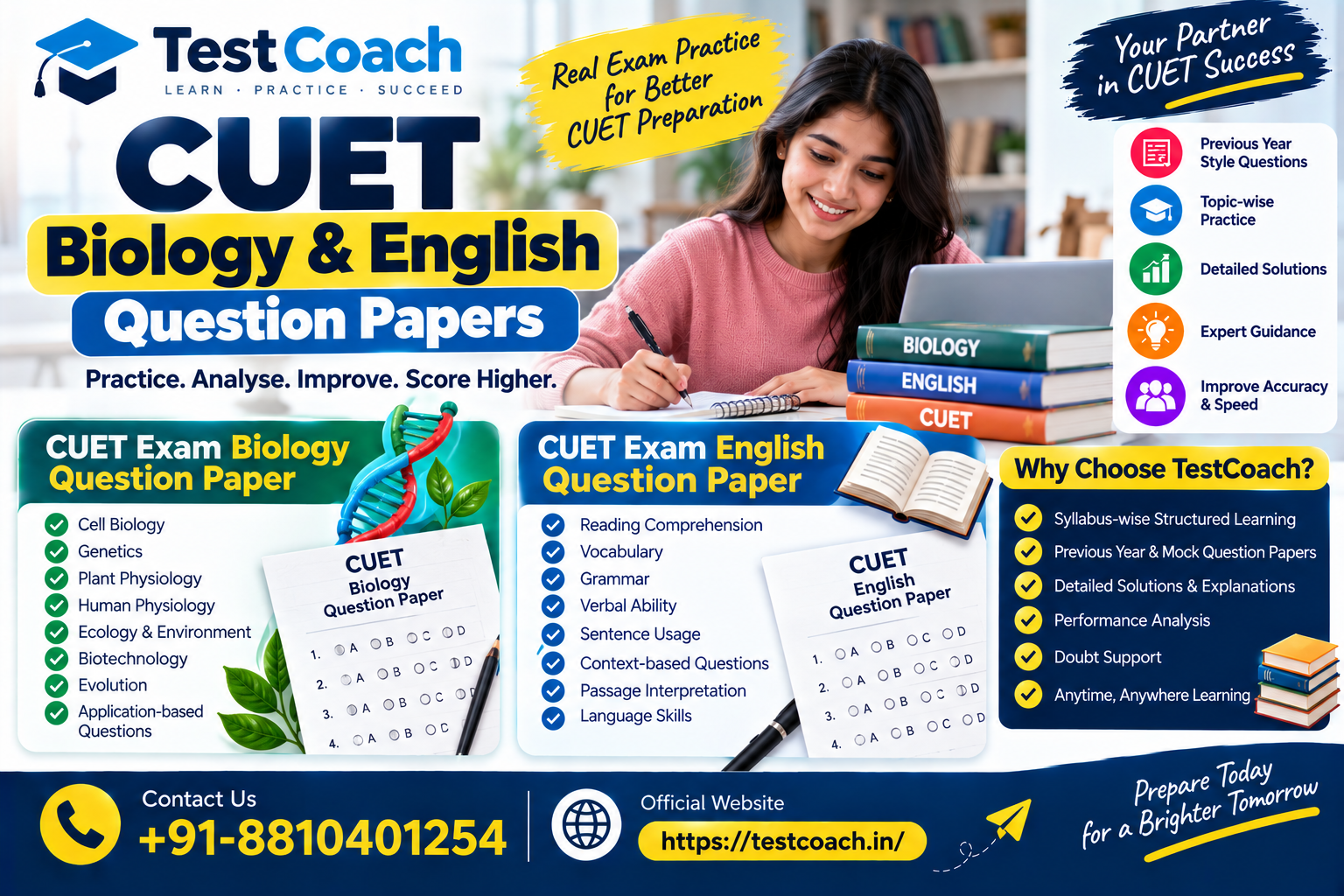
Preparing for the Common University Entrance Test requires students to develop different academic abilities according to their selected subjects. While Biology demands scientific understanding and conceptual accuracy, English evaluates language comprehension, vocabulary, and interpretation skills.
For science students, practising the cuet exam biology question paper can help strengthen knowledge of biological processes, scientific terminology, and concept-based problem-solving.
Similarly, working through the cuet exam english question paper allows candidates to evaluate reading comprehension, verbal ability, and language understanding.
Although the subjects assess different competencies, both benefit from a preparation approach that emphasises independent thinking, careful question analysis, and meaningful revision.
Understanding these differences can help CUET aspirants establish a more effective learning strategy.
Why Biology and English Need Different Study Approaches
Biology and English require distinct methods of understanding and applying knowledge.
Biology preparation involves studying living organisms, biological systems, scientific relationships, and theoretical concepts.
English preparation focuses on interpreting written information, recognising vocabulary, and understanding language in context.
Students should therefore avoid using identical study techniques for both examinations.
A balanced strategy recognises the unique demands of each subject while encouraging consistent learning.
Understanding the CUET Exam Biology Question Paper
The cuet exam biology question paper is designed to evaluate knowledge and understanding of biological concepts according to the prescribed examination syllabus.
Questions may assess factual knowledge, conceptual relationships, biological functions, and the application of scientific principles.
Important Biology Preparation Areas
Depending on the applicable syllabus, students may encounter concepts involving:
- Reproduction: Biological processes and reproductive mechanisms.
- Genetics: Heredity, variation, and fundamental genetic principles.
- Biotechnology: Biological techniques and their applications.
- Ecology: Relationships between organisms and their environments.
- Evolution: Biological diversity and evolutionary concepts.
- Human Health: Relevant biological principles concerning health and disease.
Candidates should use the officially prescribed syllabus to confirm the topics relevant to their examination.
Understanding the CUET Exam English Question Paper
The cuet exam english question paper evaluates language skills through questions aligned with the applicable examination framework.
Unlike Biology, English questions may require students to interpret information that is unfamiliar but understandable through language skills.
Important English Preparation Areas
Reading Comprehension: Understanding passages, identifying central ideas, and drawing supported conclusions.
Vocabulary: Recognising word meanings and interpreting expressions within context.
Verbal Ability: Understanding relationships between words, sentences, and written information.
Language Interpretation: Recognising the meaning and logical structure of written statements.
Preparation should reflect the officially prescribed English syllabus rather than relying on assumptions about question formats.
Biology Question Papers: Moving Beyond Memorisation
Biology contains specialised terminology, classifications, and scientific processes that students must understand accurately.
However, memorising isolated definitions may not prepare candidates for unfamiliar application-based questions.
For example, a student may remember the definition of a biological process but struggle to explain how it operates within a larger system.
A stronger approach involves connecting scientific concepts with their functions and relationships.
Students can create concept maps, explain processes in their own words, and practise interpreting relevant biological diagrams.
This approach encourages conceptual understanding rather than dependence on memorised answers.
English Question Papers: Strengthening Evidence-Based Reading
English examination preparation requires careful attention to the information contained within a passage.
Students may encounter questions asking them to identify the central idea, interpret vocabulary, or select a conclusion supported by the text.
A common mistake involves choosing an answer that sounds reasonable but is not supported by the passage.
Candidates should practise distinguishing between stated facts, reasonable inferences, and unsupported assumptions.
This skill can also support academic learning across other subjects.
Comparing Biology and English Question Preparation
Although both subjects use examination-style assessments, their learning priorities differ.
| Preparation Factor | Biology | English |
| Primary Focus | Scientific concepts | Language understanding |
| Knowledge Application | Biological processes and relationships | Interpretation and verbal reasoning |
| Useful Learning Materials | Concept maps and biological diagrams | Reading passages and vocabulary exercises |
| Common Difficulty | Incomplete conceptual understanding | Misinterpretation of written information |
| Improvement Strategy | Explain scientific relationships | Identify evidence supporting answers |
These differences highlight the value of subject-specific revision methods.
How to Analyse Previous Question Papers
Students can transform question-paper practice into a systematic learning process by reviewing their responses carefully.
An effective approach involves:
- Selecting a relevant question paper or practice set.
- Attempting questions independently.
- Comparing responses with reliable answer explanations.
- Identifying concepts behind incorrect answers.
- Recording repeated mistakes.
- Revising weak topics through appropriate study materials.
- Practising unfamiliar questions involving similar concepts.
For Biology, students should concentrate on scientific accuracy.
For English, they should focus on language interpretation and evidence-based reasoning.
This process helps turn mistakes into opportunities for academic improvement.
Using an Error Journal for Better Revision
An error journal is a simple record of questions answered incorrectly or with uncertainty.
Students can organise mistakes into categories such as misunderstood concepts, incorrect interpretation, unfamiliar terminology, and unsupported assumptions.
For example, repeated mistakes in Genetics may indicate a need to revisit fundamental biological relationships.
Similarly, incorrect English inference questions may suggest difficulty distinguishing a passage’s evidence from personal assumptions.
Reviewing these patterns can help candidates concentrate on their actual learning needs.
How to Combine Biology and English Preparation Effectively
Students preparing for both subjects should create separate learning objectives while maintaining a coordinated study approach.
Biology revision can involve conceptual explanations, textbook-based learning, and diagram interpretation.
English revision can involve reading varied passages, understanding vocabulary through context, and practising verbal questions.
A balanced approach should also include suitable practice assessments and detailed review.
Rather than comparing scores across different subjects, students should evaluate improvement according to each subject’s requirements.
Common Mistakes Students Should Avoid
Certain preparation habits can reduce the educational value of question-paper practice.
These include memorising previous answers without understanding concepts, ignoring explanations, and studying topics outside the applicable syllabus.
Students may also focus on familiar questions while avoiding difficult learning areas.
Another mistake involves assuming that previous question papers guarantee the content of future examinations.
Question papers should be treated as preparation resources, not predictions of examination questions.
Frequently Asked Questions (FAQs)
1. What does the cuet exam biology question paper assess?
It evaluates biological knowledge and conceptual understanding according to the applicable CUET Biology syllabus and examination framework.
2. What does the cuet exam english question paper include?
Depending on the prescribed structure, it may assess reading comprehension, vocabulary, verbal ability, and language interpretation.
3. How can students improve their Biology question-solving abilities?
Students should strengthen conceptual knowledge, understand biological relationships, revise relevant diagrams, and carefully analyse incorrect answers.
4. Are previous CUET question papers useful for preparation?
Yes. They can help students practise relevant question formats and recognise weaknesses, although previous papers do not guarantee future examination content.
5. Can Biology and English be prepared together?
Yes. Students can follow a coordinated preparation plan while using different learning methods suited to the requirements of each subject.
Media Contact
Department: CUET Biology and English Preparation Enquiries
Email: support@testcoach.in
Phone: +91-8810401254
Official Website: https://testcoach.in/