
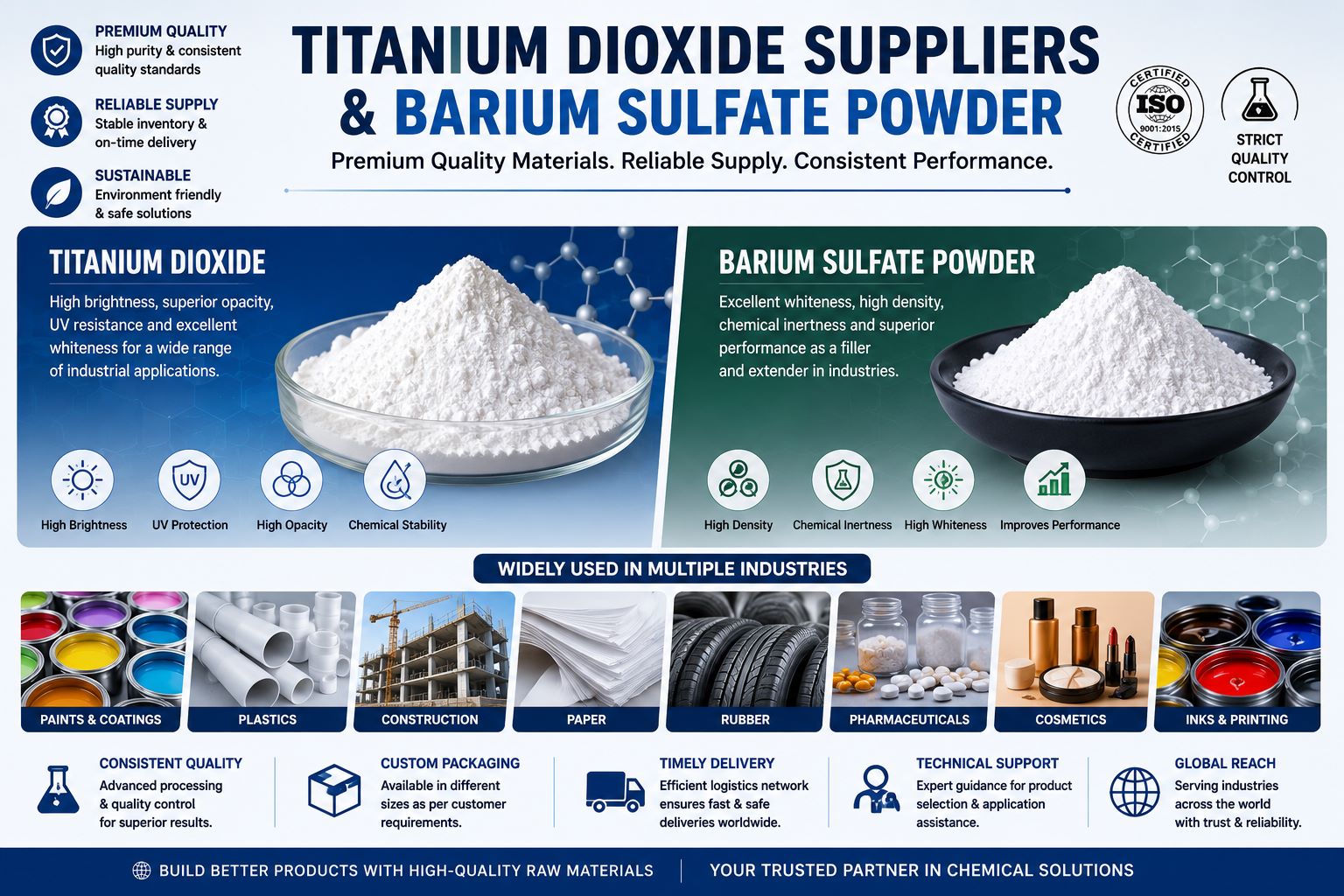
Although they perform different functions, manufacturers often evaluate both materials when developing formulations that require whiteness, opacity, chemical stability, density, surface performance, or cost control.
Choosing reliable Titanium Dioxide Suppliers and the correct grade of Barium Sulfate Powder can directly influence product consistency and manufacturing efficiency. Buyers should therefore evaluate more than price. Particle characteristics, purity, surface treatment, dispersibility, technical support, packaging, and supply reliability are equally important.
Understanding Titanium Dioxide
Titanium dioxide, commonly represented as TiO₂, is a white inorganic pigment valued primarily for its excellent brightness, opacity, and light-scattering capability. It is extensively incorporated into paints, coatings, plastics, printing inks, paper, and various industrial formulations.
Commercial titanium dioxide is primarily available in rutile and anatase forms.
Rutile titanium dioxide is generally preferred where high durability, weather resistance, opacity, and strong hiding performance are required. Anatase grades can be suitable for applications where specific brightness, processing, or formulation characteristics are more important than outdoor durability.
Professional Titanium Dioxide Suppliers typically offer different grades designed for specific industries rather than treating every titanium dioxide product as interchangeable.
Why Choosing Reliable Titanium Dioxide Suppliers Matters
Consistency is critical when purchasing industrial raw materials. Even small variations in particle distribution, surface treatment, moisture, or purity can affect dispersion and finished-product performance.
A dependable supplier should provide:
- Consistent product specifications
- Technical data sheets and safety documentation
- Batch traceability
- Appropriate packaging
- Reliable delivery schedules
- Application-specific grade recommendations
- Quality-control documentation
- Technical assistance when formulation issues arise
Manufacturers should compare suppliers based on total production value rather than selecting solely according to the lowest quoted price.
Good Titanium Dioxide Suppliers can also help buyers select suitable grades for coatings, plastics, masterbatch, printing inks, rubber, and other demanding industrial applications.
Important Properties of Titanium Dioxide
Several characteristics determine whether titanium dioxide will perform effectively within a formulation.
Particle Size and Distribution
Particle size influences light scattering, opacity, dispersion, gloss, and processing characteristics. Controlled particle distribution generally produces more predictable formulation performance.
Surface Treatment
Some titanium dioxide grades undergo inorganic or organic surface treatment to improve properties such as dispersibility, weather resistance, compatibility, and processing behaviour.
Whiteness and Tinting Strength
High-quality TiO₂ can provide strong brightness and tinting strength. However, the ideal grade depends on the formulation, resin system, manufacturing process, and final application.
Dispersibility
Poor dispersion can result in uneven appearance, reduced opacity, processing problems, and inconsistent finished products. Buyers should therefore evaluate dispersion performance under their actual production conditions.
What Is Barium Sulfate Powder?
Barium Sulfate Powder is an inorganic material represented chemically as BaSO₄. It is recognised for characteristics including high density, chemical stability, low oil absorption in suitable grades, good filling properties, and compatibility with many industrial formulations.
It may be produced from naturally occurring barite or through precipitation processes depending on the required purity and particle characteristics.
The material is widely used in:
- Paints and coatings
- Plastics
- Rubber compounds
- Printing inks
- Powder coatings
- Adhesives and sealants
- Industrial fillers
- Selected specialty formulations
Different production methods and particle specifications can create substantially different performance characteristics.
Natural vs Precipitated Barium Sulfate
Understanding the difference between natural and precipitated grades helps manufacturers choose the appropriate material.
| Feature | Natural Barium Sulfate | Precipitated Barium Sulfate |
| Source | Processed natural barite | Chemically manufactured |
| Purity | Depends on mineral grade | Generally more controlled |
| Particle characteristics | Depends on grinding | More precisely controlled |
| Cost | Often economical | Usually higher |
| Applications | General industrial filling | Higher-performance formulations |
Neither option is automatically better. Selection should depend on technical requirements and overall formulation economics.
Titanium Dioxide and Barium Sulfate Powder in Formulations
Titanium dioxide primarily functions as a high-performance white pigment, while Barium Sulfate Powder commonly performs as a functional extender or filler.
When appropriately formulated, barium sulfate may complement titanium dioxide in certain coating, plastic, or ink systems. However, replacing titanium dioxide directly with filler without laboratory evaluation can reduce hiding power and alter mechanical or visual performance.
Formulators generally balance:
- Required opacity
- Brightness
- Surface finish
- Processing behaviour
- Density
- Durability requirements
- Raw-material cost
- Final product specifications
Successful formulation therefore depends on understanding how multiple raw materials interact rather than focusing on a single ingredient.
Major Applications Across Industries
Paints and Coatings
TiO₂ contributes whiteness and opacity, while barium sulfate can support filling, film properties, density, and formulation optimisation.
Plastics and Masterbatch
Titanium dioxide is frequently incorporated into white and coloured plastic systems. Carefully selected barium sulfate grades may be used where dimensional, density, processing, or filler characteristics are required.
Printing Inks
Both materials can contribute to specific ink properties depending on the printing technology and formulation. Particle size and dispersion become particularly important in these systems.
Rubber Products
Barium Sulfate Powder can function as a mineral filler in selected rubber compounds. Manufacturers must consider compatibility, particle characteristics, and the required mechanical properties.
Powder Coatings
Fine and controlled grades may be selected for formulations where surface finish, density, chemical stability, and consistent processing are important.
How to Select the Right Supplier
Before placing a commercial order, manufacturers should request technical information and preferably evaluate samples.
Important questions include:
- What TiO₂ or BaSO₄ grade is recommended for the intended application?
- What is the typical purity?
- What particle-size distribution is provided?
- Is surface treatment applied?
- What quality-control system is used?
- Can a certificate of analysis be provided?
- What packaging formats are available?
- What is the minimum order quantity?
- Are batch-to-batch specifications controlled?
- Is technical support available?
Testing material under real production conditions remains one of the most reliable ways to confirm suitability.
Quality Factors for Barium Sulfate Powder
When sourcing Barium Sulfate Powder, buyers should consider parameters such as:
Purity
Higher purity can be particularly important in demanding coatings, plastics, inks, and specialty formulations.
Particle Size
Fine and controlled particle distribution can influence dispersion, surface finish, processing behaviour, and final appearance.
Whiteness
Whiteness becomes important when the material is incorporated into light-coloured or highly visible formulations.
Moisture
Excess moisture may interfere with storage, processing, dispersion, or manufacturing consistency.
FAQs
1. What is titanium dioxide mainly used for?
Titanium dioxide is primarily used as a white pigment in paints, coatings, plastics, inks, paper, and related industrial materials.
2. What should I check when comparing Titanium Dioxide Suppliers?
Evaluate grade consistency, technical specifications, purity, surface treatment, documentation, delivery reliability, and technical support.
3. What is Barium Sulfate Powder used for?
It is widely used as a functional filler or extender in coatings, plastics, rubber, inks, sealants, and other industrial formulations.
4. Can barium sulfate replace titanium dioxide?
Not on a simple one-to-one basis. Titanium dioxide provides strong opacity, while barium sulfate performs differently. Any substitution should be validated through formulation testing.
5. Is precipitated barium sulfate different from natural barite powder?
Yes. Precipitated material is chemically manufactured and generally offers more controlled purity and particle properties.
6. Which titanium dioxide type is commonly used for exterior coatings?
Rutile TiO₂ is commonly selected because suitable grades can provide strong opacity and exterior durability.
7. Why is particle size important?
Particle distribution affects dispersion, surface appearance, processing behaviour, opacity, and other formulation properties.
8. How should industrial buyers verify quality?
Request technical data, safety documentation, certificates of analysis, representative samples, and production-level testing where practical.
9. Is the cheapest raw material always economical?
No. Poor consistency may increase formulation problems, waste, reprocessing, and production costs.
10. Can titanium dioxide and barium sulfate be used together?
Yes, they can be incorporated into the same formulation when technically appropriate and properly balanced.