
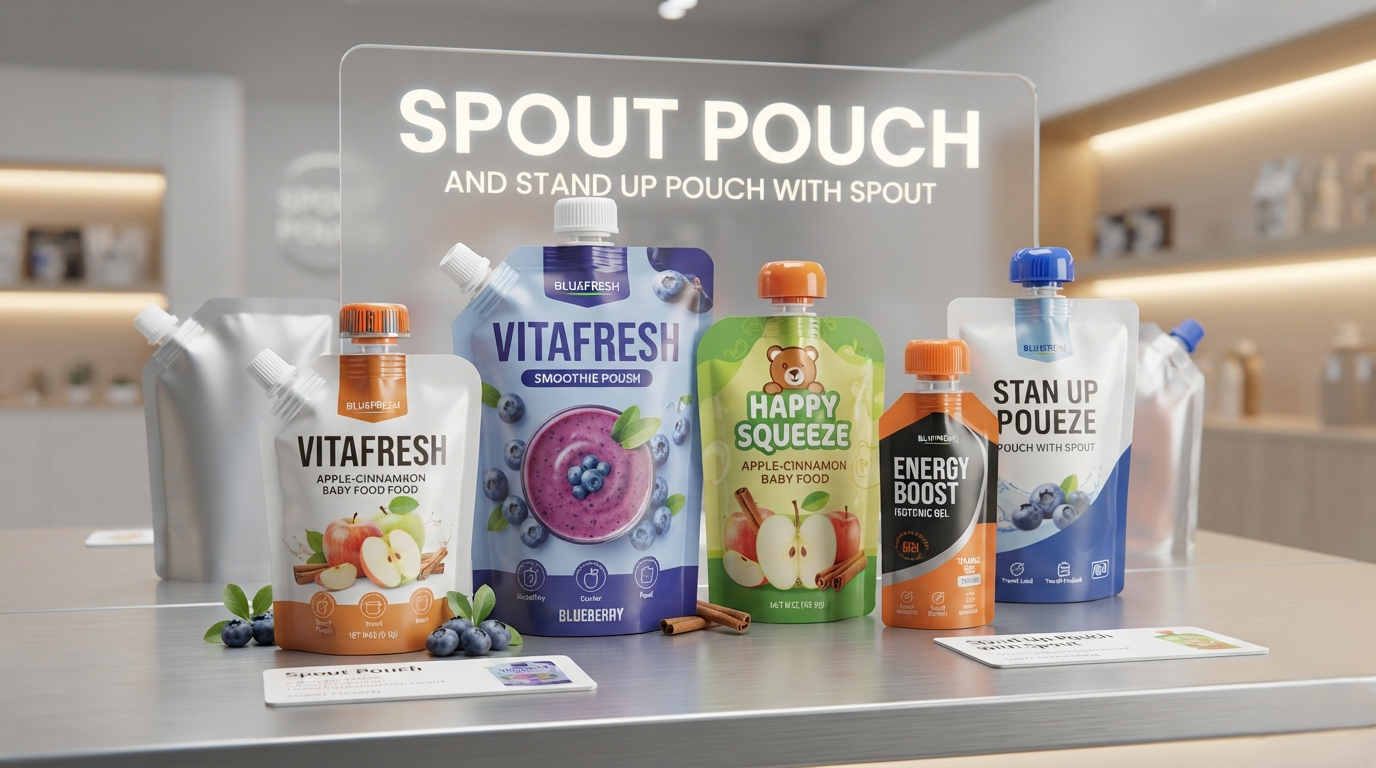
Among flexible packaging options, the Spout Pouch and stand up pouch with spout have become popular solutions for liquid, semi-liquid, powder, and paste-based products.
These innovative pouches combine the flexibility of laminated packaging with the convenience of a bottle-style dispensing system. From beverages and sauces to detergents, cosmetics, baby food, and industrial liquids, spouted packaging provides manufacturers with a practical alternative to rigid containers.
What Is a Spout Pouch?
A Spout Pouch is a flexible packaging pouch fitted with a plastic dispensing spout and usually a screw cap. The spout allows consumers to pour or dispense the product without cutting open the package.
The pouch is generally manufactured using multiple layers of films selected according to the product’s barrier, strength, and storage requirements. Depending on the application, manufacturers may use polyethylene, PET, nylon, aluminium foil, metallized films, or other food-grade materials.
Spouts can be positioned at the top center or corner of the pouch. Different cap sizes, nozzle diameters, shapes, and closure systems can also be selected according to product viscosity and consumer requirements.
Its combination of flexibility and controlled dispensing makes this packaging particularly useful for products that may be consumed or used several times after opening.
Understanding a Stand Up Pouch with Spout
A stand up pouch with spout includes a specially designed bottom gusset that expands when the pouch is filled. This enables the package to stand vertically on store shelves.
The standing structure provides excellent opportunities for branding because the front and back surfaces offer significant printable space. Manufacturers can display logos, product information, nutritional details, instructions, promotional messages, and attractive graphics directly on the pouch.
Compared with conventional bottles, jars, or cans, stand-up spouted packaging often requires less material while remaining highly functional.
Common applications include:
- Fruit juices and beverages
- Ketchup and sauces
- Cooking oils
- Baby food
- Liquid detergents
- Hand wash
- Shampoo and conditioner
- Cosmetic products
- Automotive fluids
- Pharmaceutical liquids
The exact pouch construction depends heavily on what is being packaged.
Why Businesses Are Choosing Spouted Flexible Packaging
Brands increasingly look for packaging that balances functionality, cost efficiency, shelf presentation, and transportation performance.
A Spout Pouch can deliver several practical advantages.
First, flexible materials are generally lightweight compared with glass bottles, metal containers, and many rigid plastic packages. Lower packaging weight may reduce transportation requirements, particularly when large quantities are shipped.
Second, empty pouches occupy considerably less warehouse space than rigid bottles.
Third, manufacturers receive a large printable surface that can support premium branding and product communication.
Another major advantage is convenience. Consumers can open the cap, dispense the required quantity, close the package again, and store the remaining product.
This resealable structure is particularly valuable for products intended for repeated use.
Important Features of Quality Spout Pouches
A professionally manufactured stand up pouch with spout should deliver more than attractive graphics.
Important characteristics include:
- Strong sealing performance to help prevent leakage.
- Appropriate barrier properties for moisture, oxygen, aroma, or light.
- Durable laminated construction.
- Secure attachment between the pouch and spout.
- Convenient dispensing according to product viscosity.
- Reliable cap closure for repeated use.
- Good shelf stability when a stand-up format is selected.
- Printing suitable for professional brand presentation.
Manufacturers should select specifications after considering the characteristics of the packaged product rather than choosing packaging based entirely on appearance.
Materials Used for Spouted Pouches
Material selection plays an important role in packaging performance. Different products have different protection requirements.
For example, a beverage may require good oxygen and moisture protection, while household chemicals may demand stronger chemical resistance.
Typical flexible packaging structures combine several layers, with each layer performing a specific function.
Outer layers usually provide printability and physical strength. Barrier layers protect the contents from environmental factors. Inner sealant layers create strong seals and provide direct product-contact compatibility.
High-barrier structures can also incorporate aluminium foil or metallized material when additional protection is necessary.
Before selecting materials, businesses should evaluate filling temperature, expected shelf life, transportation conditions, storage requirements, and applicable regulatory standards.
Spout Pouch Versus Traditional Packaging
| Feature | Spout Pouch | Rigid Bottle |
| Package weight | Lightweight | Usually heavier |
| Storage before filling | Requires limited space | Requires more space |
| Branding area | Large printable surface | Depends on label |
| Dispensing | Convenient spout | Convenient opening |
| Portability | High | Moderate to high |
| Material requirement | Usually lower | Usually higher |
| Shelf presentation | Excellent with stand-up design | Excellent |
| Custom shapes | Highly flexible | More tooling dependent |
Neither packaging type is universally superior. Product characteristics, filling equipment, distribution conditions, branding strategy, and customer expectations should determine the final choice.
Customization Opportunities for Modern Brands
Customization is one of the strongest advantages of flexible packaging.
Businesses can personalize a stand up pouch with spout through different sizes, shapes, film finishes, printing techniques, spout positions, and cap styles.
Matte finishes can create a sophisticated appearance, while glossy surfaces can produce bright, vibrant graphics. Transparent windows may allow customers to view the product inside.
Brands can also incorporate features such as:
- Custom printed graphics
- Different spout diameters
- Tamper-evident closures
- Transparent windows
- Matte or glossy finishes
- Rounded corners
- Carry handles
- Different bottom gussets
- Customized pouch dimensions
Effective customization should improve both visual appeal and product usability.
How to Choose the Right Spouted Pouch
Choosing appropriate packaging requires careful evaluation.
Start by identifying whether the product is liquid, thick paste, powder, concentrate, or another consistency. A thicker product usually requires a wider dispensing opening.
Next, consider package capacity. Spouted pouches can be designed for small single-use quantities as well as larger family or commercial packs.
Businesses should then evaluate barrier requirements, storage environment, filling process, expected shelf life, transportation conditions, and sealing performance.
Testing filled samples before beginning full-scale production is highly recommended. Drop tests, leakage tests, compression tests, and shelf-life assessments can identify potential problems before products enter the market.
Sustainability Considerations
Flexible packaging is increasingly discussed within sustainability strategies because lightweight designs can reduce the amount of packaging material required compared with some rigid alternatives.
However, sustainability depends on the complete packaging structure, manufacturing process, transportation system, recycling infrastructure, and local regulations.
Brands considering environmentally responsible Spout Pouch solutions should discuss recyclable mono-material structures, downgauging opportunities, and material reduction with experienced packaging suppliers.
Sustainability claims should always be specific and supported rather than relying on broad terms such as environmentally friendly without evidence.
Frequently Asked Questions
1. What products can be packed in a Spout Pouch?
Juices, sauces, oils, detergents, cosmetics, concentrates, baby foods, and numerous other products can use spouted packaging.
2. Can spout pouches stand upright?
Yes. A stand up pouch with spout uses a bottom gusset designed to create a stable standing base.
3. Are spouted pouches resealable?
Most designs include screw caps that allow repeated opening and closing.
4. Can the pouch size be customized?
Yes. Dimensions and filling capacity can normally be customized according to product requirements.
5. Can branding be printed directly on the pouch?
Yes. Flexible packaging supports high-quality customized printing across large surface areas.
6. Where can the spout be positioned?
Common positions include the top center and upper corner.
7. Are spout pouches suitable for thick liquids?
Yes, provided the correct spout diameter and pouch structure are selected.
8. Can transparent windows be included?
Yes, depending on the selected material structure and barrier requirements.
9. What determines pouch shelf life?
Product formulation, barrier structure, sealing quality, filling conditions, and storage environment all influence shelf life.
10. Should businesses test samples before bulk production?
Yes. Product compatibility, leakage, transportation, dispensing, and storage testing are strongly recommended.