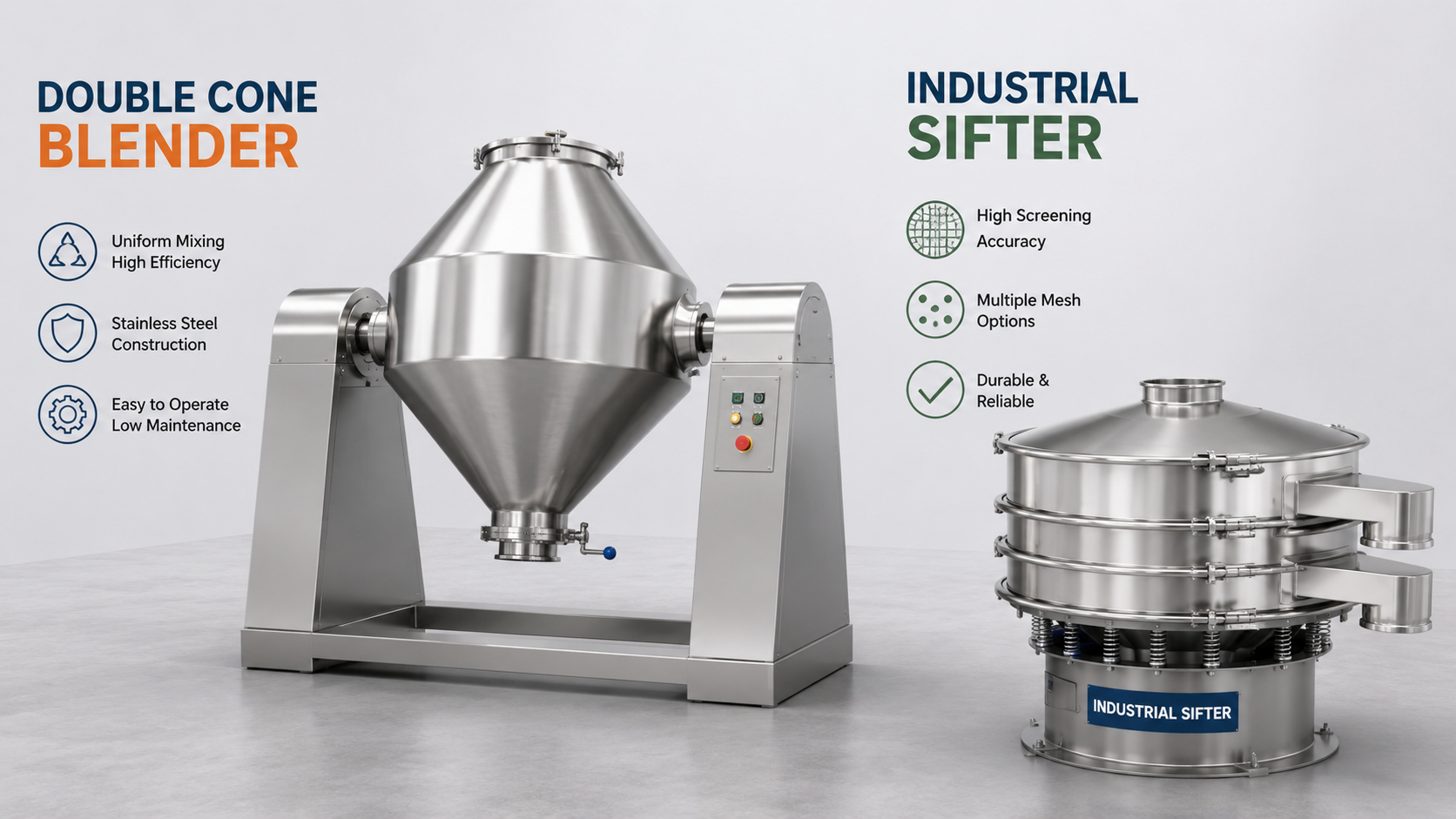
Powder processing demands consistency, cleanliness, accuracy, and reliable production equipment. Whether a manufacturer handles pharmaceuticals, chemicals, nutraceuticals, cosmetics, food ingredients, or specialty powders, the quality of blending and screening directly influences the final product. Two machines commonly used for these operations are the double cone blender and industrial sifter.
Although these machines perform different functions, they frequently complement each other. A double cone blender creates a uniform mixture of dry materials, while an industrial sifter separates unwanted particles, breaks agglomerates, and helps maintain the required particle-size distribution. Understanding their working principles, advantages, selection factors, and applications helps manufacturers develop more efficient powder-processing systems.
What Is a Double Cone Blender?
A double cone blender is a rotating powder-mixing machine designed primarily for gentle and uniform blending of dry, free-flowing materials. Its distinctive vessel consists of two cone-shaped sections joined together.
During operation, the vessel rotates around a horizontal axis. The powder repeatedly moves, divides, tumbles, and recombines inside the chamber. This continuous movement gradually distributes individual ingredients throughout the batch without requiring aggressive mixing blades.
The relatively gentle blending action makes this equipment particularly suitable when maintaining particle integrity is important.
Typical applications include:
- Pharmaceutical powders
- Nutraceutical formulations
- Food ingredients
- Chemical powders
- Cosmetic ingredients
- Herbal formulations
- Dry additives and premixes
The machine is especially useful for materials having reasonably similar particle characteristics and good flow properties.
How Does a Double Cone Blender Work?
The blending process begins by loading measured ingredients into the vessel. The chamber is normally filled only to an appropriate working capacity rather than completely filled, because sufficient internal space is necessary for effective powder movement.
Once rotation begins, gravity causes materials to continuously change position. Powder travels from one section of the vessel toward another while repeatedly falling and redistributing.
A typical operating sequence involves:
- Loading accurately measured ingredients.
- Closing and securing the charging point.
- Rotating the blending vessel at the specified speed.
- Allowing materials to tumble for a predetermined blending time.
- Stopping the machine at the appropriate position.
- Discharging the homogeneous mixture through the outlet.
Correct loading percentage, rotational speed, particle characteristics, and blending duration all influence final uniformity.
Major Advantages of Double Cone Blending
One important advantage of a double cone blender is its relatively simple design. Because the vessel itself rotates, complicated internal mixing components may not be necessary for many applications.
The equipment can provide several operational benefits:
- Gentle handling of powders and granules
- Consistent dry blending
- Relatively low product degradation
- Straightforward loading and discharge
- Reduced number of internal moving components
- Easier cleaning compared with complex mixers
- Suitability for hygienic processing environments
- Availability in different production capacities
Stainless-steel construction is commonly preferred where hygiene, corrosion resistance, and easy sanitation are priorities.
What Is an Industrial Sifter?
An industrial sifter is a screening machine used to classify powders or granular materials according to particle size. It can remove oversized particles, foreign material, lumps, and unwanted contaminants before materials continue to another processing stage.
Depending on its design, the machine uses a screen or mesh with defined openings. Material small enough to pass through the screen moves forward, while oversized material is retained or discharged separately.
Industrial screening can therefore improve product consistency while also protecting downstream processing equipment.
Sifters are widely found in:
- Pharmaceutical manufacturing
- Food processing
- Chemical production
- Nutraceutical facilities
- Spice processing
- Powder coating production
- Cosmetic manufacturing
- Mineral and specialty-material processing
How an Industrial Sifter Improves Powder Quality
Powders can develop lumps during storage, transportation, handling, or exposure to humidity. Raw materials may also contain particles outside the required size range.
An industrial sifter helps establish more controlled material characteristics before blending, packing, granulation, or further processing.
Depending on the application, sifting may help manufacturers:
- Remove oversized particles
- Break or separate loose agglomerates
- Improve particle-size consistency
- Remove certain foreign materials
- Prepare powders for subsequent blending
- Improve material flow
- Maintain repeatable batch quality
Mesh selection is particularly important. A screen that is unnecessarily fine can restrict throughput, while an excessively large opening may fail to provide the required separation.
Double Cone Blender vs Industrial Sifter
Although both machines handle powders, their primary purposes are fundamentally different.
| Factor | Double Cone Blender | Industrial Sifter |
| Main function | Mixing ingredients | Screening materials |
| Primary objective | Blend uniformity | Particle-size control |
| Basic action | Tumbling | Screening or vibration |
| Typical input | Multiple ingredients | Powder or granules |
| Typical output | Homogeneous mixture | Screened material |
| Common stage | Blending | Pre- or post-processing |
| Key consideration | Mixing consistency | Mesh size and throughput |
Manufacturers should therefore view these machines as complementary equipment rather than substitutes.
Using a Double Cone Blender and Industrial Sifter Together
A well-designed powder-processing line may use both technologies in sequence.
Raw ingredients can first pass through an industrial sifter to remove unwanted oversized material and achieve more consistent particle characteristics. Screened ingredients can then be transferred into a double cone blender for uniform mixing.
A simplified workflow may be:
Raw material → Sifting → Weighing → Blending → Quality inspection → Packing
The exact sequence varies according to the product and manufacturing process. Some facilities may also perform screening after blending when the formulation and quality requirements justify it.
Combining controlled screening with consistent blending can improve process repeatability and reduce quality variation between batches.
Important Factors When Selecting Equipment
Equipment should be selected according to actual process requirements rather than capacity alone.
For a double cone blender, manufacturers should evaluate batch size, bulk density, powder flowability, filling ratio, required mixing uniformity, discharge arrangement, cleaning requirements, contact-part material, motor specifications, and automation requirements.
For an industrial sifter, important considerations include:
- Required throughput
- Particle-size distribution
- Screen or mesh specification
- Material characteristics
- Number of separation stages
- Cleaning accessibility
- Dust-control requirements
- Contact-part construction
- Ease of screen replacement
Pilot trials can be particularly valuable when powders have unusual flow, segregation, electrostatic, or agglomeration characteristics.
Hygiene, Cleaning, and Maintenance
Cleaning is essential whenever equipment processes products with strict contamination requirements.
Product-contact surfaces should be accessible and suitable for the intended cleaning procedure. Manufacturers should establish documented cleaning routines according to their industry, material properties, and applicable quality standards.
For double cone equipment, operators should routinely inspect seals, bearings, drive components, discharge valves, and vessel surfaces.
For sifters, inspection should focus on screens, seals, clamps, vibration components, and discharge connections. Damaged screens require prompt replacement because they can compromise particle-size control.
Preventive maintenance helps reduce unexpected downtime and protects consistent production.
Frequently Asked Questions
1. What is a double cone blender mainly used for?
It is primarily used for homogeneous blending of dry powders and free-flowing granular ingredients.
2. Can a double cone blender handle delicate materials?
Yes. Its gentle tumbling action can make it suitable for materials requiring relatively low mechanical stress.
3. What does an industrial sifter remove?
It can separate oversized particles, agglomerates, and certain unwanted foreign materials according to screen size.
4. Can both machines be used in one production line?
Yes. Materials can be sifted before being transferred to the blender.
5. Which industries commonly use these machines?
Pharmaceutical, food, chemical, nutraceutical, cosmetic, and other powder-processing industries commonly use them.
6. Why is blender loading capacity important?
Adequate empty space inside the vessel allows powder to tumble and redistribute effectively.
7. How is the correct sifter mesh selected?
Mesh selection depends on the required particle size, material characteristics, throughput, and process objective.
8. Is stainless steel suitable for these machines?
Stainless steel is commonly used for product-contact parts because of its durability, corrosion resistance, and cleanability.
9. Can an industrial sifter improve production consistency?
Yes. Controlled screening can help produce a more consistent particle-size range for subsequent operations.
10. How should equipment capacity be selected?
Capacity should be based on batch volume, bulk density, desired throughput, processing time, and future production requirements.