
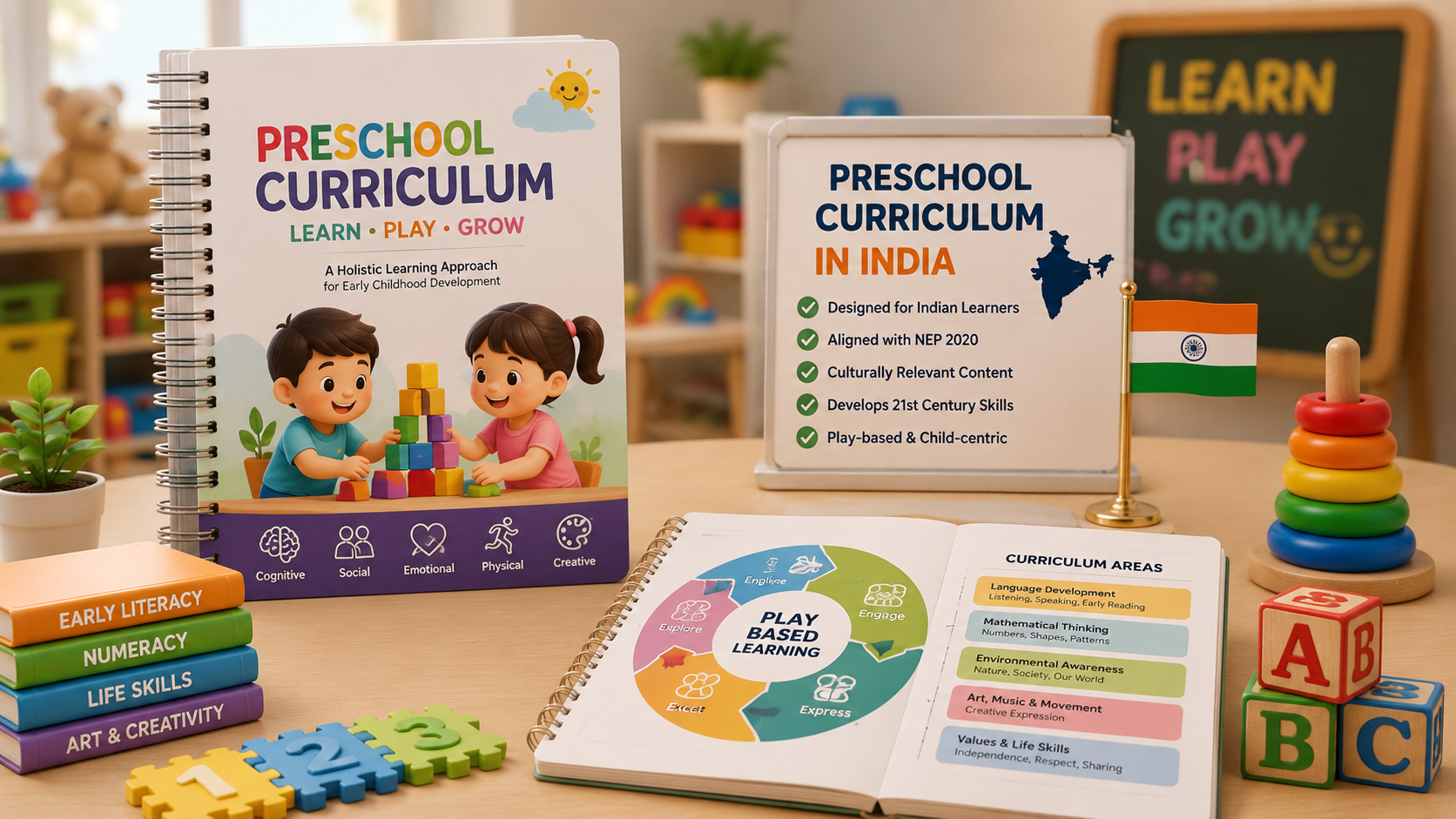
A thoughtfully designed preschool curriculum therefore goes far beyond teaching alphabets, numbers, colours, and shapes. It creates meaningful experiences through play, conversation, movement, creativity, exploration, and social interaction.
A modern preschool curriculum in India focuses increasingly on holistic development rather than formal academic pressure. Children learn through stories, games, art, music, sensory activities, outdoor experiences, role-play, puzzles, and guided discovery. The objective is to build curiosity and confidence while developing the physical, emotional, social, language, and cognitive abilities needed for future schooling.
What Is a Preschool Curriculum?
A preschool curriculum is a structured learning framework designed specifically for young children, generally before they enter primary school. It determines what children experience in the classroom, how teachers introduce concepts, and which developmental skills are encouraged at different ages.
Unlike conventional school education, preschool learning should not depend heavily on textbooks, memorisation, examinations, or lengthy written exercises. Young children understand ideas more effectively when they can see, touch, hear, move, question, imitate, experiment, and participate.
A balanced curriculum usually covers:
- Language and communication development
- Early literacy and numeracy
- Cognitive and problem-solving abilities
- Fine and gross motor development
- Social and emotional learning
- Art, music, dance, and creativity
- Environmental awareness
- Personal hygiene and self-help skills
- Sensory exploration
- Values and positive behaviour
These areas work together to prepare children for school and everyday life.
Why Preschool Education Matters in Early Childhood
Early childhood is a period of rapid development. Children constantly absorb information from their surroundings and learn through interaction with adults, other children, objects, nature, and everyday situations.
An effective preschool curriculum provides age-appropriate experiences instead of pushing children toward advanced academics too early.
For example, sorting colourful objects introduces classification and mathematical thinking. Listening to a story develops vocabulary and imagination. Building blocks can strengthen spatial awareness, coordination, creativity, and problem-solving simultaneously.
Good preschool education also encourages children to become more independent. Simple responsibilities such as arranging materials, putting toys away, washing hands, eating independently, and waiting for a turn gradually build confidence and responsibility.
Key Features of Preschool Curriculum in India
A quality preschool curriculum in India needs to reflect children’s developmental requirements as well as their cultural and social surroundings. Activities become more meaningful when children can connect classroom learning with familiar experiences.
An effective approach generally includes play-based learning, activity-based education, storytelling, experiential learning, collaborative activities, creative expression, and opportunities for exploration.
Indian preschool classrooms may also introduce children to local festivals, family relationships, community helpers, seasons, animals, food, plants, transportation, traditions, and the environment.
The goal should be understanding rather than memorising information.
Play-Based Learning Makes Education Meaningful
Play is one of the most powerful learning methods during early childhood. A well-planned preschool curriculum turns ordinary play into valuable educational experiences without making children feel that they are completing formal lessons.
Building a tower with blocks, for instance, can teach balance, size, comparison, patience, and coordination. Pretend shops can introduce counting, communication, social roles, and decision-making.
Popular play-based activities include:
- Building blocks and construction games
- Role-playing and pretend play
- Matching and sorting activities
- Puzzles and problem-solving games
- Sand and water exploration
- Clay and modelling activities
- Outdoor games
- Music and movement exercises
Teachers guide these experiences while allowing children enough freedom to discover solutions independently.
Developing Early Language and Communication Skills
Communication development is a major component of a strong preschool curriculum in India. Children should receive frequent opportunities to listen, speak, describe experiences, ask questions, and participate in conversations.
Storytelling, picture reading, rhymes, puppet shows, phonological activities, show-and-tell sessions, and group discussions can improve vocabulary and listening abilities.
Instead of immediately expecting children to write complete words or sentences, teachers can gradually develop pre-writing abilities through drawing, tracing, colouring, pattern-making, and activities that strengthen hand muscles.
This progression makes literacy development more natural and enjoyable.
Introducing Early Mathematics Through Everyday Activities
Preschool mathematics should begin with practical concepts children can experience rather than abstract calculations.
Children can explore numbers through toys, beads, fruits, classroom objects, steps, blocks, and games. They can learn big and small, more and less, long and short, heavy and light, near and far, and basic shapes through everyday observation.
This approach builds mathematical thinking before formal arithmetic begins.
| Learning Area | Example Activity | Skill Developed |
| Numbers | Counting toys | Number awareness |
| Shapes | Shape matching | Visual recognition |
| Patterns | Bead sequencing | Logical thinking |
| Comparison | Sorting objects by size | Classification |
| Measurement | Comparing blocks | Early measurement |
Such activities make mathematical concepts easier for young children to understand.
Social and Emotional Development
Academic readiness is only one part of preschool education. Children must also learn how to communicate feelings, cooperate with others, manage small frustrations, share materials, and participate in groups.
A balanced preschool curriculum creates opportunities for children to practise these abilities naturally.
Teachers can encourage children to take turns, help classmates, express emotions through words, complete simple responsibilities, and resolve minor disagreements constructively.
Positive reinforcement is especially important. When children feel respected and secure, they are generally more willing to participate, communicate, and experiment with unfamiliar activities.
Physical and Motor Skill Development
Physical development should receive regular attention in every preschool curriculum in India.
Gross motor activities such as running, jumping, balancing, dancing, throwing, and climbing help develop larger muscle groups. Fine motor activities strengthen the smaller muscles required for writing and everyday tasks.
Useful fine motor activities include clay modelling, threading beads, tearing and pasting paper, colouring, folding, building blocks, and manipulating safe classroom objects.
A healthy preschool routine should balance active movement with quieter classroom experiences.
Role of Teachers in Preschool Learning
Preschool teachers are facilitators, observers, guides, and supportive learning partners. Their role is not simply to deliver information.
Teachers observe how individual children communicate, participate, solve problems, and respond to different activities. These observations help them adjust activities according to varying developmental levels.
An effective teacher creates a welcoming environment where children feel comfortable asking questions and making mistakes. Rather than immediately giving answers, teachers can encourage children to observe, predict, experiment, and discover.
How Parents Can Support Preschool Learning at Home
Learning should continue naturally beyond the classroom without turning home into another formal school.
Parents can reinforce the preschool curriculum through everyday experiences such as:
- Reading stories together
- Counting household objects
- Naming colours and shapes
- Encouraging independent dressing and eating
- Drawing and colouring
- Talking about plants and animals
- Singing rhymes
- Involving children in simple household activities
- Asking open-ended questions
- Limiting unnecessary academic pressure
Consistent communication between parents and teachers can also help identify a child’s interests, strengths, and areas requiring additional support.
Frequently Asked Questions About Preschool Curriculum
1. What is the main purpose of a preschool curriculum?
Its purpose is to support holistic development and prepare children socially, emotionally, physically, cognitively, and linguistically for future education.
2. What should a preschool curriculum include?
It should include language, numeracy, creative activities, physical development, social-emotional learning, sensory exploration, and life skills.
3. What makes a good preschool curriculum in India?
It should be age-appropriate, play-based, inclusive, culturally relevant, engaging, flexible, and focused on overall development.
4. Should preschool children receive homework?
Learning at this age is generally more effective through short, enjoyable activities and everyday experiences than extensive formal homework.
5. Why is play important in preschool?
Play develops creativity, communication, coordination, problem-solving, imagination, and social abilities.
6. How is mathematics taught in preschool?
Children learn through counting, sorting, matching, patterns, shapes, comparison, and practical activities.
7. How can preschool improve communication skills?
Stories, conversations, rhymes, songs, picture discussions, and role-play provide regular opportunities to listen and speak.
8. Does preschool help children become independent?
Yes. Age-appropriate routines can encourage self-care, responsibility, confidence, and decision-making.
9. What is the role of parents in preschool education?
Parents reinforce classroom learning through conversations, stories, play, routines, and supportive home experiences.
10. How should parents choose a preschool curriculum?
Look for a balanced programme that prioritises safety, qualified educators, play, creativity, communication, movement, exploration, and individual development.