
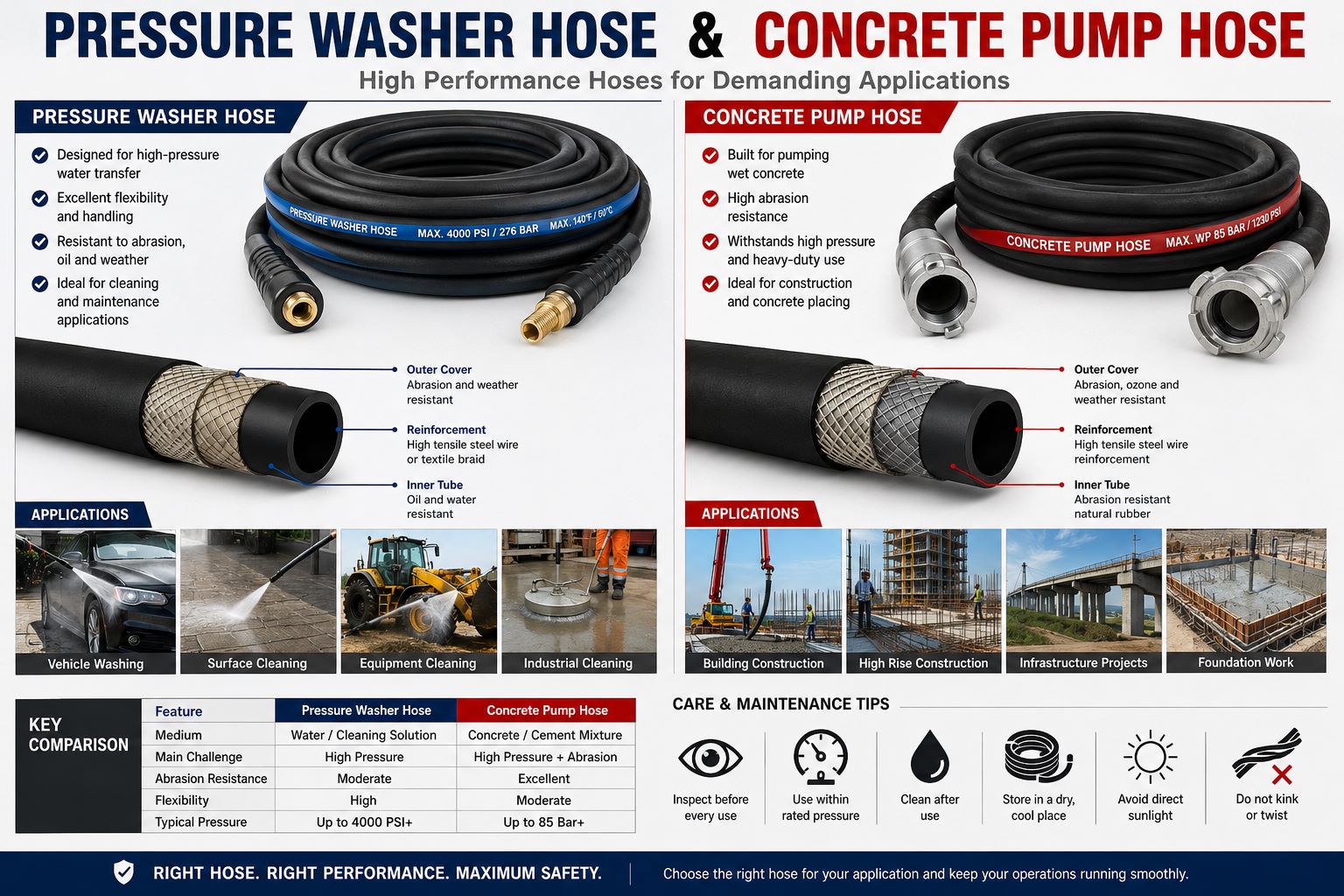
Among these components, Pressure Washer Hose and Concrete Pump Hose products perform demanding jobs where ordinary hoses simply cannot provide the required pressure resistance, durability, flexibility, and abrasion protection.
Although both are designed for challenging working conditions, their applications are very different. A pressure washer hose carries high-pressure water for cleaning operations, while a concrete pump hose transfers abrasive concrete mixtures at construction sites. Understanding their construction, performance characteristics, selection criteria, and maintenance requirements helps businesses choose safer and more productive hose solutions.
What Is a Pressure Washer Hose?
A Pressure Washer Hose is specifically engineered to carry pressurized water between a pressure washer and its spray gun, lance, or cleaning attachment. It must withstand substantially greater internal pressure than a conventional garden or water hose.
These hoses are commonly used for industrial cleaning, vehicle washing, building maintenance, machinery cleaning, agricultural equipment, workshops, construction sites, and commercial cleaning operations.
A quality hose generally consists of several layers. The inner tube provides a suitable passage for water, while reinforcement layers help contain operating pressure. The external cover protects the hose against abrasion, weather exposure, oil, dirt, and everyday handling damage.
Important characteristics include:
- High working-pressure capability
- Strong reinforcement construction
- Abrasion-resistant outer covering
- Suitable temperature resistance
- Flexible handling
- Secure end connections
- Resistance to kinking and premature wear
Selecting the correct hose should always begin with the pressure washer manufacturer’s operating requirements.
Why Pressure Rating Matters
Pressure is one of the most important considerations when choosing a Pressure Washer Hose. A hose should never be selected simply because its fittings physically connect to the machine.
Every system has specific operating conditions. The hose, couplings, gun, nozzle, and other components must be compatible with the intended pressure and temperature.
Using an incorrectly rated hose can increase the risk of leakage, premature deterioration, connection failure, or hose rupture. Buyers should therefore verify working pressure rather than relying only on appearance, diameter, or price.
Temperature also matters. Applications involving heated water require hoses specifically designed for the expected operating temperature. Always follow the hose and equipment manufacturers’ published specifications and safety instructions.
What Is a Concrete Pump Hose?
A Concrete Pump Hose is a heavy-duty flexible hose designed for transferring pumpable concrete and similar abrasive construction materials. It is commonly installed at the delivery end of concrete pumping systems, where flexibility helps operators position the discharge point.
Concrete pumping creates demanding conditions. The hose must handle pressure while its internal surface is continuously exposed to abrasive materials containing cement, sand, aggregates, and water.
For this reason, construction quality is critical. Typical designs incorporate an abrasion-resistant inner tube, high-strength reinforcement, and a durable external cover capable of handling demanding construction environments.
Applications can include:
- Residential foundations
- Commercial construction
- High-rise projects
- Slabs and flooring
- Infrastructure construction
- Tunnels and civil engineering
- Difficult-access concrete placement
A suitable hose supports controlled concrete delivery while helping the pumping operation remain efficient.
Key Features of a Quality Concrete Pump Hose
A reliable Concrete Pump Hose should combine pressure capability with abrasion resistance and practical flexibility. Internal wear is particularly important because concrete mixtures can progressively erode the hose lining.
The hose should also have compatible couplings and connections. Components should be selected as part of the complete pumping system rather than treated as unrelated accessories.
Key considerations include internal diameter, working pressure, hose length, bend characteristics, material compatibility, reinforcement, coupling design, and manufacturer recommendations.
External inspection is equally important. Cuts, exposed reinforcement, damaged fittings, severe deformation, unusual soft spots, or other visible deterioration may indicate that professional evaluation or replacement is necessary.
Pressure Washer Hose vs. Concrete Pump Hose
Despite both being industrial hose products, they should never be treated as interchangeable.
| Feature | Pressure Washer Hose | Concrete Pump Hose |
| Primary medium | Pressurized water | Pumpable concrete |
| Main application | Cleaning | Concrete placement |
| Key challenge | Pressure and handling | Pressure and severe abrasion |
| Flexibility | Important for cleaning movement | Important for concrete positioning |
| Inner lining | Designed for water service | Designed for abrasive concrete |
| Typical environment | Cleaning and maintenance | Construction sites |
| Selection priority | Pressure, temperature, fittings | Pressure, abrasion, diameter, fittings |
The most significant difference is the material being transported. Water-cleaning systems require a hose engineered around hydraulic pressure and temperature conditions, whereas concrete pumping requires exceptional resistance to abrasive material flow.
How to Select the Right Industrial Hose
Choosing either a Pressure Washer Hose or Concrete Pump Hose requires more than checking diameter and length.
Start by identifying the exact application and transported material. Next, determine the system’s operating pressure, temperature range, required diameter, connection type, environmental exposure, and manufacturer’s specifications.
A practical selection process includes:
- Identify the transferred medium.
- Confirm maximum intended operating conditions.
- Check the required hose diameter.
- Verify temperature compatibility.
- Select compatible couplings and fittings.
- Consider abrasion and environmental exposure.
- Choose an appropriate hose length.
- Review manufacturer instructions and applicable safety requirements.
Avoid choosing a hose solely because it is cheaper. A lower initial purchase price may offer little value if frequent replacement, downtime, or equipment problems follow.
Maintenance and Inspection for Longer Service Life
Routine inspection helps improve reliability and identify deterioration before it develops into a more serious problem.
Before operation, examine the hose and connections according to the manufacturer’s guidance. Look for visible cracking, excessive abrasion, cuts, bulging, deformation, damaged couplings, leakage, or exposed reinforcement.
Avoid unnecessary dragging across sharp or abrasive surfaces. Hoses should also be protected from vehicles, heavy machinery, excessive bending, crushing, and unsuitable storage conditions.
After use, follow the manufacturer’s cleaning and storage recommendations. Concrete pumping equipment requires particular attention because residual material can harden and affect subsequent operation.
Never attempt makeshift repairs on pressure-bearing components. Damaged hoses and fittings should be assessed and replaced according to manufacturer requirements and workplace safety procedures.
Benefits of Using the Correct Hose
Using application-specific hose products offers several practical advantages. Properly selected hoses support reliable pressure handling, efficient equipment operation, easier handling, reduced unplanned downtime, and more predictable service life.
For cleaning businesses, the right Pressure Washer Hose provides the mobility required to work around vehicles, machinery, buildings, and industrial equipment.
For construction companies, a suitable Concrete Pump Hose helps deliver concrete accurately in locations where rigid delivery lines may not provide sufficient positioning flexibility.
In both cases, correct specification is essential for dependable performance.
Frequently Asked Questions
1. What is a Pressure Washer Hose used for?
It carries pressurized water from a pressure washer to a spray gun or cleaning attachment.
2. Can a normal garden hose replace it?
No. The high-pressure side of a pressure washer requires a hose specifically rated for that service.
3. What determines the correct pressure washer hose?
Working pressure, temperature, diameter, fittings, length, and equipment manufacturer requirements are key considerations.
4. What is a Concrete Pump Hose used for?
It transfers pumpable concrete, particularly where flexible placement is required.
5. Why does concrete hose need abrasion resistance?
Concrete contains abrasive materials that progressively wear the hose’s inner lining.
6. Can the two hose types be interchanged?
No. They are engineered for different media, operating conditions, and applications.
7. How often should industrial hoses be inspected?
Inspection frequency should follow manufacturer instructions, applicable regulations, and workplace safety procedures, with visual checks performed before use where required.
8. Does hose diameter affect performance?
Yes. Diameter influences flow characteristics and must match the intended system requirements.
9. Are couplings important when choosing a hose?
Absolutely. Connections must be compatible with the hose, equipment, pressure requirements, and intended application.
10. When should a damaged hose be replaced?
A hose showing unacceptable wear, damaged reinforcement, leaks, deformation, or compromised fittings should be removed from service according to manufacturer and safety guidance.