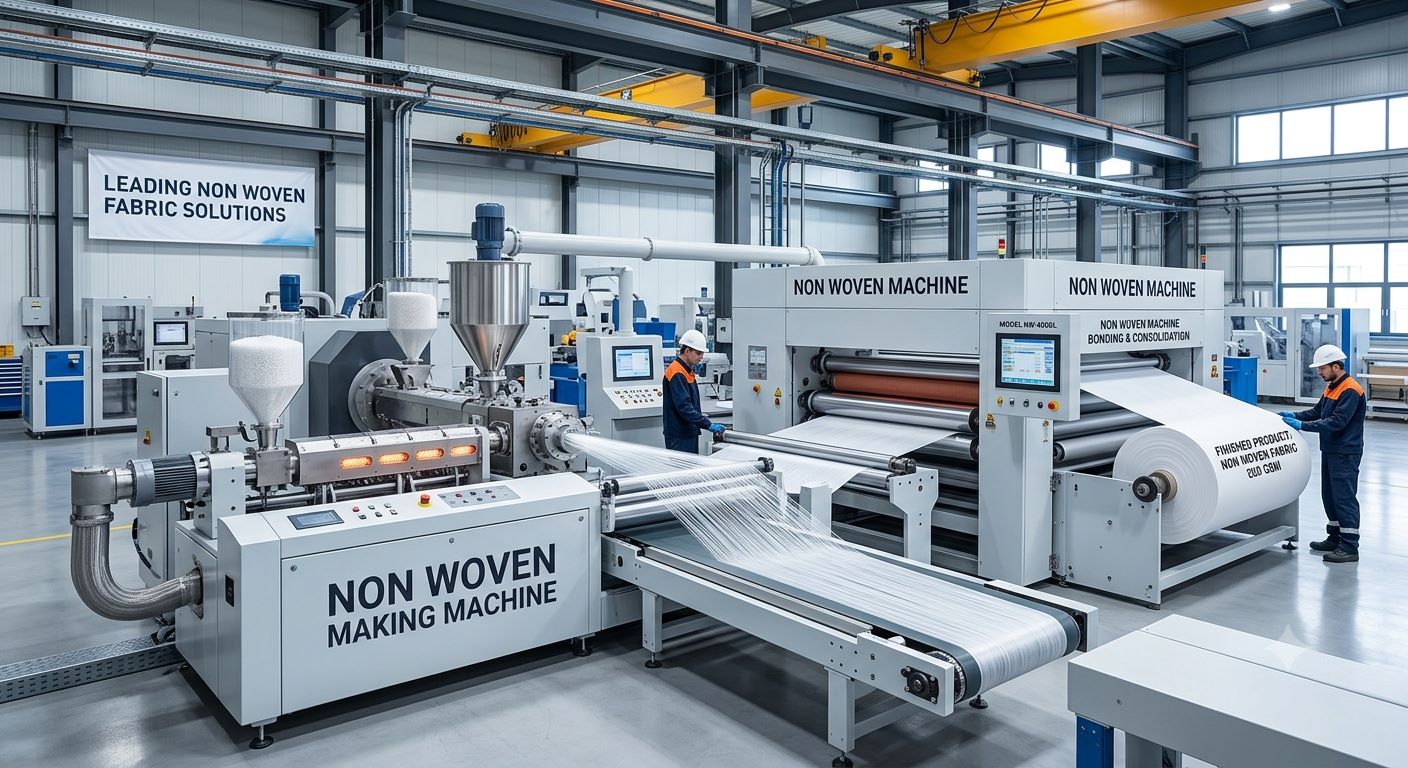
A modern Non Woven Machine combines extrusion, fiber formation, web development, bonding, cooling, cutting, and winding into a highly automated production line. These machines are widely used to manufacture materials for medical products, hygiene items, agriculture, packaging, construction, furniture, filtration, and household applications.
Understanding how these machines work, their key components, production capabilities, and selection factors can help manufacturers establish efficient and competitive nonwoven production facilities.
What Is a Non Woven Making Machine?
A Non Woven Making Machine is industrial equipment used to manufacture fabric without traditional weaving or knitting processes. Instead of interlacing yarn, the machine directly converts fibers or molten polymers into a bonded fabric structure.
Polypropylene, commonly known as PP, is one of the most frequently used raw materials because it offers excellent strength, low weight, chemical resistance, and economical processing.
Depending on the technology, nonwoven fabrics can be manufactured through spunbond, meltblown, spunlace, needle-punch, thermal bonding, or composite production systems.
Modern machinery is designed for continuous production, allowing manufacturers to produce large rolls of fabric with consistent weight, thickness, width, strength, and appearance.
How Does a Non Woven Machine Work?
A typical Non Woven Machine follows several interconnected production stages.
- Polymer granules are automatically supplied to the extrusion system.
- Raw material is heated until it becomes molten polymer.
- The melted polymer passes through precision spinnerets to form fine continuous filaments.
- Airflow stretches and cools the filaments.
- Fibers are distributed evenly onto a moving conveyor belt.
- The web passes through heated calender rollers for bonding.
- Cooling systems stabilize the finished fabric.
- Automatic cutters trim the fabric edges.
- The finished nonwoven material is wound into industrial rolls.
Advanced production lines use PLC and touchscreen control systems, allowing operators to monitor temperature, production speed, fabric weight, pressure, and other critical parameters.
Major Components of Non Woven Manufacturing Equipment
The performance of a Non Woven Making Machine depends heavily on the quality and synchronization of its individual components.
Important machine sections commonly include:
- Automatic raw material feeding system
- Polymer extruder
- Melt filtration unit
- Metering pump
- Spinning box and spinneret
- Filament drawing system
- Web-forming conveyor
- Thermal bonding calender
- Cooling equipment
- Edge trimming equipment
- Automatic winding system
- PLC electrical control panel
Each section must operate accurately because even small variations in temperature, airflow, polymer feeding, or conveyor speed can affect fabric quality.
Spunbond Non Woven Machine Technology
Spunbond production is among the most widely adopted technologies in the global nonwoven industry.
A spunbond Non Woven Machine converts polypropylene granules directly into continuous fibers before forming and bonding them into fabric. Because several production stages occur continuously, spunbond technology delivers high output with relatively efficient manufacturing costs.
Spunbond fabric is frequently used for shopping bags, agricultural covers, disposable medical products, furniture applications, hygiene products, protective packaging, and construction materials.
Depending on production requirements, manufacturers may choose S, SS, SSS, SMS, or SMMS production configurations.
| Machine Type | Structure | Common Applications |
| S | Single spunbond layer | Packaging, agriculture, furniture |
| SS | Double spunbond layer | Hygiene and medical applications |
| SSS | Triple spunbond layer | Premium hygiene materials |
| SMS | Spunbond + meltblown + spunbond | Medical and protective products |
| SMMS | Multiple composite layers | High-performance hygiene and medical fabrics |
Important Benefits of Modern Non Woven Machines
Modern equipment provides several advantages compared with conventional textile manufacturing.
One major advantage is high-speed continuous production. Automated lines can manufacture large quantities of material while reducing manual handling.
Another benefit is product flexibility. By adjusting operating parameters, manufacturers can produce different GSM ranges, fabric widths, colors, textures, softness levels, and mechanical characteristics.
Automation also improves consistency. Sensors, PLC controls, temperature regulators, and synchronized motors help maintain uniform product specifications throughout long production cycles.
The production process can also be highly economical when raw materials, energy consumption, recycling, and operating parameters are managed correctly.
Applications of Non Woven Fabric
Products created using a Non Woven Making Machine serve numerous industries.
In healthcare, nonwoven fabric is commonly used for surgical gowns, masks, caps, shoe covers, disposable sheets, protective clothing, and medical packaging.
The hygiene industry uses soft nonwoven layers in diapers, sanitary products, adult care products, and wipes.
Agricultural applications include crop covers, weed-control fabrics, plant protection materials, and nursery fabrics.
Nonwoven products are also used in furniture linings, mattress components, filtration products, industrial packaging, automotive interiors, cable wrapping, construction membranes, and reusable shopping bags.
This diversity gives nonwoven manufacturers access to several potential commercial markets.
How to Choose the Right Non Woven Machine
Selecting the correct machine requires much more than comparing purchase prices.
Manufacturers should first identify their intended products and customers. A production line designed mainly for agricultural fabric may require different capabilities from one producing medical-grade composite materials.
Production width should also match market requirements. Wider machines can increase capacity but may require greater factory space, power, compressed air, cooling infrastructure, and investment.
GSM range is equally important because lightweight hygiene fabrics and heavier industrial materials require different production settings.
Manufacturers should also evaluate production speed, automation level, raw-material consumption, energy efficiency, spare-parts availability, installation support, operator training, maintenance requirements, and after-sales technical service.
Quality Control in Non Woven Fabric Production
Consistent quality is essential for profitable production.
Manufacturers generally monitor fabric GSM, thickness, tensile strength, elongation, air permeability, bonding quality, color consistency, roll formation, and surface appearance.
Raw material quality also has a major influence on production stability. Polymer with inconsistent melt-flow properties can create filament breaks, uneven fiber formation, or variations in fabric strength.
Regular cleaning and preventive maintenance of spinnerets, extrusion systems, rollers, filters, and winding equipment can reduce unexpected downtime.
Real-time production monitoring allows operators to identify problems early and adjust machine parameters before significant material is wasted.
Future of Non Woven Manufacturing Technology
The future of the Non Woven Machine industry is increasingly connected with automation, sustainability, intelligent controls, and efficient resource utilization.
Factories are adopting advanced sensors and digital monitoring systems that provide real-time information about temperature, pressure, speed, energy use, and machine condition.
Automatic defect detection may further improve quality control while reducing dependence on manual inspection.
Manufacturers are also exploring recyclable materials, lightweight fabric structures, reduced-energy production techniques, and methods for minimizing manufacturing waste.
As medical, hygiene, filtration, agriculture, packaging, and technical textile markets evolve, machinery manufacturers are expected to develop faster and more flexible production systems.
Frequently Asked Questions
1. What is a Non Woven Making Machine?
It is an industrial production system that converts fibers or polymer materials into bonded nonwoven fabric without conventional weaving.
2. Which raw material is commonly used?
Polypropylene is widely used, particularly for spunbond nonwoven production.
3. What does GSM mean in nonwoven fabric?
GSM means grams per square meter and represents the weight of the fabric.
4. What is a spunbond machine?
It is equipment that converts molten polymer into continuous filaments and bonds them into nonwoven fabric.
5. What is an SMS production line?
SMS combines spunbond, meltblown, and spunbond layers into a composite nonwoven material.
6. Can one machine produce different fabric weights?
Yes. A properly configured machine can manufacture different GSM ranges by adjusting production parameters.
7. Where is nonwoven fabric commonly used?
It is used in medical, hygiene, agriculture, packaging, filtration, automotive, furniture, and construction industries.
8. Are modern machines automated?
Yes. Most advanced machines include PLC controls, touchscreens, sensors, and automatic winding systems.
9. How can manufacturers maintain fabric quality?
Quality raw materials, accurate process settings, regular testing, cleaning, and preventive maintenance are essential.
10. What should buyers check before purchasing equipment?
They should evaluate technology, capacity, width, GSM range, energy requirements, automation, support, spare parts, and expected applications.