A gate, railing, balcony, or fence has a practical purpose, but modern architectural metalwork is expected to do much more than provide strength. It should also complement the building, create visual interest, and reflect the overall design style.
This is where Forged Elements and Wrought Iron Components become important.
Instead of relying only on straight steel bars and simple frames, fabricators can introduce curves, twists, decorative motifs, textured surfaces, and artistic patterns. These details help transform basic metal fabrication into distinctive architectural work.
From traditional villas to contemporary commercial properties, decorative iron components continue to offer designers enormous creative freedom.
Forged Elements Begin with Simple Metal
One of the most interesting things about Forged Elements is how ordinary metal can be transformed into decorative shapes.
The process usually starts with steel bars, flats, rounds, or other metal sections. Depending on the design, the material may be heated before being shaped with hammers, presses, dies, bending equipment, or specialized forging machinery.
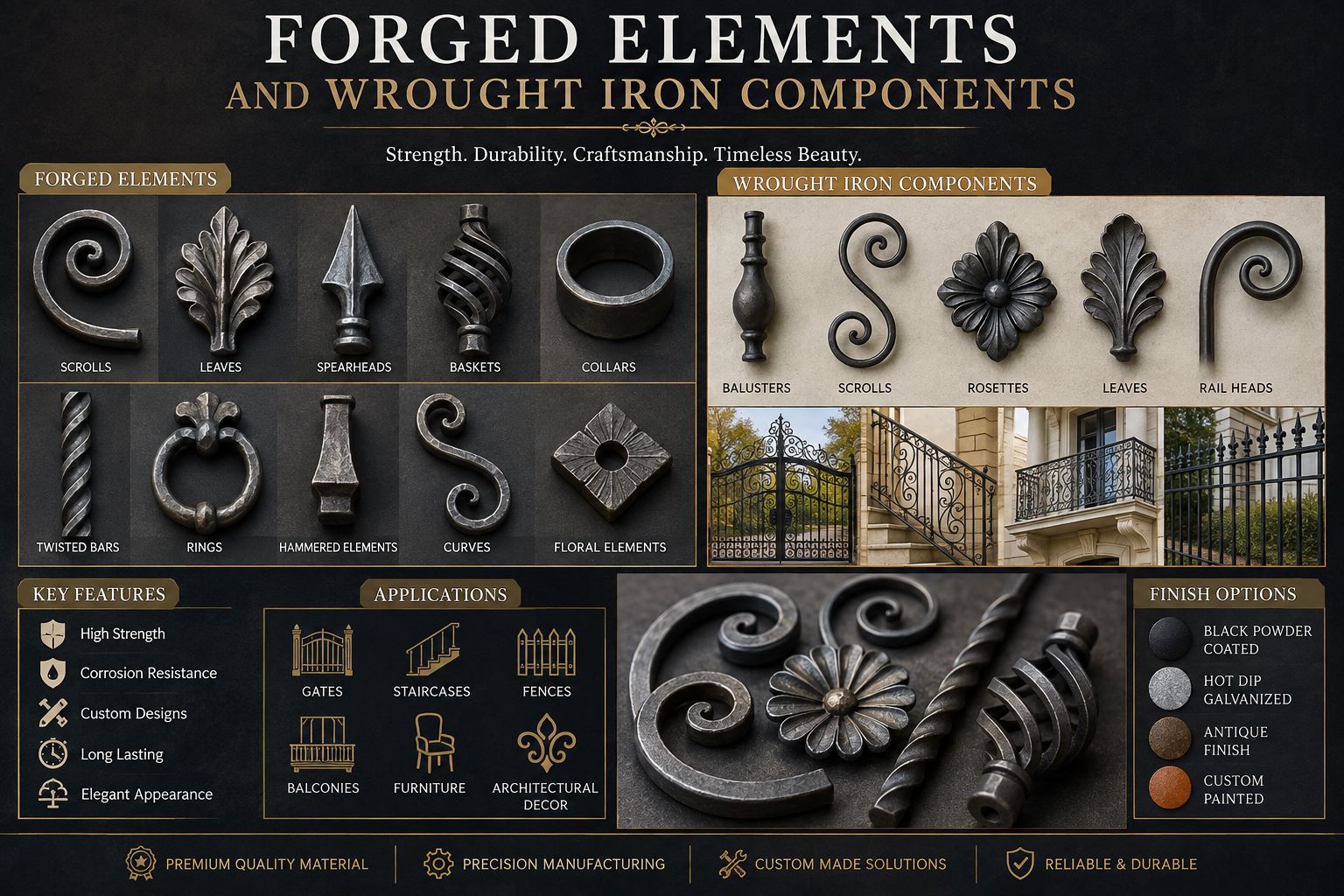
Through this process, manufacturers can produce:
- Curved scrolls
- Decorative leaves
- Flowers and rosettes
- Twisted bars
- Spearheads
- Rings and collars
- Forged baskets
- Tapered bars
- Hammered sections
- Decorative finials
The finished pieces can then become part of larger gates, railings, fences, or furniture.
Decorative Ironwork Tells a Design Story
One reason Wrought Iron Components remain popular is their ability to create a particular visual character.
A gate featuring detailed scrolls and floral motifs may create a classical appearance, while the same frame using geometric forged pieces can look significantly more modern.
This gives designers flexibility.
Classic Metalwork
Traditional designs frequently use symmetrical scroll patterns, leaves, flowers, twisted bars, and decorative spearheads.
Contemporary Metalwork
Modern designs may incorporate simpler forged curves, repeated geometric shapes, limited ornamentation, and clean spacing.
Transitional Designs
Some projects combine both approaches. A minimalist gate, for example, may contain one decorative forged centerpiece to create a subtle premium appearance.
There is no single correct style. Successful metalwork comes from choosing components that complement the architecture.
Small Components Can Change an Entire Gate
A decorative metal gate does not necessarily require dozens of ornamental pieces.
Sometimes a few carefully selected Forged Elements can dramatically change its appearance.
Imagine a plain gate consisting of vertical bars. Adding decorative rings between those bars immediately creates rhythm. Adding scrolls around the center introduces movement, while spearheads along the top create a stronger architectural profile.
The difference often comes from arrangement rather than quantity.
This is why experienced fabricators usually plan decorative patterns before welding components permanently into place.
Wrought Iron Components Around the Property
Although gates are one of the most visible applications, Wrought Iron Components can be used throughout residential and commercial properties.
Common applications include:
- Balcony railings
- Staircase balustrades
- Garden fencing
- Window grills
- Entrance gates
- Decorative screens
- Pergola details
- Furniture frames
- Boundary fencing
- Architectural partitions
Matching decorative patterns across several areas can also help create a consistent architectural identity.
For example, the same scroll design used on the main entrance gate may appear in smaller proportions on balcony railings.
Why Fabricators Use Ready-Made Forged Components
Handcrafting every decorative piece can be beautiful, but it can also require considerable time and specialist skills.
Ready-made Forged Elements allow fabrication workshops to work more efficiently while maintaining decorative variety.
The advantages can include:
- Reduced fabrication time
- Repeatable designs
- Consistent component dimensions
- Easier project estimation
- Less manual forming
- Faster assembly
- Greater design variety
- Easier replacement when required
For large fencing projects, repeated components can help maintain uniformity across long sections.
Design Balance Matters More Than Decoration
Adding more decorative elements does not automatically create a better design.
In fact, excessive ornamentation can make metalwork appear crowded.
The best use of Wrought Iron Components depends on proportion.
A large entrance gate may comfortably accommodate broad scrolls and large center ornaments. A narrow balcony railing may require smaller, simpler components.
Important design considerations include:
- Overall structure size
- Bar spacing
- Component thickness
- Pattern repetition
- Architectural style
- Viewing distance
- Available open space
- Safety requirements
A well-designed structure allows decorative metalwork to enhance rather than overpower the architecture.
Comparing Decorative and Plain Metal Fabrication
| Design Factor | Decorative Ironwork | Plain Fabrication |
| Appearance | Detailed and expressive | Simple and functional |
| Components | Scrolls, leaves, rings, finials | Bars, flats and frames |
| Customization | Extensive | Moderate |
| Style options | Classic to contemporary | Mainly modern or industrial |
| Visual identity | High | Minimal |
| Fabrication planning | Pattern focused | Structure focused |
Neither approach is universally better. The correct choice depends on the purpose and design expectations of the project.
Protection Is Essential for Outdoor Ironwork
Beautiful Forged Elements can quickly lose their appearance if the metal is not properly protected from corrosion.
Outdoor gates, railings, and fences face moisture, rain, dust, sunlight, and atmospheric pollution.
Protective treatments may include:
- Zinc-rich primers
- Anti-corrosion paints
- Powder coating
- Hot-dip galvanizing
- Zinc coatings
- Decorative finishing systems
Surface Preparation
Before applying a coating, surfaces should generally be cleaned properly.
Rust, oil, welding residue, and loose scale can interfere with coating adhesion.
Environmental Conditions
Properties near coastal or highly humid areas may require stronger corrosion protection than interior installations.
Maintenance
Periodic inspection is also useful. Small coating damage can be repaired before corrosion spreads across a larger area.
Choosing Components Before Fabrication Starts
Selection should ideally happen during the design stage rather than after the structure has already been fabricated.
Before ordering Wrought Iron Components, confirm:
- Required dimensions
- Material type
- Component quantity
- Pattern layout
- Frame thickness
- Welding requirements
- Surface finish
- Installation environment
For custom projects, detailed drawings or sample components can prevent misunderstandings.
Large orders may also benefit from sample approval before full production begins.
Quality Can Be Seen in the Details
A decorative component may look simple, but small manufacturing defects can become very noticeable after installation.
When evaluating Forged Elements, look for consistent curves, clean edges, proper symmetry, and similar dimensions across repeated pieces.
Poorly manufactured components may show:
- Distorted curves
- Uneven twisting
- Cracks
- Heavy surface scale
- Sharp unfinished edges
- Inconsistent dimensions
These problems can increase fabrication work and reduce the quality of the completed structure.
Custom Designs Open New Possibilities
Standard decorative components are suitable for many projects, but custom designs offer even greater creative freedom.
Manufacturers may produce custom pieces from technical drawings, CAD files, sketches, photographs, or physical samples.
Customized designs can include:
- Family initials
- Company logos
- Floral motifs
- Heritage reproductions
- Personalized monograms
- Special scroll patterns
- Architectural symbols
Custom Forged Elements are particularly useful when a project requires a distinctive visual identity.
Frequently Asked Questions
Are forged elements only decorative?
No. Many are decorative, but some also form part of functional metal assemblies.
Where are wrought iron components commonly installed?
They are commonly used in gates, railings, fences, grills, balconies, furniture, and decorative architectural structures.
Can forged elements be welded?
Many steel forged components can be welded using suitable fabrication procedures.
Are decorative components available in standard sizes?
Yes. Many suppliers provide standard sizes as well as custom manufacturing options.
Can wrought iron components be used for modern architecture?
Yes. Geometric and minimal components work well in contemporary designs.
Are forged components suitable for exterior projects?
Yes, provided suitable corrosion protection is applied.
What decorative shapes are commonly available?
Scrolls, leaves, rings, flowers, spearheads, baskets, collars, and finials are widely available.
Is mild steel commonly used for decorative ironwork?
Yes. Many modern decorative components use mild steel because it is practical for fabrication and welding.
Can custom forged designs be manufactured?
Yes. Manufacturers can create designs according to drawings, samples, or specifications.
What should be checked before bulk purchasing?
Check material, dimensions, surface quality, consistency, finish options, production capability, and sample quality.