Beauty packaging does far more than simply hold a product. A well-designed cream jar protects the formulation, improves user experience, supports brand positioning, and helps the product stand out on crowded retail shelves. Similarly, a cosmetic jar can influence how consumers perceive quality before they even try the formula inside.
From moisturizers and night creams to body butters, face masks, scrubs, balms, and hair treatments, jars remain one of the most widely used packaging formats in the cosmetics industry. Choosing the right material, size, closure, decoration, and protective features is therefore an important decision for beauty brands and manufacturers.
What Is a Cream Jar?
A cream jar is a container specifically designed for semi-solid cosmetic formulations such as moisturizers, anti-aging creams, eye creams, body creams, and facial treatments.
Unlike bottles designed for liquids, jars usually have a wide opening that makes thick formulations easy to access. Consumers can scoop the required quantity using their fingers or a cosmetic spatula.
Modern cream packaging is available in:
- Glass
- PET plastic
- PP plastic
- Acrylic
- SAN
- Double-wall plastic
- PCR recycled materials
- Bioplastic alternatives
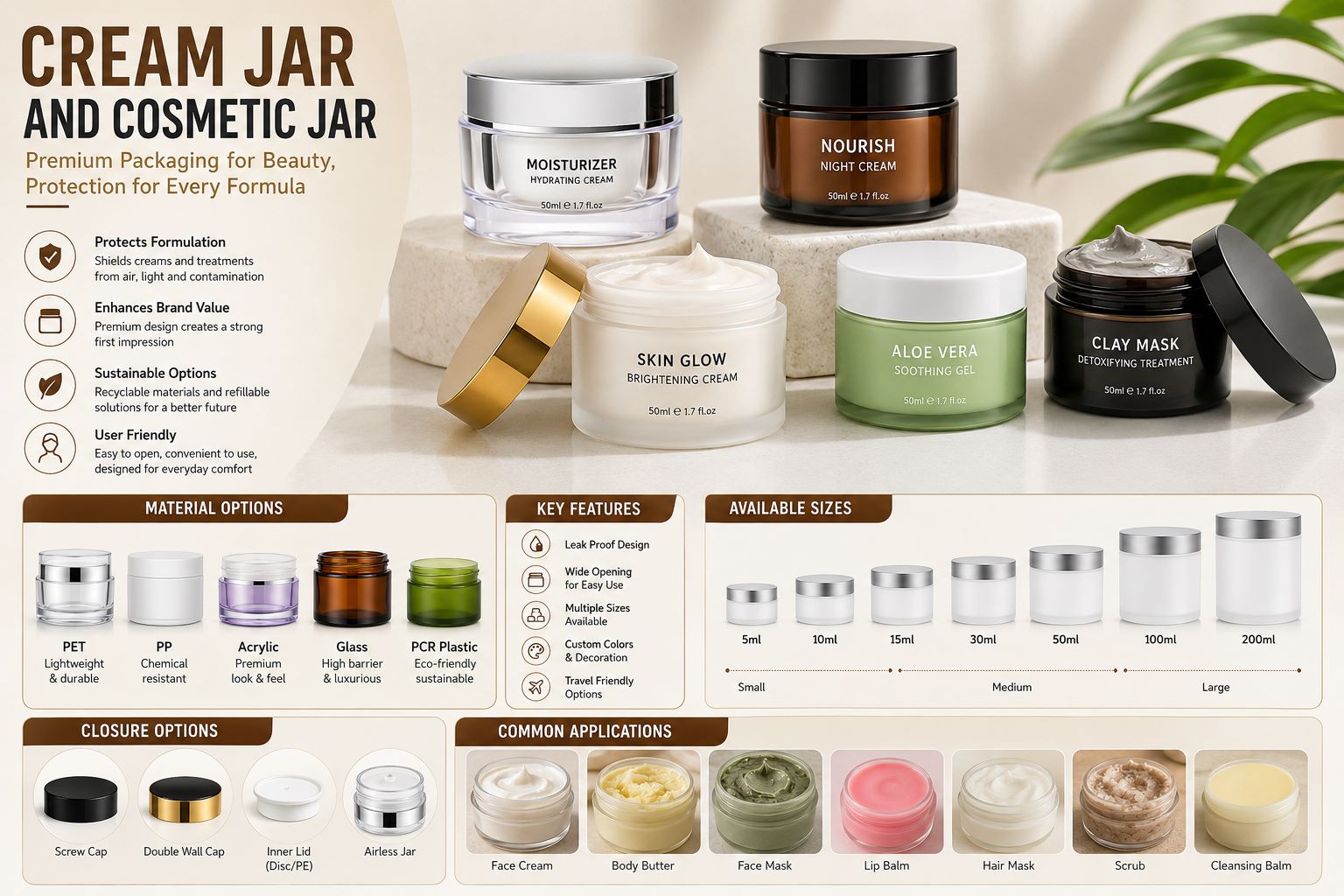
The correct material depends on formulation compatibility, product positioning, transportation requirements, sustainability targets, and budget.
Understanding Cosmetic Jar Packaging
A cosmetic jar is a broader packaging category suitable for different beauty and personal-care formulations.
Common products packaged inside cosmetic jars include:
- Face moisturizers
- Body butter
- Lip balm
- Hair masks
- Facial scrubs
- Clay masks
- Styling wax
- Herbal creams
- Sunscreen cream
- Cosmetic gels
Packaging manufacturers offer cosmetic jars in multiple shapes, capacities, finishes, and closure configurations.
Why Jar Packaging Remains Popular
Consumers appreciate jar packaging because it provides convenient access to thicker products.
Brands prefer it because the large external surface gives them considerable space for labels, printing, embossing, metallic finishes, and other decorative treatments.
Packaging Also Communicates Product Value
A heavy glass jar can create a premium impression, while lightweight plastic packaging may communicate convenience and portability.
Therefore, packaging selection should always support the brand’s target market and product positioning.
Cream Jar Materials and Their Advantages
Choosing the right cream jar packaging material can affect product safety, appearance, cost, and shipping efficiency.
| Material | Main Advantages | Common Applications |
| Glass | Premium appearance, strong barrier | Luxury creams, serums, masks |
| PET | Lightweight, transparent, recyclable | Creams, gels, scrubs |
| PP | Chemical resistance, durable | Moisturizers, body creams |
| Acrylic | Premium appearance and clarity | High-end skincare |
| Double-Wall Plastic | Luxurious look with low weight | Face and anti-aging creams |
| PCR Plastic | Supports sustainability goals | Eco-conscious cosmetics |
Glass continues to be associated with premium skincare, while plastic offers greater flexibility for mass-market products.
Important Features of a High-Quality Cosmetic Jar
Not every cosmetic jar offers the same level of performance.
A reliable jar should provide several essential characteristics.
Strong Product Compatibility
Packaging materials must not negatively react with ingredients such as essential oils, active compounds, fragrances, or preservatives.
Testing packaging compatibility before commercial production is highly recommended.
Effective Closure System
Caps and closures should fit properly to minimize leakage and contamination.
Common options include:
- Screw caps
- Disc-top closures
- Inner lids
- Protective liners
- Sealing discs
Inner Protection Matters
Many cosmetic jars include an inner disc beneath the main cap.
This component helps reduce accidental leakage and provides additional protection during shipping and handling.
Choosing the Correct Jar Capacity
The ideal capacity depends on the type of formulation and its intended usage period.
Popular sizes include:
- 5 ml for samples
- 10–15 ml for eye cream
- 30 ml for premium facial treatments
- 50 ml for moisturizers
- 100 ml for masks and creams
- 200–500 ml for body and hair products
A 50 ml cream jar is particularly common in facial skincare because it provides sufficient product while remaining compact and premium-looking.
Design and Decoration Options
Packaging appearance plays an important role in beauty marketing.
Manufacturers can customize cosmetic jar packaging using techniques such as:
- Screen printing
- Hot foil stamping
- Frosted finishing
- UV coating
- Spray coloring
- Metallization
- Embossing
- Label application
- Digital printing
Minimal packaging has become particularly popular among premium skincare brands.
Clear typography, subtle colors, matte surfaces, and simple logos can create a sophisticated appearance without excessive decoration.
Cream Jar vs Cosmetic Jar
Although these terms are sometimes used interchangeably, their applications can differ.
| Feature | Cream Jar | Cosmetic Jar |
| Primary Use | Cream-based formulations | Multiple cosmetic formulations |
| Typical Opening | Wide | Wide |
| Common Sizes | 15–100 ml | 5–500 ml+ |
| Materials | Glass, PP, PET, acrylic | Glass, plastic, acrylic |
| Products | Face cream, moisturizer | Balm, scrub, mask, gel, cream |
| Market | Mainly skincare | Skincare, haircare, cosmetics |
A cream jar is therefore a specific type of cosmetic packaging, while cosmetic jars cover a much wider range of beauty applications.
Sustainability in Cosmetic Jar Manufacturing
Environmental responsibility is becoming increasingly important across the beauty industry.
Brands are exploring packaging solutions that reduce unnecessary material consumption.
Popular approaches include:
- Using PCR plastic.
- Reducing packaging weight.
- Creating refillable jars.
- Selecting recyclable mono-material packaging.
- Minimizing unnecessary secondary packaging.
Refillable cosmetic jars are particularly attractive for premium brands because consumers can retain the outer container while replacing only the internal product cartridge.
This approach can combine luxury positioning with material reduction.
What Beauty Brands Should Check Before Purchasing Jars
Packaging should never be selected based purely on appearance.
Businesses should evaluate:
- Material compatibility
- Closure quality
- Leakage resistance
- Jar capacity
- Decoration possibilities
- Minimum order quantity
- Production lead time
- Shipping durability
- Regulatory requirements
- Recycling potential
Sample testing is especially important before placing a large production order.
FAQ About Cream Jar and Cosmetic Jar Packaging
1. What is a cream jar used for?
A cream jar is commonly used for facial moisturizers, body creams, anti-aging formulas, eye treatments, masks, and similar semi-solid cosmetic products.
2. Which material is best for cosmetic jars?
There is no universal best material. Glass works well for premium products, while PET and PP provide lightweight and cost-effective solutions.
3. Are glass cosmetic jars recyclable?
Many glass jars are recyclable, although consumers should check local recycling requirements and separate components made from different materials.
4. What is the most common cream jar size?
A 50 ml jar is widely used for facial moisturizers and skincare creams.
5. Can cosmetic jars be customized?
Yes. Brands can customize jar shape, color, printing, labels, caps, surface finishes, and decorative effects.
6. Are plastic cosmetic jars safe?
Cosmetic-grade plastic jars can be suitable when the packaging material has been properly tested for compatibility with the formulation.
7. Why do cream jars have inner lids?
Inner lids provide additional protection against leakage, contamination, and accidental product contact with the outer cap.
8. Can cosmetic jars be used for hair products?
Yes. Larger jars are frequently used for hair masks, conditioners, styling creams, waxes, and treatment products.
9. What are double-wall cosmetic jars?
Double-wall jars contain an inner product container surrounded by an external shell, creating a more substantial and premium appearance.
10. How should brands choose a cosmetic jar supplier?
Evaluate manufacturing quality, material options, customization capabilities, certifications, minimum order quantities, lead times, and sample availability.