
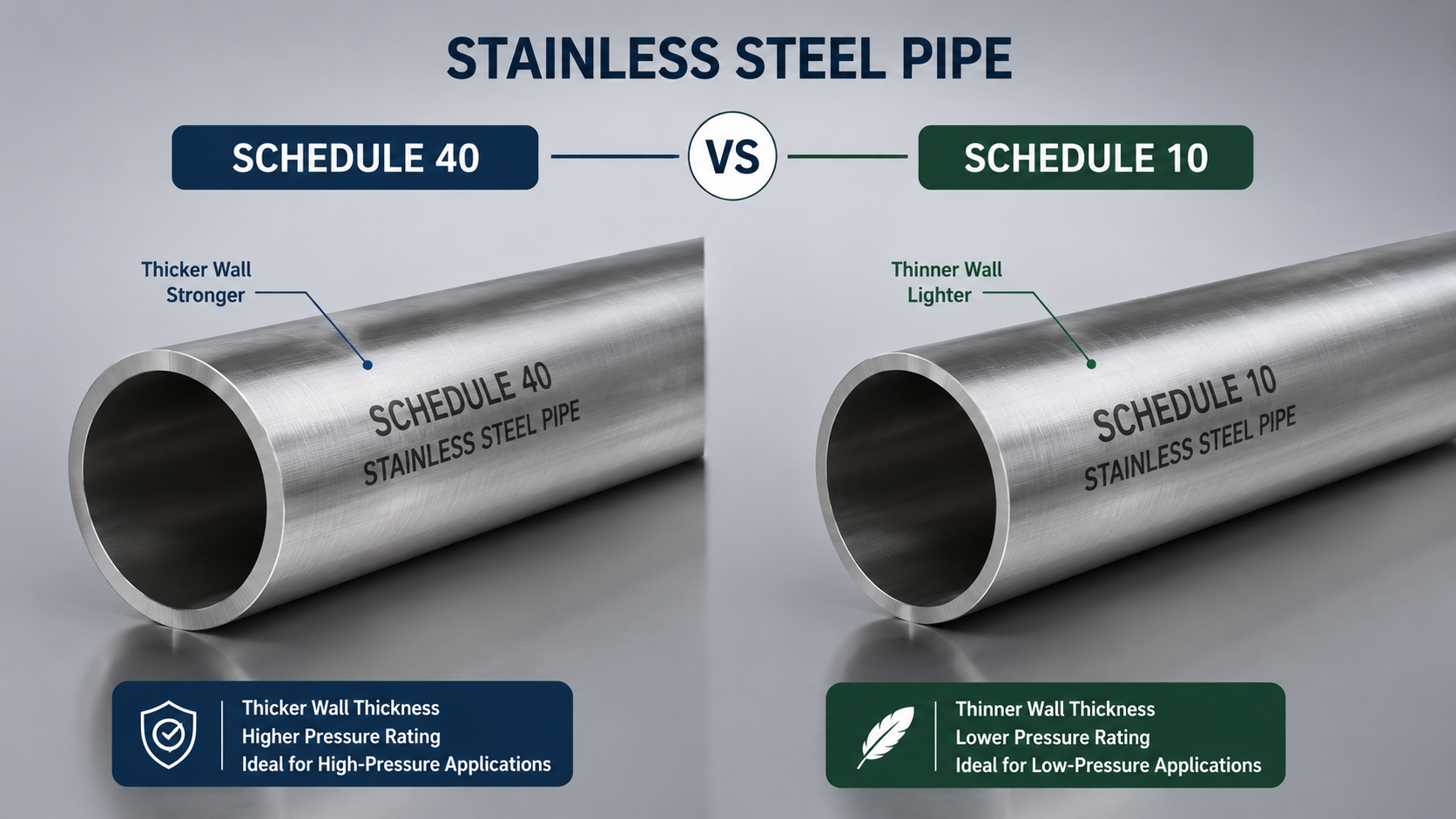
Industrial buyers and engineering teams are paying closer attention to pipe wall thickness as stainless steel continues to play a major role in modern processing, construction, water, food, pharmaceutical, and manufacturing projects. Two specifications frequently reviewed during purchasing are Stainless Steel Pipe Schedule 40 and Schedule 10 Stainless Steel Pipe.
Although the two products can look almost identical from the outside, their internal dimensions, wall thickness, weight, strength, and application suitability differ. These differences can influence everything from project cost and transportation requirements to flow performance and long-term system reliability.
The growing focus on efficient material selection has made understanding pipe schedules increasingly important for contractors, fabricators, engineers, and procurement professionals.
Pipe Schedule Decisions Move Beyond Simple Wall Thickness
A pipe schedule is a dimensional classification primarily associated with pipe wall thickness. It does not represent one universal thickness for every pipe diameter.
For a particular nominal pipe size, a higher schedule generally means a thicker wall. Consequently, Stainless Steel Pipe Schedule 40 normally contains more material than Schedule 10 of the same nominal diameter.
However, engineers must refer to the applicable dimensional specifications before finalizing material because actual thickness varies with pipe size.
Some commonly specified stainless steel pipe schedules include:
- Schedule 5S
- Schedule 10S
- Schedule 40S
- Schedule 80S
- Schedule 160
The selection depends on how and where the pipeline will operate.
Schedule 10 Stainless Steel Pipe Supports Lightweight Projects
Schedule 10 Stainless Steel Pipe is commonly considered where lower pipe weight and efficient material usage are important.
Its thinner wall makes individual pipe lengths easier to move, lift, support, and install. This can be particularly valuable in projects involving extensive piping networks or installations at elevated locations.
Applications may include:
- Water distribution
- Food processing lines
- Beverage production
- Pharmaceutical systems
- Drainage installations
- Architectural piping
- Utility networks
- Certain low-pressure process systems
The lower wall thickness can reduce material consumption, but the pipe must still meet the required design pressure and mechanical conditions.
Schedule 40 Continues to Serve More Demanding Installations
While lighter piping offers economic benefits, many industrial applications require additional wall thickness.
Stainless Steel Pipe Schedule 40 is widely used when increased mechanical strength, durability, and resistance to physical loading are needed.
Industries using Schedule 40 may include chemical processing, power production, industrial manufacturing, petrochemical operations, water treatment, and process engineering.
Its greater wall thickness can be beneficial in pipelines exposed to:
- Higher operating demands
- Mechanical impact
- Vibration
- External loading
- Tough industrial environments
- More demanding fabrication conditions
Schedule 40 should still be evaluated according to the actual design code rather than selected only because it is thicker.
New Projects Increasingly Compare Weight Against Strength
A major consideration in modern piping design is finding the correct balance between sufficient strength and unnecessary material use.
The differences can be summarized as follows:
| Specification | Schedule 10 | Schedule 40 |
| Wall construction | Thinner | Thicker |
| Weight per length | Lower | Higher |
| Material requirement | Reduced | Increased |
| Inside diameter | Generally larger | Generally smaller |
| Mechanical resistance | Moderate | Greater |
| Pressure capability | Generally lower | Generally higher |
| Handling requirements | Easier | Heavier |
| Typical project cost | Often lower | Often higher |
This comparison explains why project specifications should be developed according to actual operating conditions.
Using excessive wall thickness can increase material, shipping, welding, and structural support costs. Selecting insufficient thickness can create reliability and safety concerns.
Internal Diameter Emerges as an Important Flow Factor
Wall thickness also affects the available space inside the pipe.
When two pipes have the same nominal size and outside diameter, Schedule 10 Stainless Steel Pipe normally provides a larger inside diameter because its wall is thinner.
A larger internal passage may contribute to improved flow characteristics in certain systems.
Potential advantages can include:
- Increased flow area
- Reduced resistance
- Lower friction losses
- Potentially improved pumping efficiency
However, engineers must consider total pipeline length, fittings, fluid properties, velocity, elevation, and pump performance before determining the final pipe size.
The schedule should therefore form part of a complete hydraulic or process design.
Material Grade Remains Critical for Long-Term Service
Selecting the correct schedule does not guarantee corrosion resistance.
The stainless steel grade also plays a critical role.
304 stainless steel is commonly used in general industrial and commercial applications because it offers a useful balance of corrosion resistance, fabrication performance, and availability.
316 stainless steel includes molybdenum and provides improved resistance in many aggressive or chloride-containing conditions.
Low-carbon versions such as 304L and 316L are frequently selected for welded applications.
Both Stainless Steel Pipe Schedule 40 and Schedule 10 may be available in these grades, depending on manufacturing specifications and supplier availability.
Pressure Requirements Require Engineering Verification
Pressure capability remains one of the most important factors when comparing the two schedules.
A thicker pipe can generally handle greater mechanical stresses, but wall thickness is only one part of the calculation.
Design teams also evaluate:
- Nominal diameter
- Actual wall thickness
- Material strength
- Operating temperature
- Design pressure
- Weld efficiency
- Corrosion allowance
- Manufacturing tolerances
- Relevant piping code
- Expected service conditions
Therefore, a Schedule 40 designation should never be treated as a universal pressure rating.
Actual allowable pressure must be determined using recognized engineering standards and project-specific calculations.
Installation Costs Are Becoming Part of Schedule Selection
Material price is only one component of total piping expenditure.
A heavier Stainless Steel Pipe Schedule 40 system can require additional transportation capacity, lifting equipment, structural supports, and installation labor.
By comparison, Schedule 10 Stainless Steel Pipe can reduce weight across a large project.
This may help lower:
- Shipping requirements
- On-site handling effort
- Support loads
- Installation time
- Material consumption
However, cost savings should never override design requirements.
The most economical piping system is one that achieves the required performance without unnecessary material.
Stainless Steel Pipes Continue Expanding Across Key Industries
Stainless steel remains widely specified because of its corrosion resistance, hygienic surface, durability, appearance, and compatibility with numerous industrial fluids.
Major application sectors include:
- Chemical manufacturing
- Food and beverage production
- Pharmaceuticals
- Oil and gas processing
- Water treatment
- Power generation
- Marine projects
- Building services
- Pulp and paper
- General manufacturing
Different sections of the same industrial facility may even require different pipe schedules based on pressure and service conditions.
Buyers Increase Focus on Certification and Traceability
Procurement professionals are increasingly checking technical documentation before accepting stainless steel pipe.
Important purchasing information can include:
- Material grade
- Heat number
- Nominal size
- Schedule designation
- Actual dimensions
- Manufacturing specification
- Welded or seamless construction
- Testing requirements
- Surface condition
- Material test certificate
Verifying these details helps ensure that supplied piping matches the approved project specification.
Frequently Asked Questions
1. Why is Schedule 10 thinner than Schedule 40?
The schedule designation represents different standardized wall thickness categories, with Schedule 10 generally having less wall thickness.
2. Is Schedule 10 stainless steel pipe lightweight?
Yes. Its thinner wall generally makes it lighter than Schedule 40 of the same nominal size.
3. Why is Schedule 40 widely used industrially?
Its increased wall thickness provides greater mechanical strength for many demanding installations.
4. Can Schedule 10 provide good corrosion resistance?
Yes. Corrosion resistance mainly depends on the stainless steel grade and operating environment.
5. Does Schedule 40 reduce the inside diameter?
Yes. A thicker wall generally produces a smaller internal diameter when the outside diameter remains the same.
6. Is Schedule 10 suitable for food processing?
It can be used where the selected grade, finish, pressure capability, and hygienic requirements meet the application specification.
7. Are both schedules available in 304 stainless steel?
They are commonly available in 304 and other stainless steel grades, depending on size and supplier.
8. Can 316 stainless steel be supplied in both schedules?
Yes, many suppliers offer Schedule 10 and Schedule 40 pipes in 316 or 316L.
9. Which schedule uses more stainless steel?
Schedule 40 generally uses more material because of its thicker wall.
10. What should be checked before purchasing stainless steel pipe?
Buyers should verify size, schedule, grade, pressure requirements, temperature, manufacturing standard, testing, and certification.