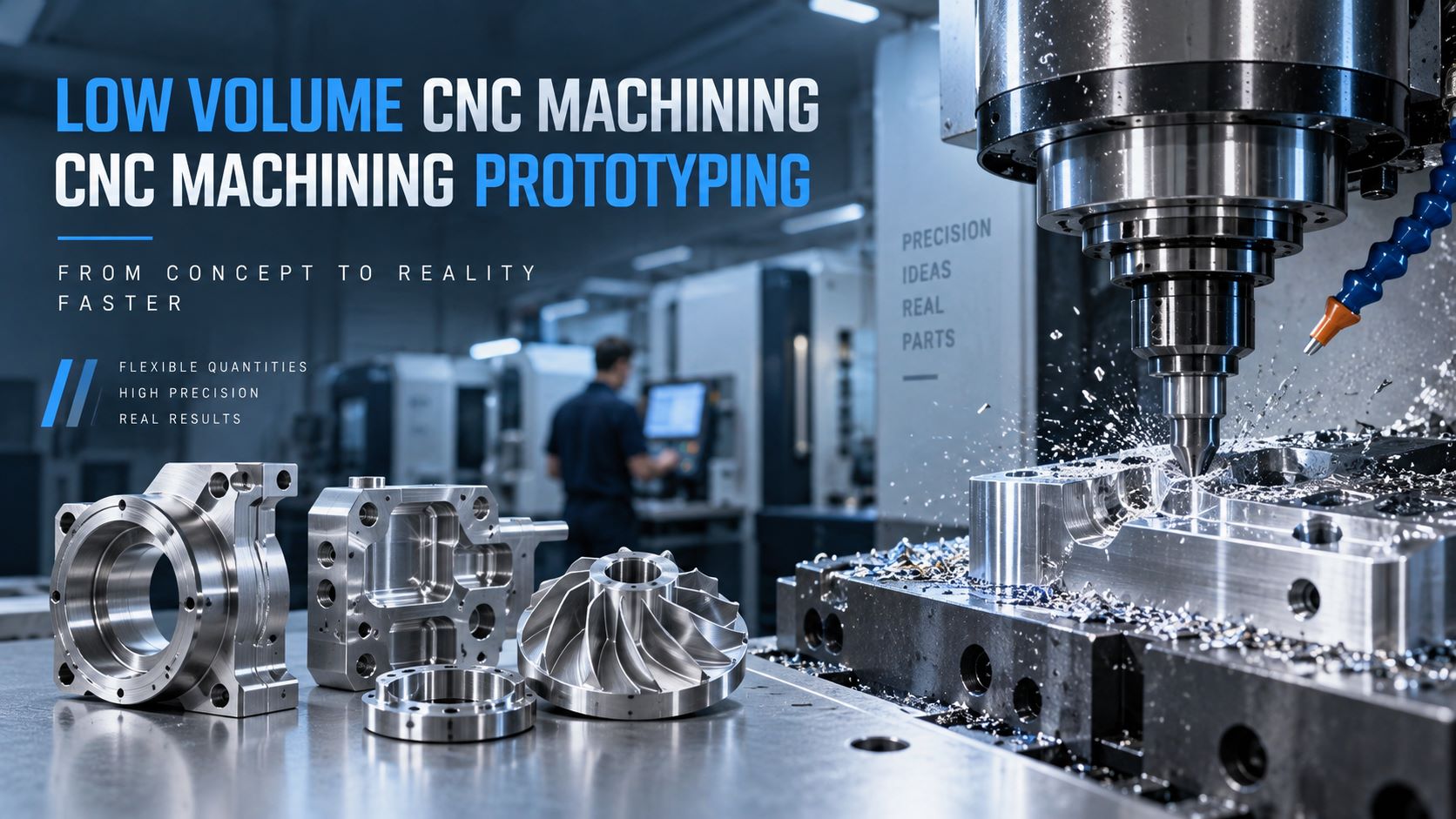
Manufacturing no longer means producing thousands of identical parts before a product reaches the market. Modern companies increasingly prefer flexible production strategies that allow them to test designs, manufacture limited quantities, and improve products before investing heavily in mass production.
This is where low volume CNC machining and CNC machining prototyping provide significant advantages. These manufacturing methods allow engineers and product developers to transform digital designs into accurate physical components using production-grade metals and plastics.
From early engineering validation to bridge production, CNC machining offers a practical route between initial product development and full-scale manufacturing.
Why Modern Manufacturers Prefer Flexible CNC Production
Traditional manufacturing methods such as injection molding, die casting, and specialized tooling can be highly efficient for large volumes. However, they often require significant upfront investment.
For companies producing smaller quantities, these costs may not make financial sense.
Low volume CNC machining offers a flexible alternative because manufacturers can produce precise parts directly from CAD models without creating expensive dedicated molds.
Businesses commonly choose this approach when they need:
- Pilot production batches
- Custom industrial components
- Replacement machine parts
- Limited-edition products
- Engineering test components
- Pre-production assemblies
- Market validation units
- Specialized equipment parts
Manufacturers can also modify digital files between production runs, making design improvements much easier.
Understanding CNC Machining Prototyping
CNC machining prototyping involves manufacturing physical prototypes by removing material from a solid block using computer-controlled cutting equipment.
Unlike purely visual prototypes, CNC-machined components can often be tested under actual operating conditions.
A prototype manufactured from aluminum, stainless steel, engineering plastic, or another production material can help engineers understand how the final component may perform.
How CNC Prototypes Improve Product Development
One of the most important purposes of a prototype is discovering design problems before production.
A digital model may appear perfect on a computer screen while still having problems related to assembly, tolerance, strength, or manufacturability.
Through CNC machining prototyping, product development teams can evaluate important factors such as:
- Component dimensions
- Assembly compatibility
- Material performance
- Mechanical strength
- Hole and thread accuracy
- Surface quality
- Structural stability
- Functional performance
Testing these characteristics early can reduce expensive modifications later.
Moving from Prototype to Low Volume Manufacturing
Once engineers validate a prototype, the next challenge is often producing a limited number of components.
Mass production may still be unnecessary because market demand has not yet been established.
Low volume CNC machining provides a bridge between prototype development and large-scale production.
For example, a manufacturer may initially produce five prototypes for testing. After design approval, the company might order 100 or 500 units for field testing or early customers.
If demand grows, production can later move toward larger manufacturing processes.
CNC Machining Compared with Traditional Tooling
| Manufacturing Factor | CNC Short-Run Production | Traditional Mass Production |
| Tooling investment | Relatively low | Usually high |
| Design modification | Flexible | More difficult |
| Production quantity | Small to medium | High volume |
| Material options | Extensive | Process dependent |
| Setup flexibility | High | Lower |
| Inventory requirement | Lower | Often higher |
| Market testing | Well suited | Less economical |
Neither approach is universally better. The right choice depends on production quantity, component geometry, material, tolerance, and long-term demand.
Materials Commonly Used in CNC Machining
Another major benefit of CNC machining prototyping is access to engineering-grade materials.
Popular metals include:
- Aluminum
- Stainless steel
- Mild steel
- Brass
- Copper
- Titanium
Engineering plastics can include ABS, POM, nylon, acrylic, polycarbonate, PTFE, and PEEK.
Selecting the right material depends on mechanical requirements, weight, temperature, corrosion resistance, electrical properties, and cost.
Designing CNC Parts for Better Manufacturability
Good CNC machining begins before material reaches the machine.
Engineers should consider manufacturing limitations while designing components.
Use Practical Tolerances
Extremely tight tolerances increase machining and inspection requirements. Critical areas should receive precise tolerances, while non-critical features can use standard manufacturing tolerances.
Avoid Unnecessary Complexity
Complicated internal cavities, extremely deep pockets, and difficult-to-access surfaces may require additional setups or specialized equipment.
Maintain Suitable Wall Thickness
Very thin walls may vibrate or deform during machining. Choosing practical wall thickness improves dimensional stability and machining reliability.
Industries Benefiting from Short-Run CNC Production
Many technology-driven industries use low volume CNC machining because product requirements frequently change.
Applications can be found in:
- Aerospace engineering
- Automotive development
- Medical equipment
- Robotics
- Industrial automation
- Electronics
- Renewable energy
- Research equipment
- Telecommunications
- Consumer product development
For these industries, manufacturing flexibility can be almost as important as production speed.
How to Select a CNC Machining Supplier
The lowest quotation should not automatically determine the best manufacturing partner.
An experienced supplier should understand materials, tolerances, tool access, dimensional inspection, and design-for-manufacturing principles.
Before placing an order, evaluate:
- CNC equipment capabilities
- Available materials
- Quality control processes
- Inspection equipment
- Finishing options
- Engineering support
- Production capacity
- Communication quality
Manufacturers working on demanding components should also discuss material certification, dimensional reports, traceability, and first-article inspection.
Frequently Asked Questions
1. What does low volume CNC machining mean?
Low volume CNC machining generally refers to manufacturing relatively small quantities of CNC parts rather than thousands or millions of identical components.
2. Why use CNC machining for prototypes?
CNC machining produces highly accurate prototypes using materials that may also be used in final production.
3. Can CNC prototypes be functionally tested?
Yes. CNC machining prototyping is often selected specifically because components can undergo mechanical, assembly, thermal, and performance testing.
4. What quantities are suitable for low volume production?
Quantities can range from several pieces to hundreds or sometimes thousands, depending on part complexity and manufacturing economics.
5. Is aluminum suitable for CNC prototypes?
Yes. Aluminum is widely used because it offers good machinability, strength, low weight, and multiple finishing possibilities.
6. Can CNC machining handle complex parts?
Yes. Multi-axis CNC machines can manufacture complex geometries, although part design strongly affects machining difficulty and cost.
7. What affects CNC machining prices?
Major factors include material, machining time, complexity, tolerance, quantity, surface finish, inspection, and setup requirements.
8. Can designs be changed after the first batch?
Yes. One advantage of low volume CNC machining is that CAD and CAM data can often be updated without creating entirely new tooling.
9. What surface finishes are available?
Options may include anodizing, polishing, plating, painting, powder coating, bead blasting, passivation, and laser engraving.
10. What information is required for a CNC quote?
Manufacturers normally require a 3D CAD model, quantity, material, tolerance information, finishing specifications, and sometimes a 2D engineering drawing.