Modern sheet metal manufacturing depends on accuracy, repeatability, flexibility, and efficient production. Whether a workshop manufactures HVAC components, electrical enclosures, automotive parts, tanks, cabinets, or custom metal assemblies, selecting the correct forming equipment can directly affect product quality and operating costs.
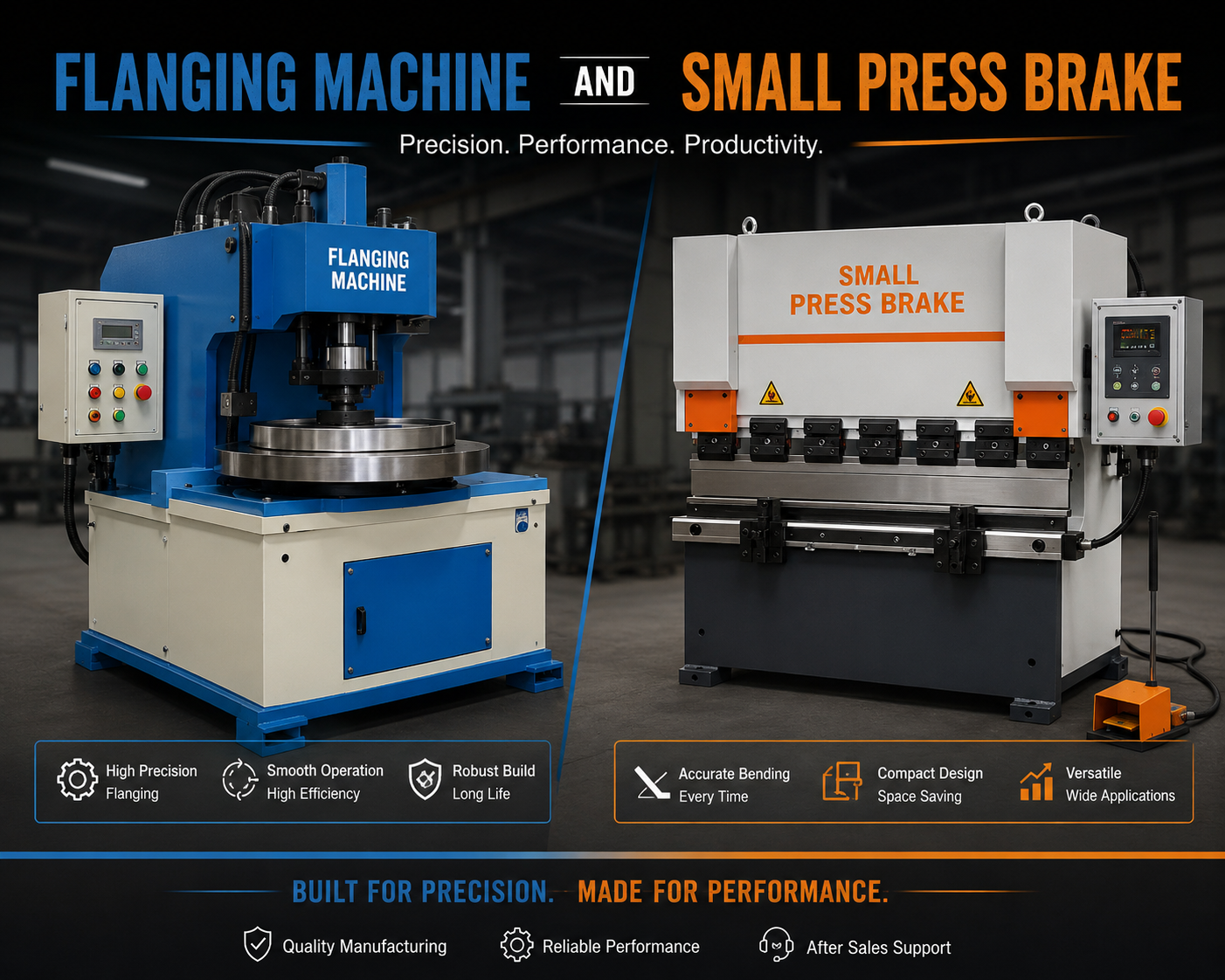
Two highly useful machines in this field are the flanging machine and small press brake. Although they perform different forming operations, both help manufacturers create accurate bends, edges, and profiles while reducing dependence on manual fabrication.
Understanding how these machines work, where they are used, and what specifications matter can help fabrication businesses make better equipment investments.
What Is a Flanging Machine?
A flanging machine is designed to form flanges or raised edges on sheet metal components. A flange may be created along a straight edge, circular part, pipe end, or shaped workpiece depending on the machine configuration.
Flanges improve structural strength and can also create suitable surfaces for welding, fastening, joining, sealing, or assembling components.
Common applications include:
- Pressure vessels and storage tanks
- Ventilation and HVAC components
- Automotive sheet metal parts
- Industrial ducts
- Stainless steel vessels
- Pipe fabrication
- Food-processing equipment
- Metal containers and covers
Modern flanging equipment may use hydraulic, mechanical, or CNC-controlled systems to maintain consistent forming pressure.
How Does a Flanging Machine Work?
The basic operation involves positioning a sheet metal component between specially designed forming tools or rollers. Controlled pressure gradually shapes the material into the required flange.
Material Positioning
The operator places the metal component securely into the working area. Correct alignment is important because poor positioning can create uneven flange dimensions.
Controlled Forming
Rollers, dies, or forming tools apply pressure to the metal. Depending on the machine design, the workpiece or forming head may rotate during the process.
Final Profile Formation
The machine continues forming until the desired flange angle, radius, and height are achieved.
Why Controlled Forming Matters
Gradual forming distributes stress more evenly across the material. This can reduce cracking, deformation, and unnecessary material damage while improving dimensional consistency.
What Is a Small Press Brake?
A small press brake is a compact metal-bending machine designed to create precise bends in sheet metal.
Unlike larger industrial press brakes intended for extremely long or heavy components, compact machines are particularly suitable for workshops producing small and medium-sized parts.
Typical products include:
- Electrical boxes
- Metal brackets
- Machine covers
- Control panels
- Stainless steel components
- Furniture fittings
- Custom fabrication parts
- Prototype components
A small press brake offers an effective balance between bending capability, workshop space requirements, and production flexibility.
How a Small Press Brake Improves Fabrication
A press brake uses a punch and die combination to bend sheet metal. The workpiece is positioned over the die, while the punch moves downward and applies controlled force.
Modern machines may include digital controls, hydraulic systems, servo drives, back gauges, and CNC programming.
These technologies allow operators to control parameters such as:
- Bending angle
- Stroke depth
- Back-gauge position
- Material thickness
- Bending sequence
Accurate control becomes especially important when producing repeated components where every part needs nearly identical dimensions.
Flanging Machine vs Small Press Brake
Although both machines form sheet metal, their applications are different.
| Feature | Flanging Machine | Small Press Brake |
| Primary operation | Creating flanges | Creating bends |
| Typical components | Tanks, ducts, vessels | Brackets, panels, boxes |
| Forming method | Rolling or specialised forming | Punch and die bending |
| Suitable geometry | Straight or circular edges | Primarily straight bends |
| Production benefit | Consistent flange profiles | Accurate bending angles |
| Common users | Vessel and duct manufacturers | General fabrication workshops |
Manufacturers may use both machines within the same production facility because their capabilities complement each other.
Important Benefits of Flanging Machines
A quality flanging machine can improve manufacturing efficiency in several ways.
Consistent Flange Dimensions
Machine-controlled forming helps maintain uniform flange height, radius, and angle throughout production.
Reduced Manual Labour
Traditional flange forming can involve significant manual work. Mechanised equipment can reduce operator effort and increase production consistency.
Improved Joint Preparation
Accurate flanges provide cleaner surfaces for welding, bolting, sealing, or mechanical assembly.
Better Production Efficiency
Repeatable machine settings help manufacturers process multiple components with fewer dimensional variations.
Advantages of Using a Small Press Brake
A small press brake is particularly useful for manufacturers that require versatility without installing oversized equipment.
Important advantages include:
- Compact workshop footprint
- Accurate bending
- Lower handling requirements
- Suitable operation for short production runs
- Fast tooling changes
- Efficient prototype production
- Flexible manufacturing capability
Compact CNC press brakes can further improve productivity because frequently manufactured components can be programmed and reproduced accurately.
Choosing the Right Flanging Machine
Before purchasing equipment, evaluate the type of products you manufacture.
Important factors include material type, sheet thickness, workpiece diameter, required flange height, production quantity, automation level, machine power, and available workspace.
A company forming large stainless steel vessel heads will require very different equipment from a workshop producing lightweight ventilation components.
Selecting the Right Small Press Brake
Press brake capacity should also match real production requirements.
Consider:
- Maximum bending length
- Machine tonnage
- Material thickness
- Controller type
- Back-gauge accuracy
- Tooling availability
- Safety features
- Maintenance accessibility
Selecting equipment only according to price can create long-term limitations. Production requirements, machine reliability, technical support, and tooling compatibility should also influence the decision.
Automation and CNC Technology in Metal Forming
Automation is increasingly important within sheet metal fabrication.
CNC technology enables operators to store programs, control forming positions, repeat bending sequences, and reduce setup variations.
For a small press brake, CNC control can significantly simplify multi-bend components.
Advanced flanging equipment may similarly use automated positioning and forming controls to maintain repeatable dimensions.
However, automation does not eliminate the importance of skilled operators. Correct tooling selection, material knowledge, machine setup, and quality inspection remain essential.
Applications Across Different Industries
Both machines support numerous manufacturing sectors.
A flanging machine is particularly valuable in tank fabrication, HVAC production, pressure vessel manufacturing, automotive processing, and stainless steel equipment production.
A small press brake is widely used within electrical equipment manufacturing, machinery fabrication, construction products, metal furniture, automotive components, and general engineering workshops.
Their versatility makes them valuable equipment for businesses seeking both customised and repeatable production.
Frequently Asked Questions
1. What is the main purpose of a flanging machine?
It creates controlled flanges on sheet metal components for strengthening, welding, fastening, or assembly.
2. Can flanging machines process stainless steel?
Yes. Suitable machines can process stainless steel when their capacity and tooling match the material thickness and grade.
3. What does a small press brake do?
It bends sheet metal into predetermined angles and profiles using a punch-and-die system.
4. Is a small press brake suitable for small workshops?
Yes. Its compact footprint makes it particularly suitable for workshops with limited production space.
5. Can a press brake produce repeated parts?
Yes. CNC and digital control systems can improve repeatability significantly.
6. Are flanging and bending the same process?
No. Bending changes the general angle of a workpiece, while flanging specifically forms an edge or rim.
7. Which industries commonly require flanging equipment?
Tank manufacturing, HVAC, automotive, pressure vessel, ducting, and metal-processing industries commonly use it.
8. How do I calculate the required press brake capacity?
Required tonnage depends on material strength, thickness, bending length, die opening, and bending method.
9. Does CNC technology improve press brake productivity?
Yes. CNC systems can reduce setup time, control bending sequences, and improve repeatability.
10. What should buyers check before purchasing metal-forming equipment?
Buyers should evaluate capacity, accuracy, tooling, safety, automation, maintenance requirements, technical service, and future production needs.