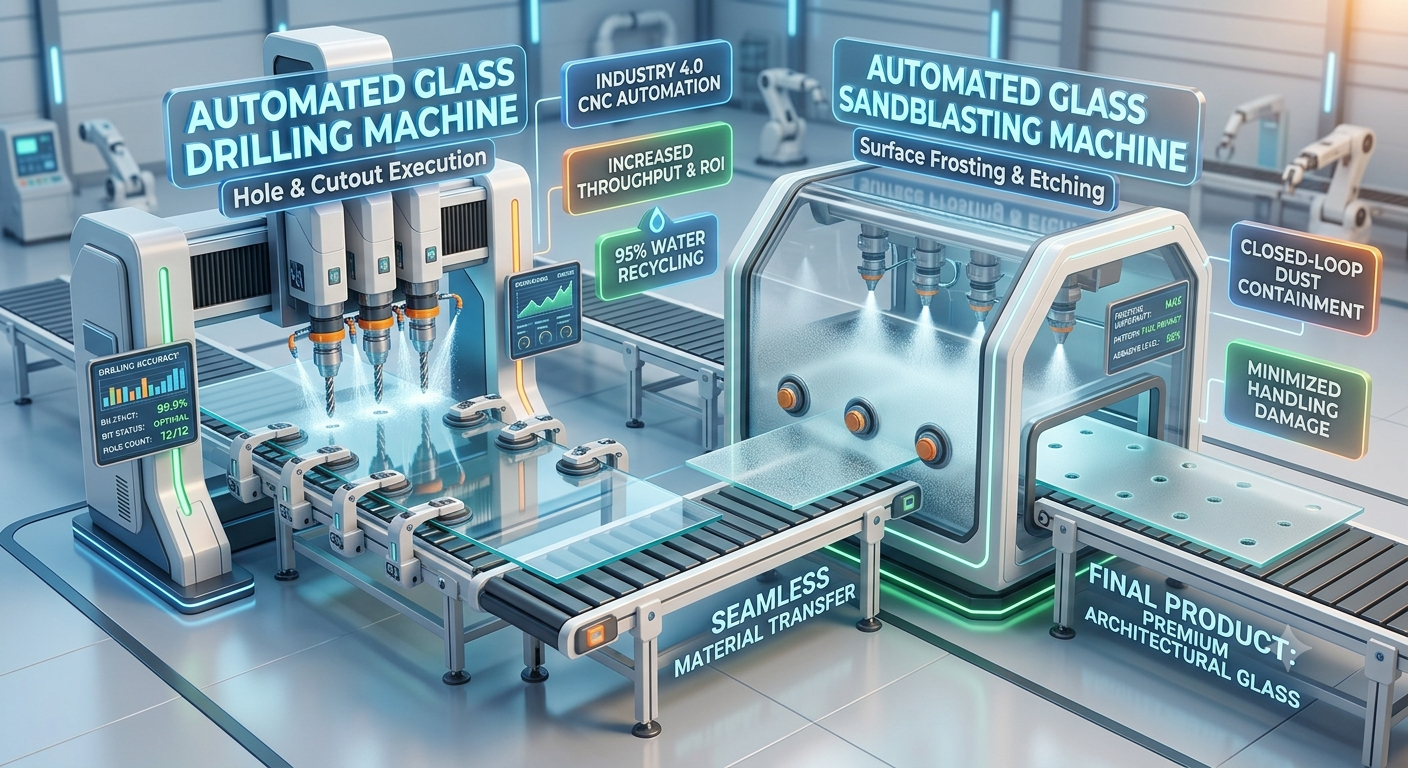
Modern glass fabrication demands more than basic cutting and polishing. Architectural, furniture, interior, appliance, and decorative glass projects increasingly require customised finishes, precise holes, attractive patterns, and repeatable quality. Two important solutions are the Glass Sandblasting Machine and Glass Drilling Machine. Together, they help processors create functional and visually distinctive products while improving production control.
Why Advanced Glass Processing Equipment Matters
Modern glass applications demand accuracy, consistency, safety, and design flexibility. Manual processing may suit small jobs but becomes less practical as production increases. A Glass Sandblasting Machine creates frosted, matte, patterned, or decorative surfaces, while a Glass Drilling Machine produces accurate holes for fittings, handles, hinges, and architectural hardware. Dedicated equipment can reduce rework and improve consistency.
Understanding the Glass Sandblasting Machine
A Glass Sandblasting Machine uses abrasive media propelled at controlled pressure against the glass surface. This process removes the glossy appearance from selected areas and creates an etched or frosted effect.
Operators can process complete panels or create patterns with masks and templates. Automatic systems are useful for higher volumes because they improve consistency.
Common Applications of Glass Sandblasting
Typical applications include:
- Frosted privacy glass for offices and bathrooms
- Decorative doors and partitions
- Architectural glass panels
- Signage and branding designs
- Furniture and tabletop glass
- Custom interior design elements
- Patterned glass for commercial spaces
A good machine should provide controlled abrasive flow, effective dust collection, uniform treatment, and easy adjustment.
How a Glass Drilling Machine Supports Precision Fabrication
A Glass Drilling Machine creates smooth, accurate holes while limiting cracking and edge damage. Because glass is brittle and sensitive to heat, vibration, and uneven pressure, industrial machines typically use diamond tools, controlled feed, water cooling, and stable worktables.
Where Glass Drilling Is Commonly Required
Glass drilling is essential in many finished products, including:
- Shower enclosures
- Glass doors
- Balustrades and railings
- Mirrors
- Furniture glass
- Display cabinets
- Appliance glass
- Commercial partitions
- Architectural façades
- Custom fabricated panels
Accurate drilling is essential when hardware must align with hinges, brackets, handles, or mounting systems.
Glass Sandblasting Machine vs Glass Drilling Machine
| Factor | Glass Sandblasting Machine | Glass Drilling Machine |
| Main purpose | Surface finishing and decoration | Creating accurate holes |
| Processing method | Abrasive blasting | Diamond drilling |
| Typical result | Frosted, matte, or patterned surface | Smooth circular openings |
| Key requirement | Uniform abrasive pressure | Stable feed and cooling |
| Common industries | Interiors, décor, architecture | Construction, furniture, hardware |
| Main benefit | Design flexibility | Dimensional precision |
The two machines are not substitutes. They complement each other in a complete glass processing facility.
Important Features to Check Before Buying
Equipment selection should reflect production needs, not price alone. Evaluate glass dimensions, thickness range, daily output, automation, maintenance, and available floor space.
Important considerations include:
- Maximum and minimum glass size
- Supported glass thickness
- Processing speed
- Tool or abrasive consumption
- Dust extraction or water-cooling system
- Control interface
- Safety protection
- Ease of maintenance
- Spare-parts availability
- Technical support
For sandblasting, consistent coverage and efficient filtration matter most. For drilling, focus on spindle stability, accuracy, cooling, and tool quality.
Benefits of Combining Both Machines in One Production Setup
Using both technologies gives customised architectural and interior glass workshops greater flexibility. A partition, for example, may need a frosted privacy pattern plus holes for hinges and handles. Completing both processes internally can improve turnaround, quality control, customisation, and scheduling.
Operating and Maintenance Best Practices
Performance depends on correct operation and routine care. Sandblasting systems require checks of abrasive quality, nozzle wear, filters, seals, and dust extraction. Drilling systems need inspection of diamond tools, water circulation, spindle condition, clamps, and positioning components. Preventive maintenance also reduces unexpected downtime.
For growing fabrication businesses, these machines can also support a broader service portfolio, allowing teams to accept specialised residential, commercial, furniture, and architectural jobs without depending heavily on external processors for routine finishing or precision hole-making work daily.
FAQ About Glass Sandblasting and Drilling Machines
1. What is a Glass Sandblasting Machine used for?
It is used to create frosted, etched, matte, and decorative finishes on glass surfaces using controlled abrasive blasting.
2. Can sandblasting create custom designs?
Yes. Masks, stencils, or programmed processing can be used to produce logos, patterns, borders, and decorative effects.
3. What is a Glass Drilling Machine used for?
It creates accurate holes in glass for handles, hinges, mounting hardware, fittings, and other functional components.
4. Why is water used during glass drilling?
Water helps cool the drill and glass, reduces heat buildup, removes debris, and supports a cleaner drilling process.
5. Can one machine perform both sandblasting and drilling?
Normally, no. These processes require different working principles, tools, and control systems.
6. Which machine is suitable for decorative glass production?
A Glass Sandblasting Machine is especially useful for decorative, privacy, patterned, and architectural surface treatments.
7. Which machine is better for glass hardware installation?
A Glass Drilling Machine is required when accurate holes are needed for handles, hinges, brackets, or fittings.
8. Are automatic machines better than manual machines?
Automatic equipment can improve consistency and productivity for larger volumes, while manual or semi-automatic systems may suit smaller workshops.
9. How can glass breakage during drilling be reduced?
Proper tool selection, controlled pressure, sufficient cooling, accurate positioning, and stable glass support can reduce drilling-related breakage.
10. What should buyers ask a machine supplier?
Ask about capacity, compatible glass thickness, automation, consumables, installation, operator training, warranty, technical service, and spare-parts support.