Extrusion technology plays a central role in modern plastics, polymer processing, food manufacturing, compounding, recycling, and several other industrial applications. Two of the most widely used systems are the twin extruder and single extruder. Although both machines perform the fundamental task of pushing material through a die to create a continuous product, their internal design, processing capability, mixing efficiency, operating cost, and ideal applications can differ considerably.
Choosing between a twin extruder and single extruder should therefore be based on material characteristics, production objectives, formulation complexity, output requirements, and long-term operating economics. Understanding these differences helps manufacturers invest in equipment that supports consistent product quality and efficient production.
What Is a Single Extruder?
A single extruder uses one rotating screw inside a heated barrel to transport, compress, melt, mix, and discharge material through a die. It is one of the simplest and most established extrusion technologies used in the plastics industry.
Raw materials such as pellets, granules, powders, or recycled compounds enter through the feeding section. As the screw rotates, the material moves along the barrel while receiving heat from both barrel heaters and mechanical friction.
Single screw extrusion is commonly used when the material formulation is relatively straightforward and intensive mixing is not required.
Typical applications include:
- Plastic pipe manufacturing
- Film extrusion
- Sheet production
- Cable coating
- Profiles
- Tubing
- Simple polymer processing
- Certain recycling operations
Because of its relatively simple construction, a single extruder is generally easier to operate, clean, maintain, and troubleshoot.
What Is a Twin Extruder?
A twin extruder, commonly called a twin screw extruder, contains two screws rotating inside the barrel. Depending on the equipment design, the screws may rotate in the same direction or opposite directions.
Twin screw systems offer significantly greater control over material movement, mixing, kneading, dispersion, and thermal processing.
They are particularly valuable when manufacturers need to combine polymers with additives, fillers, pigments, reinforcing materials, stabilisers, or other components.
Common applications include:
- Polymer compounding
- Masterbatch production
- Engineering plastics
- PVC processing
- Bioplastics
- Filled polymer compounds
- Reactive extrusion
- Food processing
- Pharmaceutical manufacturing
- Advanced recycling applications
The strong mixing capability of a twin extruder makes it suitable for formulations where uniform ingredient distribution directly affects finished-product performance.
How Single Extruder Technology Works
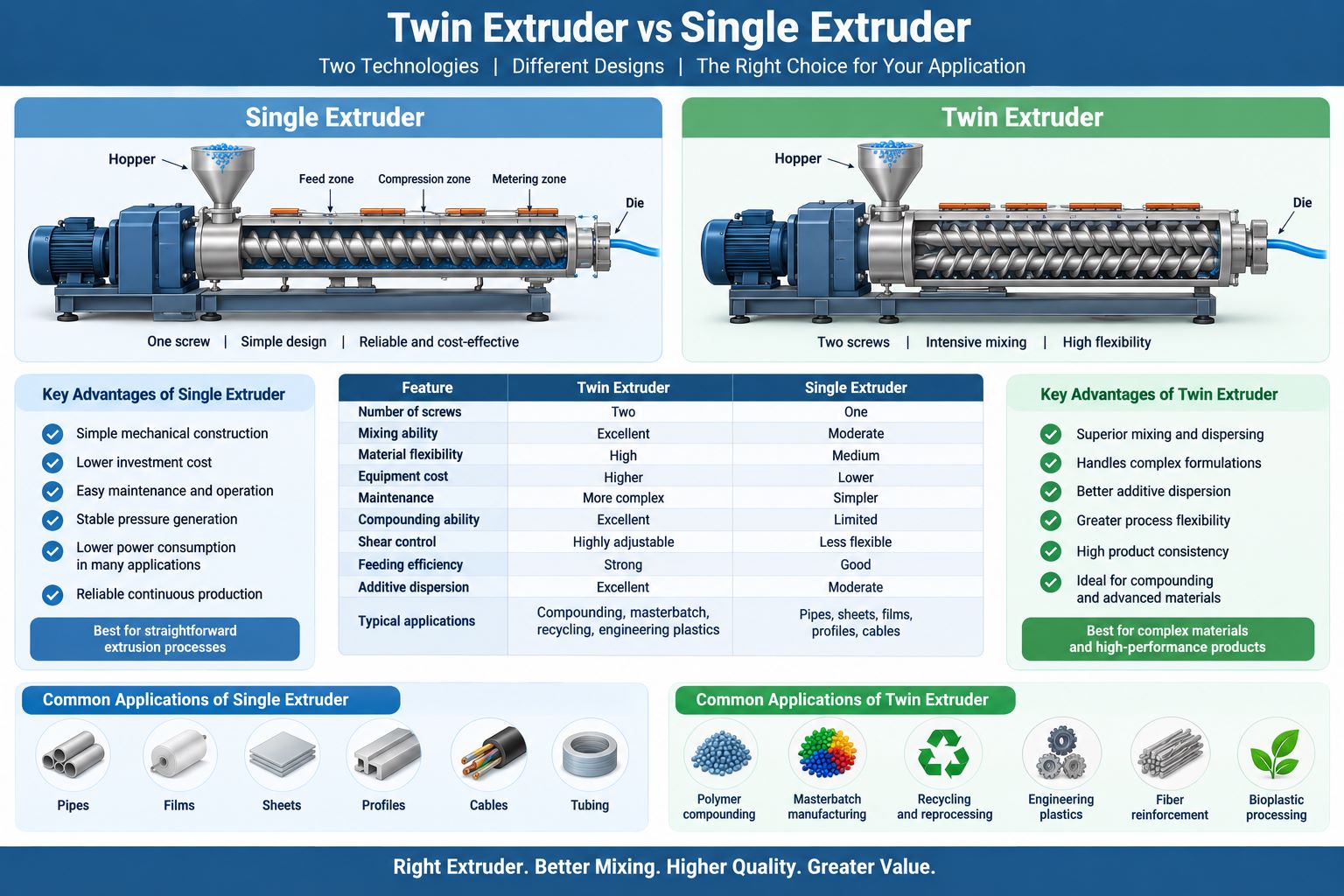
Inside a single extruder, the screw normally contains feeding, compression, and metering zones.
Material enters through the hopper and moves forward as the screw rotates. During transportation, the available space between the screw and barrel gradually changes. This creates compression while heat and shear convert the raw material into a processable melt.
The melted polymer is then pushed through a screen, breaker plate, and extrusion die.
Its relatively predictable material flow makes single screw technology particularly effective for continuous manufacturing processes involving stable polymer formulations.
Manufacturers often prefer this system when they need:
- Simple operation
- Stable continuous output
- Lower equipment investment
- Reliable polymer melting
- Reduced maintenance requirements
For standard extrusion operations, these characteristics can deliver excellent production efficiency.
How Twin Extruder Technology Works
A twin extruder processes material through interaction between two screws. The screw elements can often be configured according to the required processing function.
Different elements may be installed for conveying, kneading, mixing, dispersing, or creating controlled pressure.
This modular capability gives manufacturers much greater control over processing conditions.
A twin screw system can perform several operations within one production line, including:
- Feeding
- Melting
- Mixing
- Kneading
- Dispersing
- Degassing
- Chemical reaction
- Pressure generation
- Homogenisation
This flexibility is one reason twin screw extrusion has become widely used for advanced compound development.
Twin Extruder and Single Extruder Comparison
The most important difference between the two technologies is their processing capability.
| Feature | Single Extruder | Twin Extruder |
| Number of screws | One | Two |
| Machine complexity | Lower | Higher |
| Mixing ability | Moderate | Excellent |
| Initial investment | Lower | Higher |
| Maintenance | Simpler | More specialised |
| Material flexibility | Moderate | High |
| Compounding ability | Limited | Excellent |
| Process control | Standard | Advanced |
| Additive dispersion | Moderate | Highly effective |
| Best application | Basic extrusion | Complex processing |
A single extruder can therefore be the practical choice for standard production, while a twin extruder offers advantages where material formulation and intensive processing are more demanding.
Advantages of a Single Extruder
One of the strongest advantages of single screw equipment is simplicity.
Manufacturers dealing with conventional thermoplastic materials can achieve consistent output without investing in overly complex machinery.
Important advantages include:
- Lower capital cost
- Straightforward machine operation
- Lower maintenance complexity
- Reliable continuous production
- Good energy performance for suitable materials
- Easy availability of replacement components
- Stable pressure generation
- Simple cleaning procedures
A single extruder can be especially economical for manufacturers producing large volumes of relatively uniform products.
Advantages of a Twin Extruder
The primary advantage of a twin extruder is superior material handling and mixing control.
When different raw materials must be incorporated into one homogeneous compound, twin screw technology can create effective distributive and dispersive mixing.
Key benefits include:
- Excellent additive dispersion
- Better processing of multiple ingredients
- Effective degassing
- Controlled residence time
- Flexible screw configurations
- Improved feeding characteristics
- Efficient processing of difficult formulations
- Greater process versatility
- Better control over shear intensity
These capabilities make twin screw machines particularly valuable in high-performance polymer manufacturing.
Which Extruder Should Manufacturers Choose?
There is no universal answer because the correct machine depends on the intended process.
A single extruder may be suitable when production primarily involves melting and forming one polymer or a relatively simple formulation.
A twin extruder becomes more attractive when the manufacturing process requires intensive mixing, multiple additives, high filler concentrations, reactive processing, or challenging raw materials.
Before selecting equipment, manufacturers should evaluate:
- Polymer type
- Raw material characteristics
- Required production capacity
- Product formulation
- Mixing requirements
- Moisture content
- Additive percentage
- Required product consistency
- Energy consumption
- Maintenance resources
- Future product development plans
Equipment should be selected around the complete manufacturing process rather than purchase price alone.
Importance of Screw Design
Screw geometry strongly influences extrusion performance.
Screw diameter, compression ratio, length-to-diameter ratio, flight design, and rotational speed can affect material transportation, melting behaviour, pressure development, and final output quality.
Twin screw machines provide additional flexibility because manufacturers can often change individual screw elements.
This makes it possible to optimise a twin extruder for specific materials instead of relying on one fixed processing configuration.
Proper screw design can improve productivity while reducing unnecessary shear, material degradation, and energy consumption.
Role of Temperature and Process Control
Temperature management is critical in both extrusion systems.
Excessive heat may degrade heat-sensitive polymers, while insufficient temperature can cause incomplete melting and inconsistent flow.
Modern extrusion lines may therefore monitor variables such as:
- Barrel temperature
- Melt temperature
- Screw speed
- Motor load
- Melt pressure
- Feed rate
- Cooling conditions
Accurate control of these parameters supports repeatable production and protects material properties.
Twin screw machines generally provide greater processing flexibility, but proper machine configuration and experienced operation remain essential.
Frequently Asked Questions
1. What is the main difference between a twin extruder and single extruder?
A single extruder contains one screw, while a twin extruder uses two screws and generally provides stronger mixing and material-processing capability.
2. Which extruder is better for plastic compounding?
A twin extruder is generally preferred for compounding because it can efficiently mix polymers with fillers, additives, pigments, and reinforcing materials.
3. Is a single extruder cheaper?
In many applications, single screw equipment has a lower initial cost because its mechanical design is simpler.
4. Which extruder requires less maintenance?
A single extruder normally has simpler maintenance requirements because it contains fewer complex processing components.
5. Can recycled plastic be processed through a single extruder?
Yes. Many recycled polymers can be processed successfully, although heavily contaminated or complex materials may require more advanced processing systems.
6. Why is twin screw extrusion good for mixing?
Two interacting screws create controlled shear, kneading, and material redistribution, helping produce more homogeneous compounds.
7. Can fillers be added using a twin extruder?
Yes. Twin screw systems are widely used for incorporating calcium carbonate, glass fibre, talc, pigments, and other fillers or additives.
8. Which extruder is suitable for pipes?
A single extruder is commonly used for many thermoplastic pipe applications, although processing requirements depend on the polymer and formulation.
9. Does screw speed affect product quality?
Yes. Screw speed influences residence time, shear generation, mixing intensity, melt temperature, and output.
10. How should an extrusion machine be selected?
Consider the raw material, final product, formulation complexity, required capacity, processing temperature, mixing requirement, energy consumption, and maintenance needs.