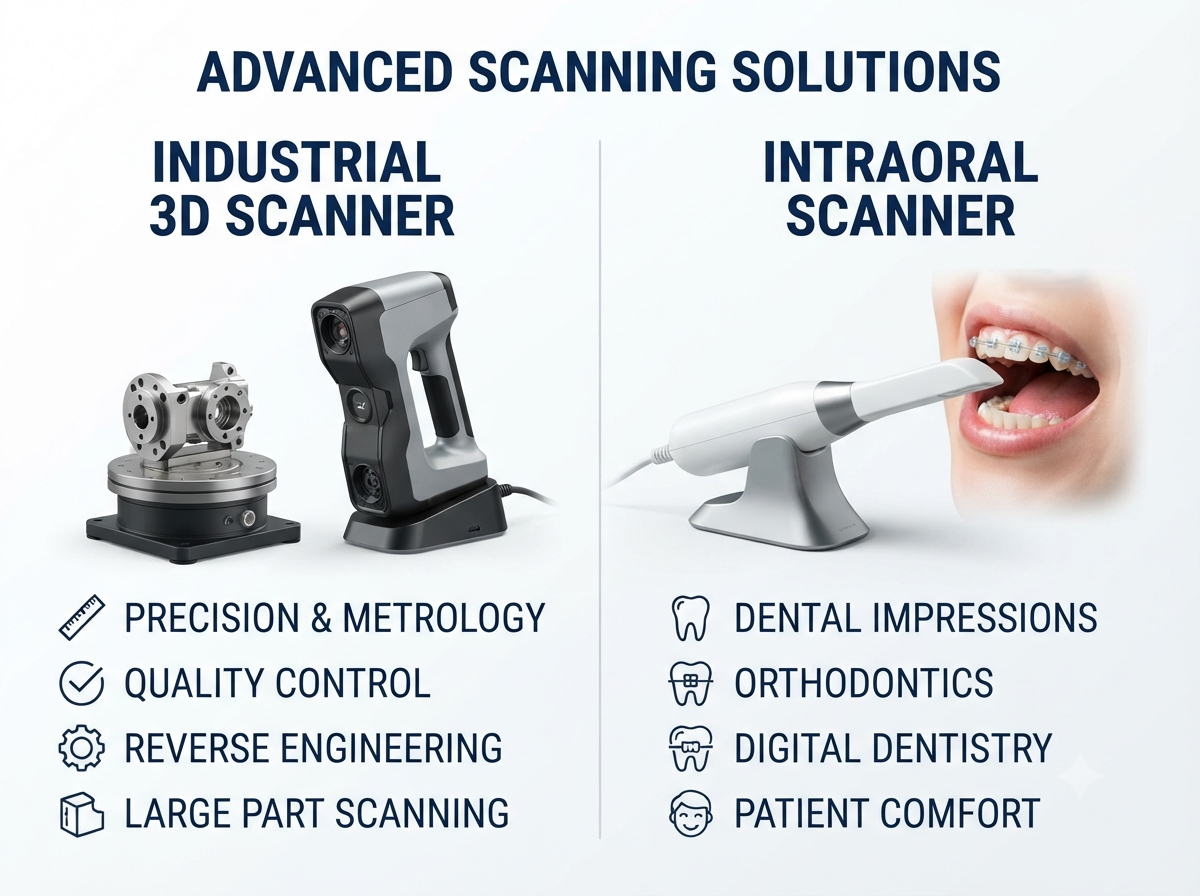
Digital scanning has transformed the way physical objects, components, and human anatomy are converted into accurate digital models. Two important technologies driving this transformation are the industrial 3D scanner and intraoral scanner. Although they serve completely different industries, both technologies rely on advanced optical systems, sensors, software, and digital modelling techniques to capture precise three-dimensional information.
An industrial 3D scanner is widely used in manufacturing, engineering, automotive, aerospace, quality inspection, and product development. An intraoral scanner, on the other hand, is designed specifically for dentistry to capture detailed digital impressions of teeth and oral structures.
Understanding how these scanners work, where they are used, and what advantages they provide can help businesses and professionals make better technology investments.
What Is an Industrial 3D Scanner?
An industrial 3D scanner is a precision measurement device that captures the geometry, dimensions, surface contours, and shape of a physical object and converts the information into a three-dimensional digital model.
Depending on the scanning technology, the system may project structured light, laser lines, or other optical patterns onto an object. Cameras and sensors analyse how the projected light changes across the surface. Specialised software then converts millions of captured measurement points into a digital representation known as a point cloud or 3D mesh.
Industrial scanning is particularly valuable where conventional measuring tools cannot easily capture complicated curves, cavities, freeform surfaces, or detailed components.
Common applications include:
- Dimensional inspection
- Reverse engineering
- Product development
- Prototype evaluation
- Tool and mould inspection
- Quality control
- Automotive component analysis
- Aerospace engineering
- Heritage object digitisation
- Additive manufacturing preparation
Modern scanners can capture detailed surfaces without physically touching the object, making them useful for delicate, complicated, or high-value components.
How Industrial 3D Scanning Improves Manufacturing
Accuracy is one of the most important requirements in industrial production. Even small dimensional variations can influence assembly performance, product quality, or component durability.
An industrial 3D scanner allows manufacturers to compare a produced component with its original CAD design. The scanning software can create visual deviation maps showing areas where the manufactured object differs from design specifications.
This approach can help engineers identify:
- Dimensional deviations
- Surface deformation
- Manufacturing defects
- Assembly alignment problems
- Tool wear
- Prototype inconsistencies
Instead of manually checking individual dimensions using calipers, gauges, or coordinate measuring equipment alone, 3D scanning can capture extensive surface information rapidly.
The technology therefore supports faster inspection processes and more complete digital documentation.
Industrial 3D Scanner for Reverse Engineering
Reverse engineering is another major application of industrial scanning. Companies frequently work with older components for which original CAD drawings are unavailable.
An industrial 3D scanner can capture the physical geometry of the existing component. Engineers can then process the scan data and create a digital CAD model.
This digital model may be used for:
- Manufacturing replacement parts
- Modifying an existing design
- Creating improved components
- Developing compatible products
- Preserving discontinued equipment designs
Reverse engineering becomes particularly useful in automotive restoration, machine maintenance, aerospace engineering, and industrial equipment manufacturing.
What Is an Intraoral Scanner?
An intraoral scanner is a handheld digital dental device designed to capture detailed three-dimensional images of a patient’s teeth, gums, bite, and surrounding oral structures.
Instead of taking conventional impressions using trays filled with impression material, dental professionals can move the scanner carefully around the patient’s mouth.
The device captures multiple images or video frames that specialised software combines into a detailed digital dental impression.
The resulting 3D model may be displayed immediately on a computer screen, allowing dentists to inspect the scan and identify areas that may require additional scanning.
Digital impressions have become increasingly important in restorative and digital dentistry.
Major Applications of Intraoral Scanning
An intraoral scanner can support many dental procedures because accurate digital impressions can be transferred directly into digital treatment workflows.
Common applications include:
- Dental crowns
- Bridges
- Veneers
- Inlays and onlays
- Dental implants
- Clear aligners
- Orthodontic treatment planning
- Digital dentures
- Smile design
- Bite analysis
An intraoral scanner can also assist communication between dentists, laboratories, orthodontists, and patients.
Digital files can be transferred electronically, helping laboratories begin designing restorations without waiting for physical impressions to be transported.
Benefits of Using an Intraoral Scanner
Digital scanning can improve both clinical workflow and patient experience.
One significant advantage is comfort. Conventional impressions may feel uncomfortable for some patients because impression trays and materials must remain inside the mouth until the material sets.
Digital scanning eliminates much of this process.
Additional benefits include:
- Immediate digital visualisation
- Reduced dependence on physical impression materials
- Easier storage of digital records
- Faster laboratory communication
- Ability to rescan selected areas
- Improved patient education
- Integration with CAD/CAM dentistry
- Efficient orthodontic workflows
Dentists can also show patients their digital dental models during consultations, making treatment discussions easier to understand.
Industrial 3D Scanner vs Intraoral Scanner
Although both systems generate three-dimensional information, their environments and technical requirements are very different.
| Feature | Industrial 3D Scanner | Intraoral Scanner |
| Main Industry | Manufacturing and engineering | Dentistry |
| Primary Purpose | Component measurement and inspection | Digital dental impressions |
| Objects Scanned | Components, tools and products | Teeth and oral structures |
| Output | Point clouds and 3D meshes | Digital dental models |
| Typical Users | Engineers and quality inspectors | Dentists and orthodontists |
| Key Applications | Inspection and reverse engineering | Restorations and orthodontics |
| Environment | Factory, laboratory or workshop | Dental clinic |
| CAD Integration | Engineering CAD platforms | Dental CAD/CAM systems |
Despite their different applications, both technologies demonstrate how digital scanning can replace many traditional manual processes.
Important Features to Consider Before Choosing a Scanner
Selecting the right scanning technology requires more than comparing price.
For an industrial 3D scanner, important considerations include scanning accuracy, measurement volume, resolution, scanning speed, portability, surface compatibility, software capabilities, calibration requirements, and CAD integration.
Businesses should also consider whether the scanner will primarily be used for inspection, reverse engineering, research, or product development.
When selecting an intraoral scanner, dental professionals should consider scan accuracy, ergonomics, scanning speed, software compatibility, file export options, CAD/CAM integration, support services, and ease of sterilisation.
Choosing equipment that integrates smoothly with existing digital workflows can provide significantly greater long-term value.
How Digital Scanning Supports Better Workflows
The greatest advantage of modern scanning technology is not simply creating three-dimensional models. Its real value comes from connecting physical objects with digital workflows.
Manufacturers can move from:
Physical component → 3D scan → inspection → CAD analysis → manufacturing improvement.
Dental clinics can create a workflow such as:
Patient scan → digital impression → restoration design → dental laboratory or milling system → final restoration.
This digital connection reduces unnecessary manual processes and makes information easier to analyse, transfer, reproduce, and archive.
Future of 3D Scanning Technology
Scanning technology continues to develop through improvements in cameras, optical sensors, artificial intelligence, automation, cloud platforms, and processing software.
Industrial systems are increasingly being integrated with automated inspection cells, robotic systems, smart manufacturing platforms, and digital twins.
Dental scanning is becoming more closely connected with digital treatment planning, chairside CAD/CAM systems, implant planning, orthodontics, and digitally manufactured restorations.
As scanning equipment becomes faster and easier to operate, adoption is likely to expand across both engineering and healthcare environments.
Frequently Asked Questions
1. What does an industrial 3D scanner do?
It captures the physical geometry of an object and converts the measurements into a detailed three-dimensional digital model.
2. Where is an industrial 3D scanner used?
It is commonly used in automotive, aerospace, manufacturing, engineering, quality inspection, reverse engineering, and product development.
3. Can 3D scanning be used for quality inspection?
Yes. Scan data can be compared with CAD models to identify dimensional deviations and manufacturing inconsistencies.
4. What is reverse engineering with a 3D scanner?
It involves scanning an existing physical component and using the captured geometry to reconstruct a digital CAD model.
5. What does an intraoral scanner capture?
It creates digital representations of teeth, gums, bite relationships, and other visible oral structures.
6. Can an intraoral scanner replace conventional impressions?
For many dental applications, digital impressions can replace traditional impression materials, depending on the treatment and clinical requirements.
7. Are intraoral scanners used for orthodontics?
Yes. They are commonly used for orthodontic records, treatment planning, and clear-aligner workflows.
8. Can intraoral scans be sent directly to a dental laboratory?
Yes. Compatible digital scan files can usually be transferred electronically to laboratories or dental CAD systems.
9. Are industrial and dental scanners the same?
No. Industrial scanners are designed for manufactured objects, while intraoral scanners are designed specifically for oral scanning.
10. What should I check before purchasing a scanner?
Consider accuracy, scanning speed, resolution, software compatibility, workflow integration, technical support, maintenance requirements, and total operating cost.