
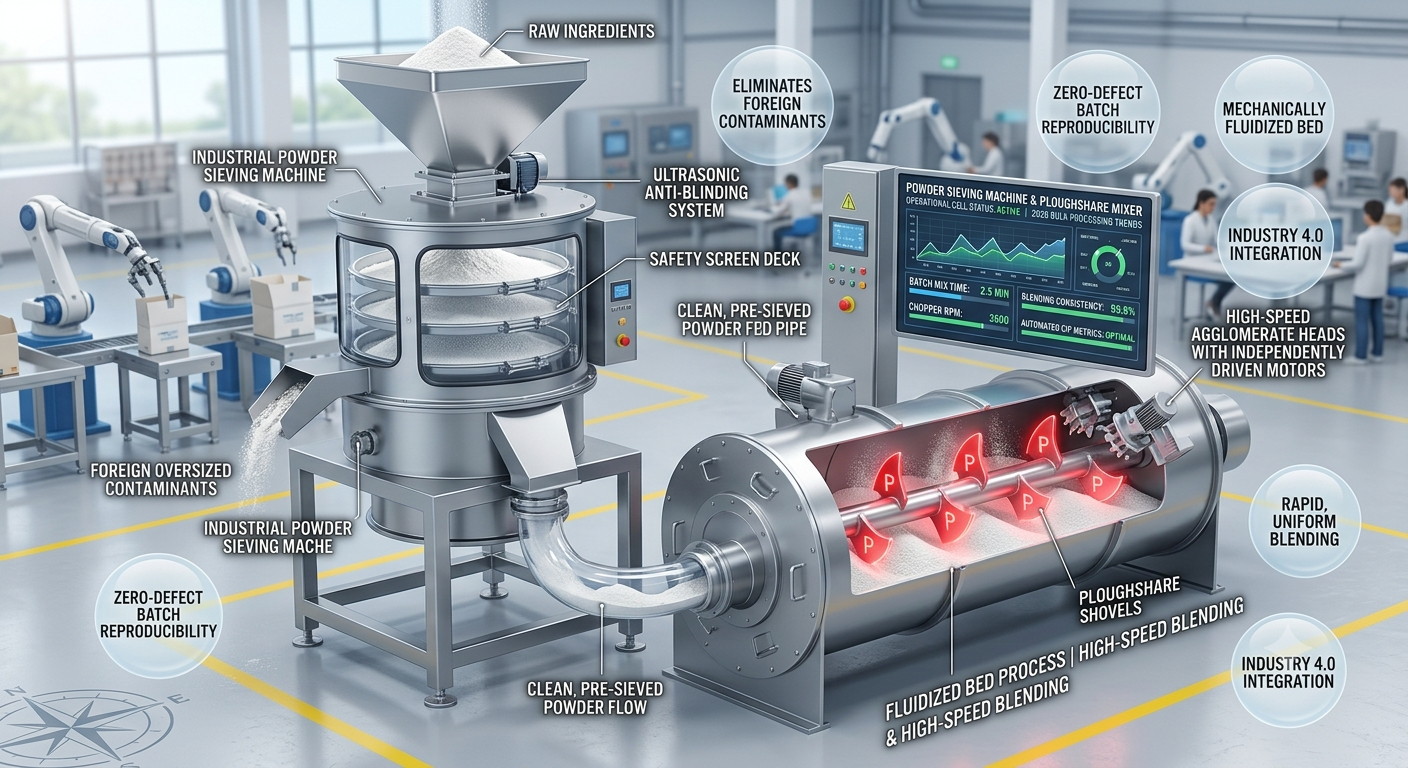
Two important machines are the powder sieving machine and the ploughshare mixer. They perform different jobs, but often work together in food, pharmaceutical, chemical, mineral, plastic, cosmetic, and construction-material production.
A powder sieving machine separates fine powder from oversized particles, lumps, and unwanted material. A ploughshare mixer blends powders, granules, and selected liquids into a uniform mixture. Understanding both technologies helps manufacturers improve product quality, speed, hygiene, and process reliability.
What Is a Powder Sieving Machine?
A powder sieving machine is industrial equipment used to classify material according to particle size. Powder moves across a mesh or screen, while vibration, rotary movement, centrifugal force, or mechanical agitation helps smaller particles pass through the selected opening.
Sieving improves consistency and protects downstream equipment. It can remove lumps, foreign particles, and oversized material before mixing, filling, or packaging.
Common applications include:
- Flour, sugar, starch, spices, and food powders
- Pharmaceutical ingredients
- Pigments, dyes, and chemical powders
- Cement, minerals, and ceramic materials
- Detergents and cosmetic powders
- Plastic resins and additives
The correct system depends on powder characteristics, capacity, mesh size, hygiene requirements, and installation space.
How a Powder Sieving Machine Works
Powder enters through the feed inlet and reaches the screening surface. A motor-driven mechanism creates controlled movement, spreading the product across the mesh. Fine particles pass through, while oversized material remains above the screen and exits separately.
A typical process follows these steps:
- Powder enters the machine.
- Material spreads across the screen.
- Acceptable particles pass through the mesh.
- Oversized particles move toward another outlet.
- Screened powder continues to mixing or packaging.
What Is a Ploughshare Mixer?
A ploughshare mixer is a high-intensity industrial mixer designed for fast blending of dry powders, granules, fibers, pastes, and certain liquid-solid formulations. Inside a horizontal cylindrical chamber, specially shaped plough elements rotate around a central shaft.
The ploughs lift, divide, and throw material through the chamber. This creates strong three-dimensional movement, allowing ingredients to distribute quickly throughout the batch.
A ploughshare mixer is useful when manufacturers require:
- Short mixing cycles
- High blend uniformity
- Good dispersion of minor ingredients
- Controlled liquid addition
- Reliable batch consistency
How a Ploughshare Mixer Works
Material enters the mixing chamber, where rotating ploughs create a mechanically fluidized zone. Instead of simply pushing powder around the vessel, the elements continuously lift and redistribute particles.
This produces radial movement, axial movement, particle exchange, folding, and rapid redistribution. When liquids are needed, spray nozzles can add oils, binders, flavors, or chemicals. Choppers may also reduce lumps.
When the required mixing time is reached, material is discharged through the bottom outlet.
Powder Sieving Machine vs Ploughshare Mixer
| Feature | Powder Sieving Machine | Ploughshare Mixer |
| Main purpose | Particle separation | Uniform blending |
| Process | Screening | Intensive mixing |
| Typical material | Dry powders | Powders, granules, some liquids |
| Main component | Mesh or screen | Rotating plough elements |
| Key benefit | Removes oversize material | Improves blend consistency |
| Process position | Before or after processing | After weighing or sieving |
Why Use Both Machines Together?
Combining a powder sieving machine with a ploughshare mixer can improve process reliability. Sieving before mixing removes lumps and unwanted particles while creating a more consistent feed. The mixer then receives cleaner, better-prepared ingredients.
A typical sequence may include:
- Raw material feeding
- Powder sieving
- Ingredient weighing
- Ploughshare mixing
- Final screening when required
- Filling or packaging
Important Features to Consider
Before selecting a powder sieving machine, consider capacity, mesh size, screening decks, vibration control, product-contact material, dust containment, and cleaning access.
For a ploughshare mixer, evaluate batch volume, motor power, shaft speed, discharge design, chopper requirement, liquid addition system, and internal finish.
Other factors include:
- Bulk density
- Moisture level
- Flowability
- Abrasiveness
- Cleaning frequency
- Automation needs
- Safety requirements
Benefits in Powder Processing
A correctly selected powder sieving machine improves particle consistency, reduces lump-related defects, and protects downstream equipment. A well-designed ploughshare mixer delivers fast mixing, effective ingredient distribution, and flexible processing.
This integrated approach supports consistent downstream filling, reduces handling interruptions, and makes process performance easier for operators to monitor.
Maintenance and Cleaning
Routine maintenance helps both machines remain reliable. On the powder sieving machine, inspect screens, clamps, seals, and vibration components. Damaged mesh should be replaced promptly.
On the ploughshare mixer, inspect plough elements, bearings, shaft seals, drive components, choppers, and discharge valves. Cleaning procedures should match the product and industry, especially in hygiene-sensitive applications.
Frequently Asked Questions
1. What does a powder sieving machine do?
It separates powder by particle size and removes lumps or oversized material.
2. Can it handle very fine powder?
Yes, when the correct mesh and screening method are selected.
3. What is a ploughshare mixer used for?
It creates fast, uniform blends of powders, granules, and selected liquid-solid formulations.
4. Can liquids be added during mixing?
Yes. Spray nozzles can add controlled amounts of liquid ingredients.
5. Why are choppers used?
They help break agglomerates and improve dispersion.
6. Should powder be sieved before mixing?
Often yes, because pre-sieving removes lumps and contamination.
7. Can sieving be done after mixing?
Yes. Final screening can remove agglomerates before packaging.
8. Which industries use these machines?
Food, pharmaceuticals, chemicals, minerals, cosmetics, plastics, and construction materials.
9. How is machine capacity selected?
Capacity depends on throughput, batch size, bulk density, flow behavior, and process targets.
10. Is stainless steel construction important?
It is often preferred where corrosion resistance, hygiene, and easier cleaning are required.