Over time, decorative iron work changed significantly. Traditional blacksmithing gradually developed into a modern manufacturing industry supported by precision machinery, digital design, advanced welding, and protective finishing technologies. Looking toward the future, decorative ironwork is expected to become even more customized, efficient, sustainable, and technologically advanced.
The Historical Beginning of Wrought Iron Craftsmanship
In the past, wrought iron production depended heavily on manual skills. Blacksmiths heated metal in a forge until it became soft enough to shape. Using hammers, anvils, chisels, and tongs, they produced decorative elements one piece at a time.
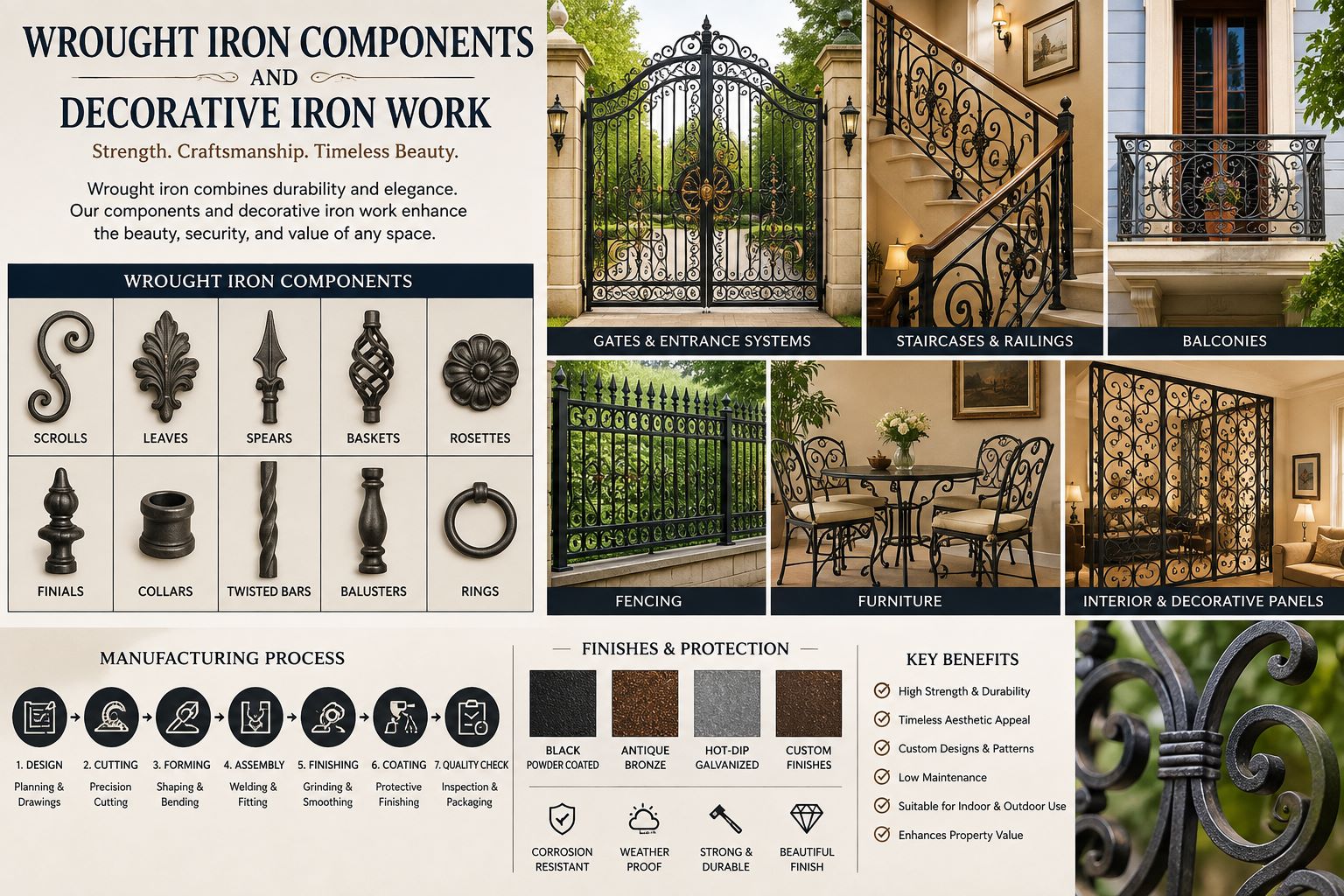
Traditional wrought iron components included:
- Decorative scrolls
- Forged leaves
- Iron flowers
- Twisted bars
- Ornamental baskets
- Spearheads
- Finials
- Rosettes
- Decorative collars
- Hand-forged balusters
Every component reflected the individual skill of the craftsman. Slight differences between pieces were common, giving traditional ironwork an authentic handmade appearance.
How Decorative Iron Work Was Used in the Past
Historically, decorative iron work served both functional and artistic purposes.
Iron gates protected important entrances while detailed scrollwork and floral patterns enhanced their appearance. Iron railings improved staircase and balcony safety while adding architectural character.
Decorative metalwork was frequently found in:
- Royal residences
- Heritage buildings
- Churches and religious structures
- Public gardens
- Large private estates
- Historic hotels
- Government buildings
- Residential balconies
- Entrance gates
- Boundary fencing
Traditional architecture often used detailed patterns because iron could be shaped into complex forms without sacrificing strength.
Challenges Faced by Traditional Iron Manufacturers
Traditional ironwork was beautiful, but production required considerable time and labor.
Every decorative section had to be heated, formed, measured, and finished manually. Producing multiple identical components was particularly difficult.
Common limitations included:
- Slow production
- High labor requirements
- Dependence on skilled craftsmen
- Limited dimensional consistency
- Longer customization periods
- Basic surface protection
- Difficult large-scale manufacturing
Despite these limitations, handcrafted ironwork became highly valued because of its unique appearance and workmanship.
The Industrial Transformation of Wrought Iron Components
As manufacturing technology developed, production methods began changing.
Mechanical bending machines, cutting equipment, presses, drills, welding systems, and rolling machines reduced the amount of manual work required.
Manufacturers could produce wrought iron components more consistently and in larger quantities.
Instead of manually producing every scroll or decorative bar, companies could manufacture standardized components that fabricators could later combine into complete gates, railings, fences, or balconies.
This transition improved both efficiency and design flexibility.
Decorative Iron Work in Modern Architecture
Modern decorative iron work no longer belongs only to classical architecture. It is now widely used in contemporary properties as well.
Today’s architects often combine decorative metal with materials such as:
- Glass
- Natural wood
- Marble
- Concrete
- Stone
- Stainless steel
- Brass
This combination makes ironwork suitable for traditional villas as well as modern offices, hotels, apartments, restaurants, and luxury homes.
Minimalist designs have also become increasingly popular. Instead of heavily ornamented surfaces, many contemporary projects feature clean bars, geometric shapes, and selected decorative details.
Modern Manufacturing Technology
Today’s production techniques are significantly more advanced than traditional blacksmithing.
Manufacturers can use computer-controlled equipment to achieve accurate dimensions and consistent designs.
Current manufacturing technologies may include:
- CNC cutting
- Laser cutting
- Mechanical bending
- Precision rolling
- Automated welding
- Press forming
- Grinding
- Sandblasting
- Powder coating
- Advanced painting systems
These technologies make it possible to manufacture both standard and customized wrought iron components efficiently.
Digital design software also allows manufacturers to prepare accurate drawings before production begins.
Past and Future Comparison of Decorative Iron Work
| Category | Past Approach | Future Direction |
| Design | Handmade drawings | 3D digital modeling |
| Manufacturing | Manual forging | Automated fabrication |
| Production Speed | Slow | Faster and scalable |
| Customization | Labor intensive | Digital customization |
| Quality Control | Manual inspection | Smart measurement systems |
| Surface Finish | Basic paint | Advanced protective coatings |
| Material Use | Conventional | Efficient and recyclable |
| Design Preview | Physical samples | Virtual visualization |
| Patterns | Traditional ornamentation | Modern and hybrid designs |
| Production Planning | Manual | Data-driven manufacturing |
The Future of Wrought Iron Components
The next generation of wrought iron components will likely be influenced by automation, customization, and digital manufacturing.
Customers may increasingly expect unique products instead of standard designs. Digital manufacturing will allow suppliers to modify patterns, dimensions, and decorative arrangements faster than traditional processes.
A customer could select a gate design, change its scroll pattern, adjust its height, choose a finish, and preview the complete structure digitally before manufacturing begins.
This level of customization could become common across the decorative metal industry.
Artificial Intelligence and Digital Design
Artificial intelligence and advanced design software may also influence the future of decorative iron work.
Design platforms could help generate ornamental patterns according to architectural styles, available dimensions, material requirements, and customer preferences.
Digital tools may help manufacturers calculate:
- Material requirements
- Pattern spacing
- Component quantities
- Production time
- Cutting arrangements
- Structural dimensions
- Installation requirements
Using accurate digital planning could help reduce errors, control production costs, and minimize unnecessary material waste.
Sustainable Decorative Iron Manufacturing
Sustainability will become increasingly important in future manufacturing.
Iron and steel can be recycled, making metal products suitable for long-term circular manufacturing strategies.
Future manufacturers may focus on:
- Greater use of recycled materials
- Energy-efficient equipment
- Reduced production waste
- Low-emission coating systems
- Longer-lasting surface protection
- Optimized material cutting
- Improved product durability
Durable decorative iron work can also support sustainability because high-quality products may remain functional for decades when properly maintained.
Future Architectural Trends
The future of decorative iron design is likely to combine simplicity with personalization.
Classical scrolls, floral patterns, and ornamental leaves will continue to appear in heritage and luxury properties. However, modern projects may increasingly favor geometric forms and subtle decorative details.
Expected trends may include:
- Laser-cut decorative panels
- Geometric railing patterns
- Minimalist entrance gates
- Custom balcony screens
- Mixed iron-and-glass railings
- Textured finishes
- Nature-inspired designs
- Modular components
- Personalized decorative motifs
- Matte and contemporary finishes
This combination of traditional art and modern technology will help keep decorative iron relevant across different architectural styles.
FAQ About Wrought Iron Components and Decorative Iron Work
1. How were wrought iron components produced historically?
They were heated in traditional forges and manually shaped by blacksmiths using hammers, anvils, and specialized hand tools.
2. Where was decorative iron work traditionally used?
It was widely used in gates, railings, balconies, fences, windows, furniture, gardens, and important architectural buildings.
3. Why was traditional ironwork time-consuming?
Each decorative component had to be individually shaped, measured, assembled, and finished by skilled workers.
4. How has manufacturing changed today?
Modern manufacturers use cutting machines, bending equipment, welding technology, CNC systems, and advanced finishing processes.
5. Can traditional iron designs still be produced?
Yes. Traditional scrolls, flowers, leaves, baskets, and ornamental patterns continue to be manufactured for classical and heritage-style projects.
6. What will future decorative iron designs look like?
Future designs will likely combine traditional details with geometric forms, minimalist patterns, and customized digital designs.
7. Will automation replace handcrafted ironwork?
Automation will improve repetitive manufacturing, while handcrafted techniques will remain valuable for artistic, luxury, and restoration work.
8. Can decorative iron manufacturing become more sustainable?
Yes. Recycled metals, efficient machinery, reduced waste, and durable coatings can improve sustainability.
9. Why will digital design become important?
Digital design allows customers and manufacturers to visualize, modify, and accurately plan projects before fabrication.
10. Will wrought iron components remain important in future construction?
Yes. Their strength, versatility, customization potential, and decorative appeal will continue supporting architectural and interior applications.