
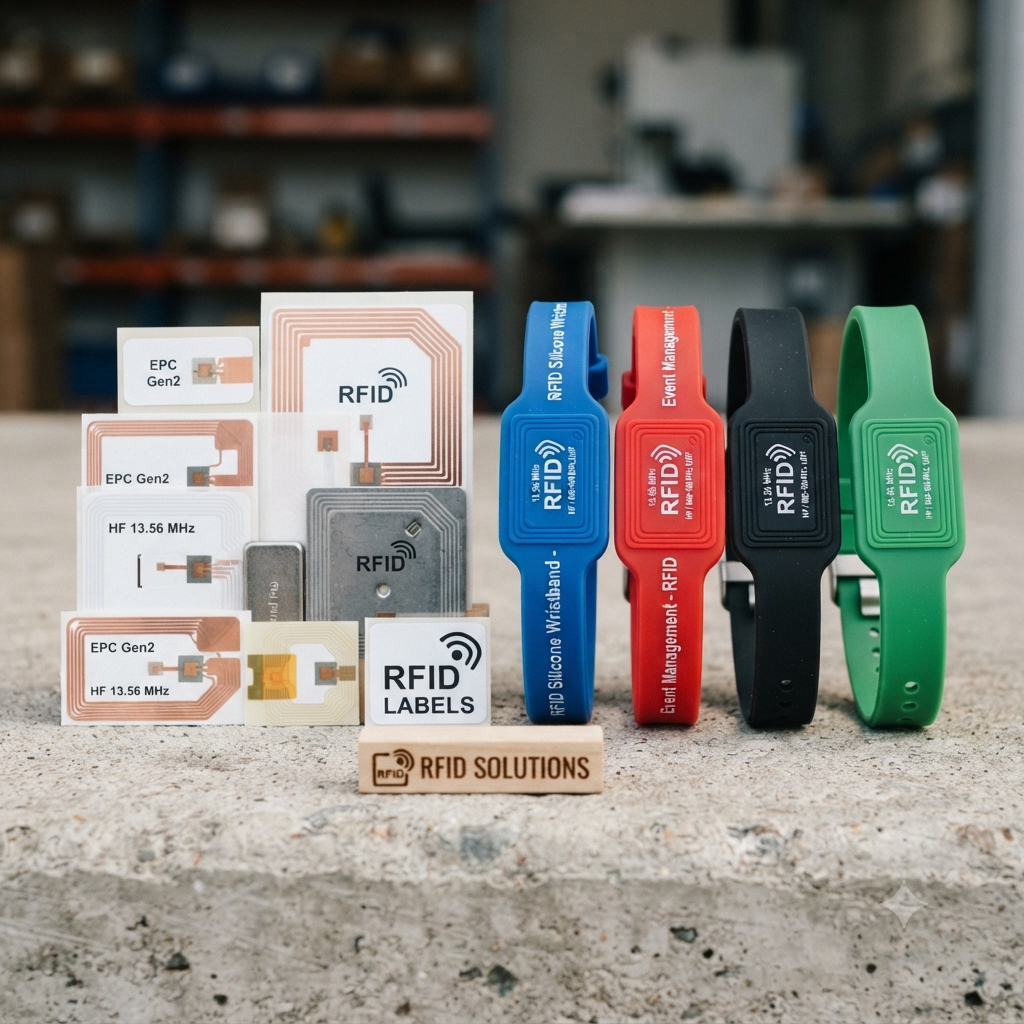
Radio Frequency Identification has transformed how organizations identify products, track assets, control access, and manage people. Two increasingly popular RFID solutions are RFID labels and RFID silicone wristbands. Although both use RFID technology to exchange information wirelessly, their applications, construction, durability, and operating environments are quite different.
Businesses in retail, logistics, healthcare, events, hospitality, manufacturing, and entertainment increasingly use these technologies because they provide faster identification, reduced manual work, and more accurate data management.
What Are RFID Labels?
RFID labels are smart identification labels containing an RFID chip and antenna. Unlike ordinary printed barcodes, RFID-enabled labels can communicate information through radio waves without requiring direct visual scanning.
A typical RFID label contains:
- An RFID microchip for storing information
- An antenna for transmitting and receiving signals
- A substrate carrying the RFID inlay
- Adhesive backing for product or asset attachment
- Printable material for text, logos, or barcodes
Depending on the application, RFID labels may operate using LF, HF, NFC, or UHF frequencies. UHF RFID is especially common in inventory management because multiple tagged products can potentially be identified efficiently within an appropriate reading environment.
How RFID Labels Improve Inventory Management
One of the strongest applications of RFID labels is inventory visibility. Traditional barcode systems normally require workers to scan products individually. RFID systems can streamline this process by reading compatible tags without direct line-of-sight.
Companies can use RFID technology for:
- Warehouse receiving and dispatch
- Inventory counting
- Product identification
- Asset tracking
- Supply chain monitoring
- Production management
- Retail stock visibility
Faster Product Identification
When properly implemented, RFID readers can capture tag information quickly. This can reduce repetitive scanning and help employees locate or process products more efficiently.
Better Data Accuracy
Automated identification also reduces dependence on manual data entry. However, system accuracy still depends on tag quality, reader placement, software configuration, operating frequency, and environmental conditions.
What Are RFID Silicone Wristbands?
RFID silicone wristbands combine RFID chips with flexible, wearable silicone bands. They are commonly used where people need convenient identification, access authorization, membership verification, or cashless transactions.
They are particularly suitable for environments where paper tickets, printed cards, or disposable identification methods may not provide sufficient durability.
Common applications include:
- Water parks
- Resorts
- Hotels
- Fitness clubs
- Festivals
- Amusement parks
- Swimming pools
- Conferences
- Schools
- Membership facilities
Because silicone is flexible and water-resistant, RFID silicone wristbands are practical for extended or repeated use.
How RFID Silicone Wristbands Work
The RFID chip embedded inside the wristband stores a unique identification number or other permitted data. When the wristband approaches a compatible reader, the reader communicates with the embedded RFID component.
The identification number can then connect with a management system that controls functions such as entry authorization, locker access, membership records, attendance, or stored-value accounts.
Businesses may customize RFID silicone wristbands with logos, serial numbers, colors, embossed branding, debossed text, or printed information.
RFID Labels vs RFID Silicone Wristbands
| Feature | RFID Labels | RFID Silicone Wristbands |
| Primary purpose | Product and asset identification | Personal identification and access |
| Form | Adhesive smart label | Wearable silicone band |
| Typical users | Retailers, warehouses, manufacturers | Hotels, events, gyms, parks |
| Water resistance | Depends on material | Generally strong |
| Reusability | Application dependent | Often reusable |
| Printing options | Text, barcode, QR, graphics | Logo, text, numbering |
| Comfort | Not applicable | Designed for wrist wear |
| Asset tracking | Excellent application | Limited |
| Access control | Possible | Highly suitable |
Neither solution is automatically better. The correct choice depends on what needs to be identified and how the RFID system will operate.
Major Benefits of RFID Labels
Businesses choose RFID labels because they can support efficient tracking while remaining compact enough for products, packaging, cartons, documents, and equipment.
Important benefits include:
- Faster inventory identification
- Reduced manual scanning
- Improved asset visibility
- Integration with warehouse systems
- Custom printing possibilities
- Support for automation
- Better traceability throughout operations
For high-volume supply chains, RFID-based identification can provide valuable information about how goods move from manufacturing facilities to warehouses and retail locations.
Major Benefits of RFID Silicone Wristbands
The biggest advantage of RFID silicone wristbands is convenience. Users do not need to repeatedly carry cards, paper passes, or physical tickets.
Organizations may use them to create smoother customer experiences through:
- Contactless access
- Cashless payment integration
- Membership identification
- Locker control
- Attendance management
- Visitor management
Their durability makes RFID silicone wristbands particularly useful for wet environments such as pools, resorts, spas, and water parks.
Choosing the Correct RFID Technology
Before buying an RFID product, businesses should first understand their technical requirements.
Consider the following factors:
- Required reading distance
- Frequency compatibility
- Chip memory
- Reader infrastructure
- Surface material
- Environmental exposure
- Expected product lifespan
- Data security
- Software integration
- Quantity requirements
An RFID label attached to metal, for example, may require different construction from one attached to cardboard. Similarly, wristband chip selection should match the existing access-control or payment system.
Customization and Branding Opportunities
Both RFID labels and RFID silicone wristbands can become valuable branding tools.
Labels can incorporate product information, barcodes, company logos, variable data, serial numbers, and customized designs.
Silicone wristbands may support different colors, printed logos, embossed branding, debossed lettering, numbering, and customized sizes. This allows hotels, events, clubs, and entertainment venues to combine identification technology with brand visibility.
Frequently Asked Questions
1. What are RFID labels used for?
RFID labels are primarily used for inventory management, asset identification, logistics, retail tracking, manufacturing, and supply chain applications.
2. Can RFID labels replace barcodes?
They can replace or complement barcodes depending on the application. Some businesses use both technologies on one label.
3. Are RFID labels reusable?
Some RFID tags are reusable, but adhesive RFID labels are frequently designed for a specific product or lifecycle.
4. What are RFID silicone wristbands?
RFID silicone wristbands are wearable bands containing RFID technology for identification, access control, payment, or membership applications.
5. Are RFID wristbands waterproof?
Silicone wristbands are generally suitable for wet environments, although buyers should verify the manufacturer’s specific protection rating.
6. Can RFID wristbands support cashless payments?
Yes. Compatible systems can associate wristband IDs with cashless payment accounts or stored-value systems.
7. Can RFID labels be customized?
Yes. They can be customized with logos, serial numbers, barcodes, text, variable information, and different materials.
8. Are RFID silicone wristbands reusable?
Many RFID silicone wristbands are designed for repeated use, particularly in gyms, resorts, clubs, and membership facilities.
9. What RFID frequency should I choose?
The correct frequency depends on reading distance, system compatibility, environment, regulatory requirements, and application.
10. How do I select an RFID supplier?
Look for RFID expertise, chip compatibility, customization capabilities, quality control, testing support, production capacity, and technical assistance.