
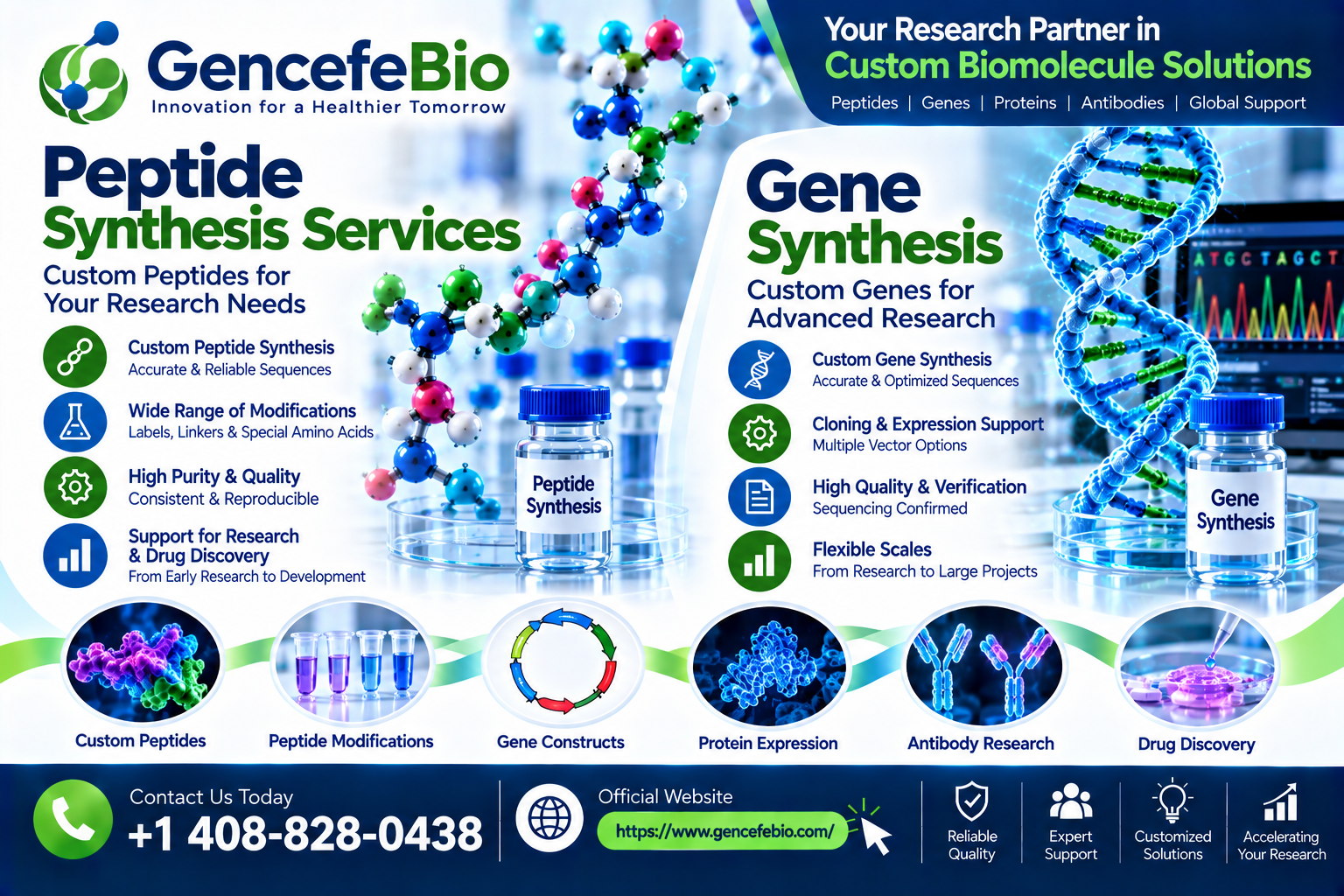
As biotechnology, pharmaceutical development, and molecular biology research continue evolving, demand for customized biomolecular materials remains important. Professional peptide synthesis services enable researchers to obtain specifically designed amino acid sequences, while gene synthesis supports the development of customized DNA constructs for genetic engineering, protein expression, and synthetic biology applications.
From academic laboratories to biotechnology companies and pharmaceutical research organizations, these technologies provide essential tools for investigating biological mechanisms and developing experimental molecular systems.
Scientists increasingly prioritize sequence accuracy, molecular purity, production flexibility, and quality-control documentation when choosing specialized synthesis services.
Growing Importance of Peptide Synthesis Services in Life Sciences
Peptides are chains of amino acids involved in numerous biological processes, including cellular signaling, molecular recognition, and protein interactions.
Researchers use synthetic peptides to investigate biological functions and develop specialized laboratory experiments.
Professional peptide synthesis services allow scientists to request customized amino acid sequences according to their research objectives.
Common applications include:
- Drug discovery and early-stage research.
- Immunology and antigen studies.
- Protein interaction analysis.
- Biochemical assay development.
- Enzyme activity investigations.
- Biomarker-related research.
- Molecular and structural biology studies.
Access to suitable peptide materials can support more reproducible scientific investigations.
What Are Peptide Synthesis Services?
Peptide synthesis services involve producing customized peptide molecules according to specified amino acid sequences, modifications, and purity requirements.
A commonly used manufacturing technique is solid-phase peptide synthesis, also known as SPPS.
This method assembles amino acids sequentially on a solid support to create the desired peptide chain.
After synthesis, the peptide undergoes appropriate processing, purification, and analytical characterization.
Common Peptide Customization Options
Sequence Selection: Researchers specify the amino acid arrangement required for their experiments.
Peptide Length: Production requirements depend on sequence length and molecular complexity.
Chemical Modifications: Options may include acetylation, phosphorylation, biotinylation, and fluorescent labeling.
Purity Levels: Different experiments require different purity specifications.
Production Quantities: Researchers can request quantities appropriate for their intended projects, subject to technical feasibility.
The successful production of complex peptides may require additional optimization.
Understanding Gene Synthesis Technology
Gene synthesis is the process of producing customized DNA sequences according to a predefined nucleotide arrangement.
Rather than relying exclusively on DNA extracted from biological samples, researchers can obtain designed genetic constructs for suitable laboratory applications.
Synthetic genes may support studies involving protein expression, molecular engineering, and biological system development.
Major Applications of Gene Synthesis
- Recombinant protein expression.
- Synthetic biology research.
- Genetic engineering investigations.
- Molecular assay development.
- Protein sequence modification studies.
- Research involving engineered biological systems.
The design and production method depend on sequence length, complexity, and intended research use.
How Peptide Synthesis and Gene Synthesis Work Together
Although these technologies produce different molecular products, they can complement one another within biotechnology research.
Peptide synthesis services provide chemically assembled amino acid sequences, while gene synthesis produces DNA constructs that may encode proteins or other functional biological sequences.
For example, researchers investigating a particular protein may use a synthetic gene to produce the complete protein through an appropriate expression system.
Synthetic peptides corresponding to selected regions of that protein may then be used in molecular recognition or interaction studies.
This complementary approach can support different stages of biological research.
The appropriate research strategy depends on the scientific question and available experimental methods.
Key Benefits of Custom Peptide Synthesis
1. Sequence-Specific Research Materials
Researchers can obtain peptides designed around particular amino acid sequences and molecular targets.
2. Flexible Chemical Modifications
Specialized modifications may support molecular labeling, conjugation, and biochemical experiments.
3. Experimental Customization
Researchers can define relevant purity levels, quantities, and other product characteristics.
4. Analytical Documentation
Suitable characterization helps confirm molecular identity and evaluate product purity.
5. Broad Research Applications
Custom peptides support multiple disciplines, including biochemistry, immunology, molecular biology, and drug discovery research.
Why Gene Synthesis Matters in Modern Biotechnology
Customized genetic materials allow researchers to study defined biological sequences and investigate molecular functions.
Gene synthesis supports experimental flexibility by enabling the design of DNA constructs for suitable research systems.
Important considerations include sequence accuracy, construct format, cloning requirements, and analytical verification.
However, obtaining a synthetic gene does not automatically guarantee successful protein expression or biological functionality.
Experimental outcomes depend on factors such as expression-system compatibility, construct design, and laboratory conditions.
Peptide Synthesis Services vs Gene Synthesis: Key Differences
| Feature | Peptide Synthesis Services | Gene Synthesis |
| Main product | Synthetic peptides | Customized DNA sequences |
| Molecular components | Amino acids | Nucleotides |
| Common production method | Chemical peptide synthesis | DNA synthesis and assembly |
| Primary research use | Peptide studies and molecular assays | Genetic engineering and protein research |
| Quality assessment | Identity, purity, modifications | Sequence accuracy and DNA integrity |
| Customization | Sequence, purity, chemical labels | Sequence design and construct specifications |
Both technologies require appropriate quality-control procedures and application-specific evaluation.
Importance of Quality Control in Molecular Synthesis
Biotechnology research depends on reliable material characterization.
For peptide products, high-performance liquid chromatography and mass spectrometry are commonly used to evaluate purity and identity.
For synthetic genes, sequence verification helps confirm that the resulting DNA corresponds to the intended design.
Additional testing may be required depending on the product format and research application.
Researchers should review available certificates of analysis, technical specifications, and storage recommendations before using materials.
Choosing a Reliable Molecular Synthesis Service Provider
Research organizations should evaluate technical capabilities rather than comparing costs alone.
Important selection criteria include:
- Supported peptide and DNA sequence complexity.
- Available chemical modification options.
- Purification and analytical testing methods.
- Production feasibility and quantity requirements.
- Product documentation and quality controls.
- Storage and shipping arrangements.
- Technical communication and project support.
Clearly defined specifications help suppliers assess project requirements and recommend suitable production options.
Frequently Asked Questions (FAQs)
1. What are peptide synthesis services?
They are specialized laboratory services that produce peptides according to specified amino acid sequences and research requirements.
2. What is gene synthesis?
Gene synthesis is the production of customized DNA sequences based on a predefined nucleotide design.
3. What is solid-phase peptide synthesis?
It is a chemical synthesis method that assembles amino acids sequentially on a solid support.
4. Where are synthetic peptides commonly used?
They are used in immunology, molecular biology, drug discovery, biochemical assays, and protein interaction studies.
5. What are the main applications of gene synthesis?
Common applications include recombinant protein research, synthetic biology, genetic engineering, and molecular assay development.
6. Can peptides include chemical modifications?
Yes. Depending on feasibility, peptides may include fluorescent labels, biotinylation, acetylation, phosphorylation, and other modifications.
7. How is peptide purity evaluated?
High-performance liquid chromatography is commonly used, often alongside mass spectrometry for molecular identity confirmation.
8. Can synthetic genes be used for protein expression?
Yes. Properly designed genetic constructs may be used in suitable expression systems, although successful expression requires experimental validation.
9. What affects molecular synthesis pricing?
Costs depend on sequence complexity, length, modifications, requested quantity, purification, and analytical requirements.
10. What should researchers verify before ordering?
Researchers should confirm sequence specifications, production feasibility, analytical documentation, purity requirements, and storage conditions.
Media Contact
Industry: Biotechnology, Molecular Biology, Genetics & Life Sciences
Service Enquiries: Peptide Synthesis, Gene Synthesis & Customized Research Materials
Contact Number: +1 408-828-0438
Email: gene@gencefebio.com
Official Website: https://www.gencefebio.com/