
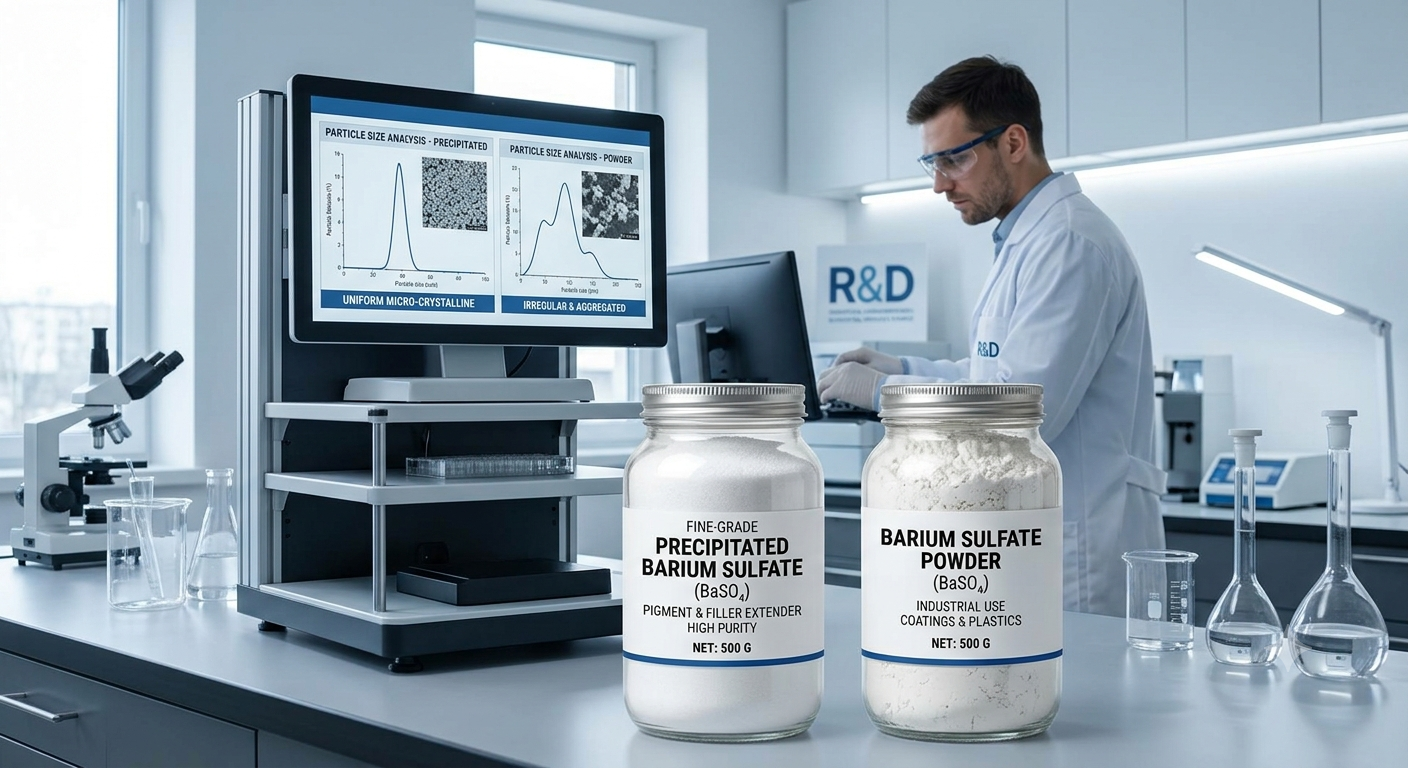
Modern manufacturing relies on functional mineral materials that improve consistency, durability, appearance, and processing. Precipitated Barium Sulfate and Barium Sulfate Powder are used in coatings, plastics, rubber, inks, batteries, and other products. Although both are based on barium sulfate, their production methods, particle characteristics, purity, and performance can differ.
Understanding these differences helps buyers and formulators select a suitable grade for gloss, density, dispersion, surface finish, and processing requirements.
What Is Precipitated Barium Sulfate?
Precipitated Barium Sulfate is a synthetically produced form of barium sulfate. It is generally manufactured through a controlled chemical precipitation process that produces fine, uniform particles with consistent purity and particle-size distribution.
Its controlled production makes precipitated grades useful when appearance, smoothness, dispersion, and predictable performance are important. The material is chemically stable and insoluble in water.
Typical characteristics include:
- Fine and consistent particle size
- High whiteness and brightness
- Good chemical stability
- Strong weather resistance
- Low oil absorption in many grades
- Good compatibility with polymers and coating systems
- Excellent density and filling performance
These properties make precipitated grades valuable in products where both technical performance and visual quality matter.
What Is Barium Sulfate Powder?
Barium Sulfate Powder is a general term used for powdered barium sulfate materials. Depending on the supplier and grade, it may be produced from naturally occurring barite through crushing, purification, grinding, and classification, or through synthetic processes.
Ground natural barium sulfate is often used as a functional filler where density, chemical inertness, and cost efficiency matter. Common applications include coatings, plastics, rubber, friction materials, construction compounds, and specialised formulations.
Key Differences Between the Two Materials
The following comparison helps explain the practical differences manufacturers may consider.
| Property | Precipitated Barium Sulfate | Barium Sulfate Powder |
| Production | Synthetic precipitation | Natural grinding or synthetic production |
| Particle control | Highly controlled | Depends on grade and processing |
| Purity | Generally high | Varies by source and grade |
| Whiteness | Usually very high | Good to high |
| Dispersion | Excellent in suitable systems | Grade dependent |
| Cost | Often higher | Usually more economical |
| Best suited for | Premium coatings, plastics, inks | Fillers, industrial compounds, general applications |
The correct choice should be based on formulation goals.
Major Industrial Applications
Paints and Coatings
In coatings, barium sulfate acts as an extender and functional filler. Fine particles can support smooth films, surface hardness, and controlled gloss.
Plastics and Masterbatch
Plastic manufacturers use barium sulfate to increase density, improve dimensional stability, and support surface finish. Fine precipitated grades are useful when uniform dispersion is required.
Rubber Products
In rubber compounds, it can improve weight, hardness, and dimensional consistency. Selection depends on particle size and compound design.
Printing Inks
Fine synthetic grades are used in inks for their whiteness, low reactivity, and smooth dispersion.
Battery and Specialised Applications
Barium sulfate also appears in selected battery, friction, and technical applications requiring controlled density or particle performance.
Why Particle Size Matters
Particle size affects dispersion, surface finish, viscosity, and product performance. Finer Precipitated Barium Sulfate can distribute evenly through resin or polymer systems, supporting smoother surfaces.
Coarser particles may still work well where density and filling capacity are the priorities. Manufacturers should review particle-size distribution, not only an average figure.
How to Choose the Right Grade
Selecting the right material requires reviewing production and final product requirements.
- Define the required whiteness and brightness.
- Check particle-size distribution.
- Review purity and moisture content.
- Compare oil absorption and dispersion behaviour.
- Confirm compatibility with resin, polymer, or rubber systems.
- Evaluate density requirements.
- Request technical data and a representative sample.
- Run production-scale testing before final approval.
A reliable supplier should provide consistent specifications and quality documentation.
Quality Factors Buyers Should Check
When sourcing Barium Sulfate Powder, consistency between batches is critical. Buyers should review chemical purity, particle size, whiteness, moisture, residue, specific gravity, and packaging quality.
For Precipitated Barium Sulfate, additional attention should be given to dispersion performance, surface treatment where applicable, and compatibility with the intended formulation.
Good traceability and manufacturing controls can also reduce unexpected changes in viscosity, colour, gloss, or processing behaviour.
Frequently Asked Questions
1. Is precipitated barium sulfate different from natural barite powder?
Yes. Precipitated material is produced synthetically, while natural barite powder is obtained by processing mineral barite.
2. Why is precipitated barium sulfate used in coatings?
Its fine particle size, whiteness, stability, and dispersion can support smooth, durable coating formulations.
3. Can barium sulfate powder be used in plastics?
Yes. It is commonly used as a functional filler in plastics and masterbatch formulations.
4. Is barium sulfate soluble in water?
Barium sulfate has extremely low water solubility, which contributes to its stability in many applications.
5. Does particle size affect performance?
Yes. Particle size influences dispersion, surface smoothness, viscosity, and filling behaviour.
6. Which grade is better for premium finishes?
Fine precipitated grades are often preferred when high whiteness and surface quality are priorities.
7. Is natural barium sulfate more economical?
In many applications, ground natural grades can offer a more cost-effective filling solution.
8. What should buyers request from suppliers?
Technical data sheets, certificates of analysis, samples, particle-size information, and application guidance are useful.
9. Can barium sulfate improve product density?
Yes. Its relatively high specific gravity makes it useful where increased density is desired.
10. How should manufacturers test a new grade?
Start with laboratory evaluation, followed by pilot or production-scale testing under actual processing conditions.