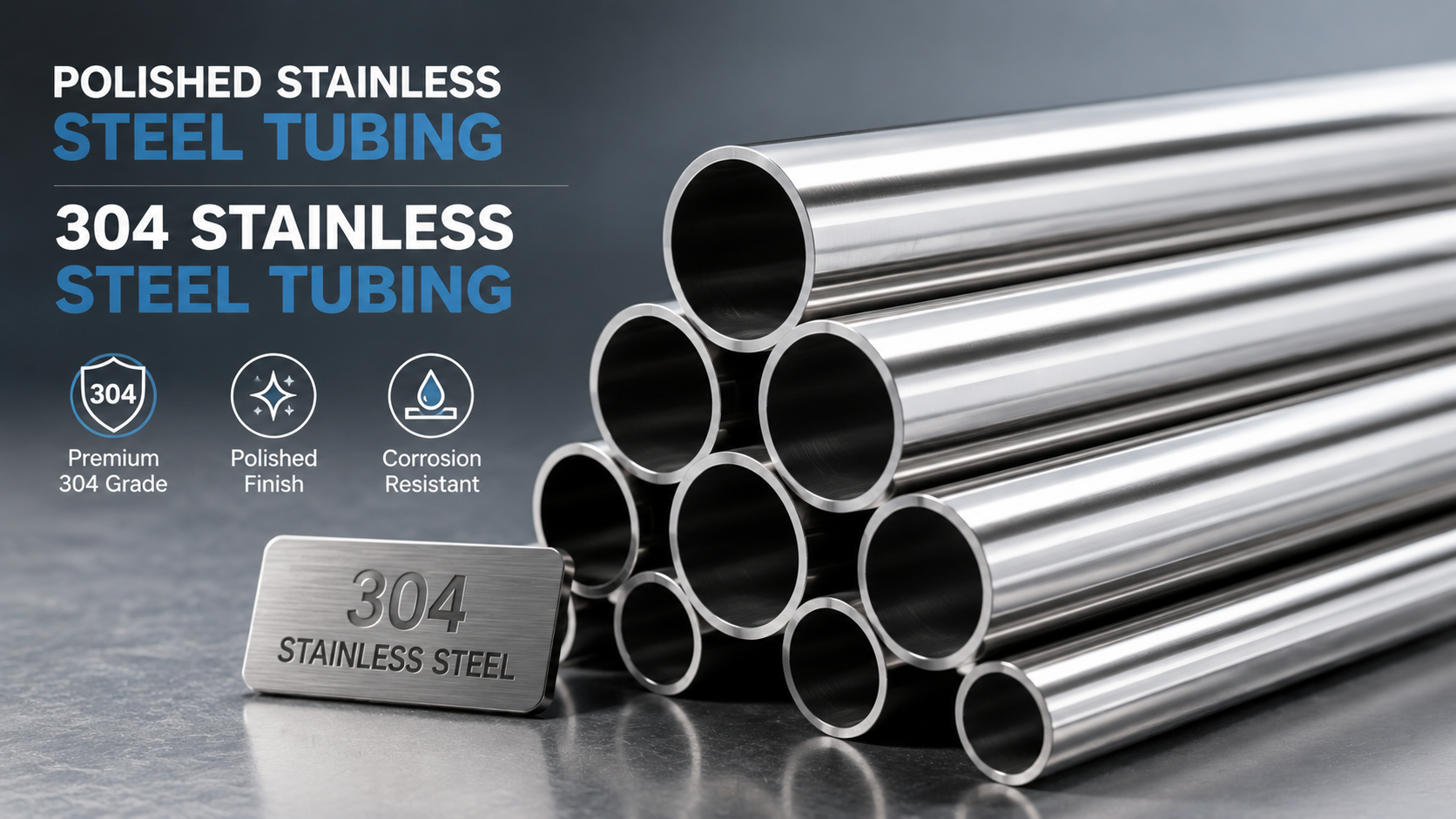
Among the numerous options available, Polished Stainless Steel Tubing and 304 Stainless Steel Tubing are particularly popular because they offer a practical balance between performance, appearance, fabrication capability, and cost.
Although these terms are sometimes used interchangeably, they describe different characteristics. Polished tubing refers mainly to surface finish, while 304 describes the stainless steel grade. In fact, 304 tubing can itself be polished to create a smooth decorative or hygienic surface.
Understanding the differences helps engineers, fabricators, contractors, manufacturers, and buyers select tubing suitable for their operating environment.
What Is Polished Stainless Steel Tubing?
Polished Stainless Steel Tubing is stainless steel tube that has undergone mechanical finishing to produce a smoother, cleaner, and often more reflective exterior surface.
Grinding, buffing, abrasive belts, or specialised polishing equipment may be used to remove surface irregularities and create the desired finish.
Polished tubing is commonly selected when appearance, cleanability, or surface smoothness is important.
Typical applications include:
- Architectural railings
- Decorative structures
- Commercial kitchens
- Food-processing equipment
- Pharmaceutical machinery
- Furniture frames
- Display systems
- Automotive components
- Handrails and balustrades
- Hygienic manufacturing installations
The degree of polishing depends on the intended application. Some projects require a satin appearance, while premium decorative installations may need an almost mirror-like finish.
What Is 304 Stainless Steel Tubing?
304 Stainless Steel Tubing is manufactured using grade 304 stainless steel, one of the most commonly used austenitic stainless steel alloys.
It contains chromium and nickel, providing strong corrosion resistance while retaining excellent fabrication and welding characteristics.
304 tubing performs effectively in many normal atmospheric, commercial, architectural, and industrial environments.
Its advantages include:
- Good corrosion resistance
- Excellent weldability
- Strong formability
- Attractive appearance
- Good mechanical strength
- Easy maintenance
- Long service life
- Compatibility with many fabrication methods
Because of these characteristics, 304 Stainless Steel Tubing is frequently used for structural frameworks, machinery, food equipment, piping components, automotive fabrication, furniture, and architectural systems.
Polished Tubing vs 304 Stainless Steel Tubing
The biggest difference is that polishing describes the surface condition, whereas 304 identifies the material grade.
| Feature | Polished Stainless Steel Tubing | 304 Stainless Steel Tubing |
| Classification | Surface finish | Stainless steel grade |
| Main Advantage | Appearance and smoothness | Corrosion resistance and versatility |
| Surface | Satin, brushed or mirror polished | Mill finish or polished |
| Decorative Use | Excellent | Excellent when polished |
| Fabrication | Depends on underlying grade | Excellent |
| Hygiene | Smooth surfaces aid cleaning | Suitable for many hygienic applications |
| Common Applications | Railings, décor, food equipment | Industrial, architectural and fabrication |
A manufacturer can therefore produce polished tubing from 304 stainless steel, combining the advantages of both specifications.
Benefits of Polished Stainless Steel Tubing
Attractive Appearance
One major advantage of polished stainless tubing is visual quality. The smooth metallic surface creates a premium appearance appropriate for visible installations.
Architects frequently specify polished tubing for staircases, entrances, commercial interiors, railings, and decorative frameworks.
Easier Cleaning
A smoother surface provides fewer irregularities where dirt and contaminants can accumulate.
This property is particularly valuable in industries where regular cleaning is essential, including food processing, beverage production and pharmaceutical manufacturing.
Improved Surface Consistency
Professional polishing can remove minor surface imperfections and create a more consistent appearance across fabricated components.
Different Finishes for Different Applications
Common finishes may include brushed, satin and mirror-polished surfaces. Choosing the correct finish depends on aesthetics, hygiene requirements, maintenance expectations and operating environment.
Advantages of 304 Stainless Steel Tubing
Corrosion Resistance
Grade 304 offers reliable resistance to atmospheric corrosion and numerous everyday chemicals. This makes the material suitable for indoor and many outdoor applications.
However, applications involving heavy chloride exposure, particularly marine environments, may require a higher grade such as 316 stainless steel.
Excellent Fabrication Properties
304 Stainless Steel Tubing can be cut, welded, bent and formed using established fabrication techniques.
This flexibility makes it popular with manufacturers producing complex tubular assemblies.
Durability
Properly selected stainless tubing can provide many years of dependable service.
Unlike painted carbon steel, stainless steel does not depend entirely on an applied protective coating for normal corrosion resistance.
Hygienic Performance
Grade 304 is frequently selected for food-related equipment because its non-porous surface can be cleaned effectively when properly manufactured and finished.
Common Applications
Both polished and 304 tubing can be found across numerous industries.
Important applications include:
- Food and beverage processing equipment
- Pharmaceutical production machinery
- Architectural handrails
- Commercial kitchen equipment
- Automotive fabrication
- Structural frameworks
- Furniture manufacturing
- Display and retail systems
- Mechanical engineering
- Decorative installations
Application conditions should always determine the final grade, wall thickness, dimensions and surface finish.
How to Choose the Right Stainless Steel Tubing
Consider more than appearance when purchasing tubing.
Important selection factors include:
- Outside diameter
- Wall thickness
- Stainless steel grade
- Surface finish
- Operating temperature
- Chemical exposure
- Pressure requirements
- Welding requirements
- Dimensional tolerance
- Indoor or outdoor environment
- Required industry standards
For decorative architecture, polished 304 tubing may provide an excellent combination of appearance and durability.
For more aggressive environments containing chlorides, chemicals or salt spray, another stainless grade may be more appropriate.
Quality Considerations Before Buying
Reliable tubing should have consistent dimensions, material composition and surface quality.
Before placing an order, verify the required specifications with the supplier. Request appropriate material documentation when traceability is important.
Inspect polished tubing for scratches, inconsistent grain patterns, dents, contamination and unwanted surface defects.
For engineering projects, never select tubing based solely on appearance. Pressure, load, temperature, corrosion conditions and applicable standards must also be evaluated.
Frequently Asked Questions
1. What is polished stainless steel tubing?
It is stainless steel tubing mechanically finished to create a smoother, cleaner or more decorative surface.
2. Is polished stainless tubing always grade 304?
No. Different stainless steel grades can be polished, including 304 and 316.
3. Can 304 stainless steel tubing be polished?
Yes. Grade 304 can be polished to satin, brushed or highly reflective finishes.
4. Is 304 stainless tubing corrosion resistant?
Yes. It provides good corrosion resistance in many normal atmospheric and industrial environments.
5. Is 304 suitable for outdoor applications?
It can be suitable for many outdoor environments, although severe marine or chloride exposure may require 316.
6. Can stainless steel tubing be welded?
Yes. Grade 304 offers excellent welding characteristics when appropriate procedures are followed.
7. Where is polished tubing commonly used?
It is frequently used in railings, kitchens, architectural structures, machinery and decorative installations.
8. Is polished tubing easier to clean?
Generally, smooth polished surfaces are easier to clean because they contain fewer surface irregularities.
9. What sizes are available?
Manufacturers can supply numerous outside diameters, wall thicknesses and lengths depending on production capabilities.
10. How do I select the correct tubing?
Evaluate grade, dimensions, wall thickness, surface finish, corrosion exposure, mechanical requirements and applicable standards.