
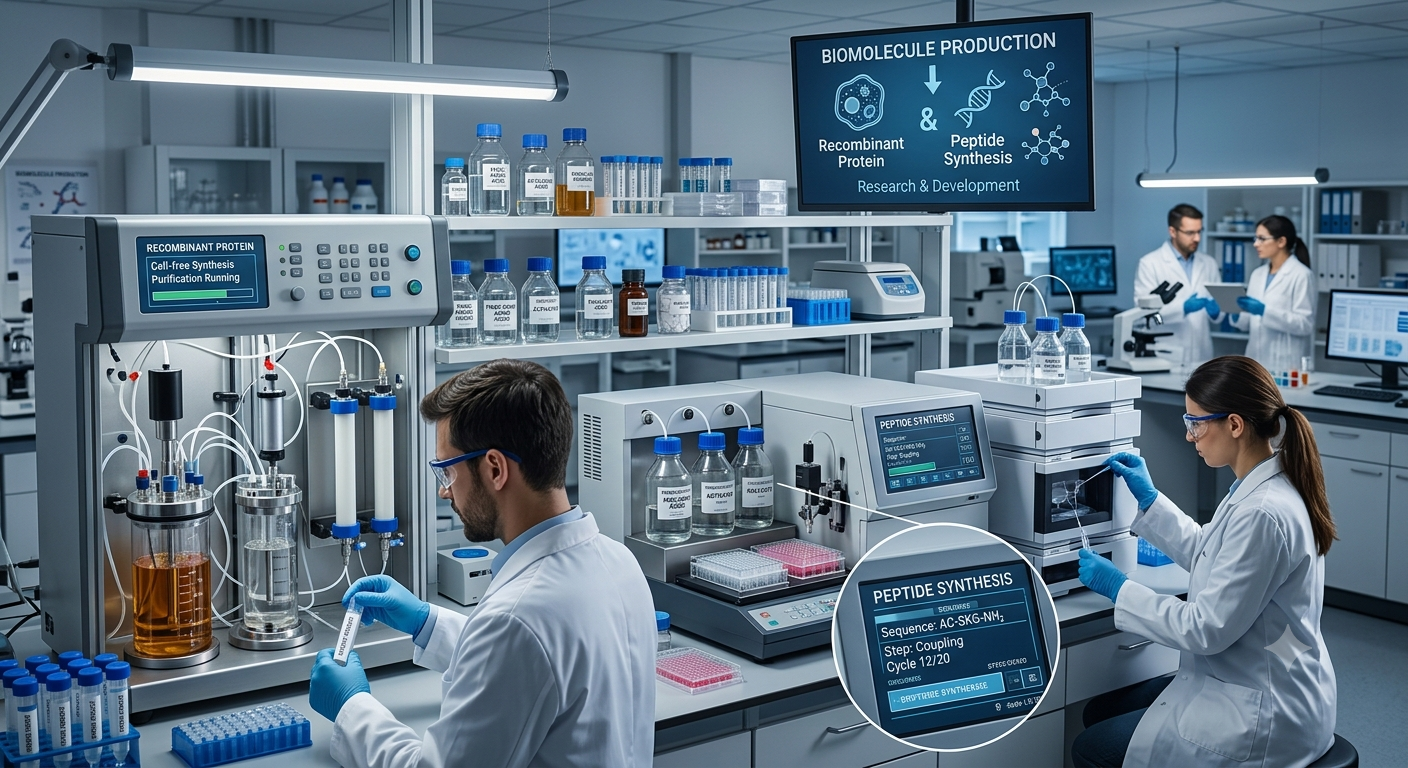
Biotechnology research increasingly depends on precisely designed biological molecules that can support experiments, diagnostics, drug discovery, and therapeutic development. Among the most important tools used in modern laboratories are recombinant protein technologies and peptide synthesis.
Both approaches help scientists study biological systems at the molecular level, but they solve different research challenges. Recombinant protein production is generally preferred when a complete functional protein is required, while peptide synthesis is commonly used when researchers need shorter, highly customised amino-acid sequences.
Understanding their differences, advantages, and applications can help research teams select the right production method for a specific project.
Understanding Recombinant Protein Technology
A recombinant protein is created by placing a selected gene into a biological expression system capable of producing the corresponding protein.
Instead of isolating proteins directly from natural tissues, researchers can manufacture them using controlled laboratory systems.
Common host systems include:
- Bacterial cells
- Yeast
- Insect cells
- Mammalian cells
- Plant expression systems
Each system offers different benefits.
Bacterial hosts are often suitable for relatively simple proteins because they grow rapidly and can produce high quantities. Mammalian cells are generally more appropriate for proteins that require complex folding or post-translational modifications.
The final choice depends on protein size, structure, biological activity, production scale, and downstream use.
How Recombinant Protein Production Works
The production process begins with the DNA sequence responsible for the target protein.
The gene is inserted into an appropriate expression vector and introduced into a selected host cell. Once successfully established, the host cell begins producing the desired molecule.
The typical workflow includes:
- Gene sequence design
- Vector construction
- Host-cell transformation or transfection
- Cell cultivation
- Protein expression
- Harvesting
- Purification
- Quality verification
Purification may involve chromatography techniques designed to separate the target protein from other cellular components.
The final product is then analysed to confirm identity, purity, concentration, and functionality.
What Makes Peptide Synthesis Different?
Peptide synthesis focuses on producing shorter chains of amino acids in a controlled sequence.
Unlike recombinant protein production, which depends on living cells, many peptides can be manufactured chemically.
This gives researchers significant freedom when designing customised sequences.
Synthetic peptides are useful when scientists need:
- Specific amino-acid sequences
- Modified residues
- Fluorescent labels
- Biotin tags
- Phosphorylation
- Conjugated molecules
- High-purity research standards
Because the sequence is assembled according to a predetermined design, researchers can precisely control the structure of the final peptide.
The Role of Solid-Phase Peptide Synthesis
One of the most widely used methods for peptide synthesis is solid-phase peptide synthesis.
During this process, the growing peptide chain remains attached to a solid resin while amino acids are added one by one.
Each cycle normally includes:
- Protecting-group removal
- Amino-acid activation
- Coupling
- Washing
- Repetition until the desired sequence is complete
After assembly, the peptide is separated from the resin and purified.
Analytical techniques such as HPLC and mass spectrometry can then be used to confirm quality and identity.
Recombinant Protein and Peptide Synthesis: Key Differences
| Feature | Recombinant Protein | Peptide Synthesis |
| Main production method | Cellular expression | Chemical assembly |
| Best suited for | Larger proteins | Shorter amino-acid chains |
| Living cells required | Yes | Usually no |
| Sequence customisation | High | Very high |
| Complex folding | Possible | Limited for large structures |
| Chemical modification | Possible but system-dependent | Highly flexible |
| Typical applications | Enzymes, cytokines, antibodies, antigens | Epitope studies, assays, drug research |
| Production challenge | Expression and folding | Sequence length and aggregation |
The selection should be based on the biological purpose of the molecule rather than simply cost or speed.
Where Recombinant Proteins Are Used
A reliable recombinant protein can support a wide range of biological studies.
Common applications include:
- Cell signalling research
- Enzyme studies
- Immunology
- Antibody development
- Structural biology
- Diagnostic research
- Vaccine development
- Drug screening
- Protein interaction studies
For example, researchers investigating a signalling pathway may require a purified cytokine to observe how cells respond under controlled laboratory conditions.
Similarly, recombinant enzymes may be used to evaluate substrate activity or test potential inhibitors.
Where Synthetic Peptides Add Value
Synthetic peptides are especially useful when researchers want to study a small but biologically important region of a larger protein.
Applications of peptide synthesis include:
- Epitope mapping
- Antibody generation
- Receptor-binding studies
- Proteomics
- Enzyme substrate design
- Biomarker research
- Diagnostic assay development
- Drug candidate screening
- Calibration standards
- Molecular interaction studies
Because custom peptides can be produced with targeted modifications, researchers can investigate specific biochemical mechanisms that may be difficult to study with full-length proteins.
Why Molecular Design Matters
The success of both recombinant protein production and peptide synthesis begins with good molecular design.
For recombinant proteins, poor sequence optimisation can affect:
- Expression yield
- Protein solubility
- Folding
- Stability
- Purification efficiency
For peptides, challenging sequences may create problems such as:
- Aggregation
- Low coupling efficiency
- Poor solubility
- Difficult purification
- Reduced final yield
Evaluating the sequence before production can therefore reduce unnecessary experimentation.
Important Quality Parameters
Researchers should not evaluate a biological molecule based only on its availability.
Quality verification is essential.
Common testing methods include:
- HPLC
- Mass spectrometry
- SDS-PAGE
- Western blot
- Protein concentration measurement
- Endotoxin analysis
- Bioactivity testing
- Sequence confirmation
The appropriate quality standard depends on how the material will be used.
A peptide intended for basic laboratory research may require different documentation from a recombinant protein used in a sensitive cell-based assay.
How to Select the Right Production Approach
The choice between recombinant protein production and peptide synthesis should begin with several questions.
Consider Molecular Size
Short sequences are generally ideal candidates for peptide synthesis.
Larger proteins are normally better produced using recombinant expression systems.
Consider Biological Activity
Some proteins must maintain a precise three-dimensional structure to function correctly.
In such cases, the selected expression system must support proper folding.
Consider Required Modifications
If the project requires very specific chemical modifications, custom peptide synthesis may offer greater flexibility.
Consider Purity Requirements
Purity specifications should match the intended experiment.
Higher-purity material may be required for quantitative or sensitive applications.
Consider Production Scale
Small-scale research quantities may have different manufacturing requirements from larger development programmes.
Frequently Asked Questions
What does recombinant protein mean?
A recombinant protein is a protein produced through genetically engineered cells containing the gene that encodes the required molecule.
Why are recombinant proteins widely used?
They provide researchers with controlled access to proteins needed for biological experiments, diagnostics, and drug development.
What is peptide synthesis used for?
Peptide synthesis is used to create customised amino-acid sequences for research, assays, antibody development, and pharmaceutical studies.
Is peptide synthesis suitable for large proteins?
Chemical synthesis becomes increasingly challenging as sequence length and structural complexity increase, so recombinant expression is usually preferred for large proteins.
What is the advantage of synthetic peptides?
Their main advantage is precise sequence control and the ability to add customised chemical modifications.
Can recombinant proteins contain tags?
Yes. Proteins may be engineered with purification or detection tags such as His-tags, depending on project requirements.
How is peptide identity confirmed?
Mass spectrometry is commonly used to verify molecular mass, while HPLC can help determine purity.
Which host system is best for recombinant protein production?
The best system depends on the protein. Bacteria may work well for simple targets, while mammalian cells may be required for more complex proteins.
Why is protein folding important?
Incorrect folding can reduce biological activity or cause aggregation, making the protein unsuitable for functional studies.
Can peptides be customised for antibody production?
Yes. Custom peptides are frequently designed as antigens for antibody development and epitope-specific research.