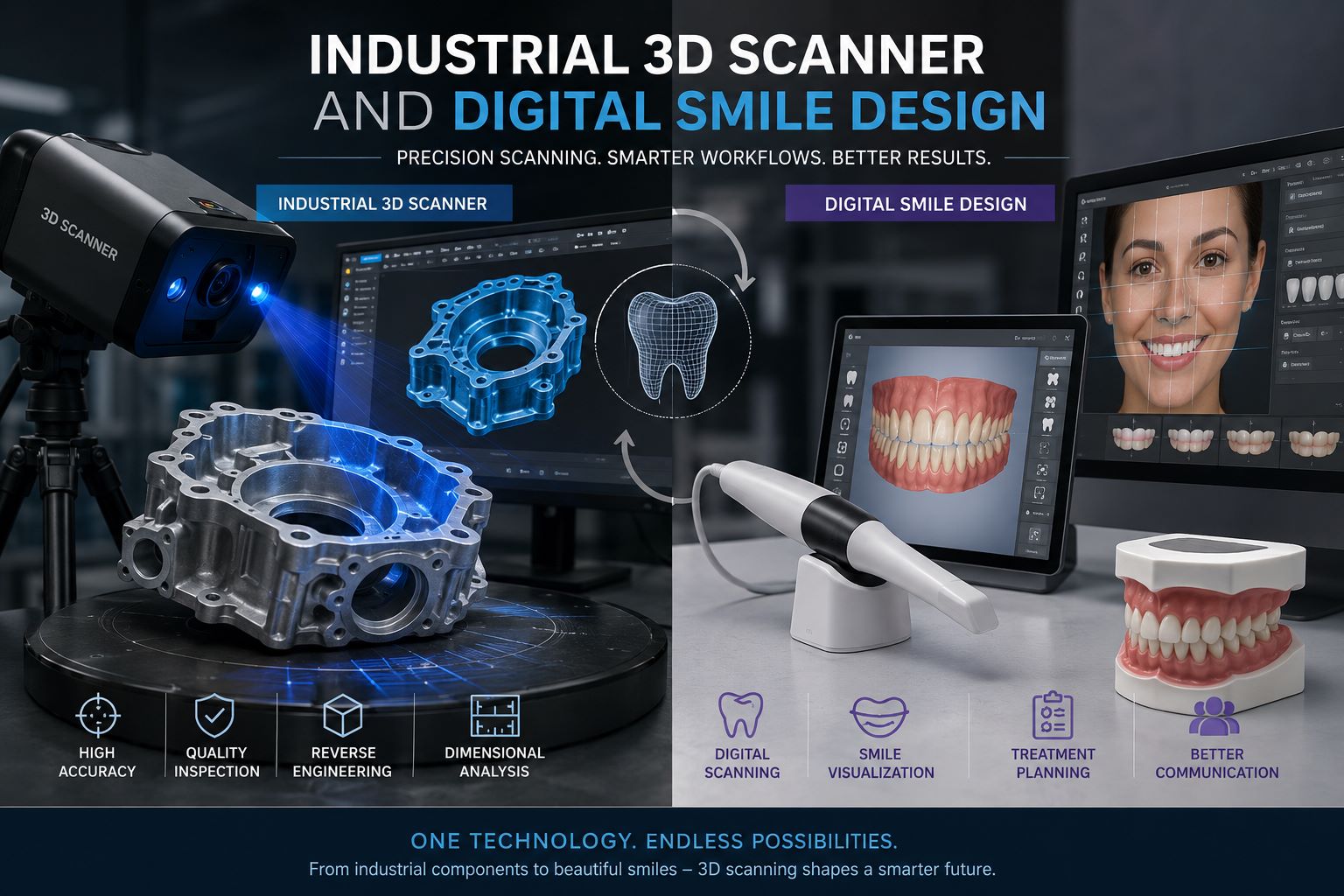
Digital technology is transforming how professionals measure, analyse, design, and produce highly accurate results. Two technologies demonstrating this shift particularly well are the industrial 3D scanner and digital smile design. Although they serve completely different industries, both rely on digital scanning, three-dimensional data, sophisticated software, and accurate visual planning.
An industrial 3D scanner converts the shape of a physical component into detailed digital information for engineering, manufacturing, inspection, and product development. Digital smile design uses photographs, scans, digital impressions, and specialised dental software to visualise and plan a patient’s smile before treatment begins.
Understanding these technologies helps businesses, engineers, dental professionals, and patients appreciate how digital workflows can improve accuracy, communication, planning, and final outcomes.
What Is an Industrial 3D Scanner?
An industrial 3D scanner is a measurement device designed to capture the dimensions, geometry, surface features, and shape of physical objects. Instead of manually measuring individual points, the scanner can collect thousands or millions of data points and create a digital representation known as a point cloud.
The information can then be converted into a 3D model and analysed using CAD, inspection, reverse-engineering, or manufacturing software.
Industrial scanning technologies commonly include:
- Structured-light scanning
- Laser 3D scanning
- Handheld 3D scanning
- Optical scanning
- Automated robotic scanning
- Metrology-grade scanning systems
Manufacturers use these technologies when accurate measurement of complex components would be difficult or time-consuming using conventional tools.
How Industrial 3D Scanning Works
The scanning process begins when a scanner projects laser light or structured patterns onto a component. Cameras and sensors analyse how this projected light changes across the object’s surface.
Software calculates millions of coordinates to reproduce the object’s geometry digitally.
A typical workflow includes:
- Preparing and positioning the component.
- Calibrating the scanning equipment.
- Capturing multiple surfaces and angles.
- Combining individual scans into one model.
- Cleaning and processing the point cloud.
- Creating a polygon mesh or CAD-compatible model.
- Comparing measurements with original design data.
This digital approach can significantly simplify inspection of complicated shapes, curves, moulds, castings, and engineered components.
Industrial 3D Scanner Applications
The flexibility of an industrial 3D scanner makes it useful across automotive, aerospace, manufacturing, engineering, tooling, energy, and product development sectors.
One important application is quality inspection. Manufacturers can scan a finished component and compare its digital geometry against original CAD specifications. Colour-based deviation maps can help identify dimensional differences quickly.
Reverse engineering is another common application. When original CAD files are unavailable, technicians can scan an existing component and rebuild its digital model.
Additional applications include:
- Prototype inspection
- Tool and die measurement
- Mould analysis
- Product redesign
- First article inspection
- Heritage component reproduction
- Manufacturing defect detection
- Digital archiving
- Assembly analysis
The appropriate scanner depends on component size, surface characteristics, accuracy requirements, working environment, and production volume.
Major Advantages of Industrial 3D Scanning
Traditional measurement techniques remain valuable, but complex components can require extensive manual inspection. Three-dimensional scanning offers a more comprehensive way to capture geometric information.
Important benefits include:
- Fast collection of extensive dimensional data
- Non-contact measurement options
- Accurate capture of complex geometries
- Improved reverse-engineering workflows
- Easier comparison against CAD models
- Better digital documentation
- Reduced manual measurement requirements
- Support for automated quality control
However, accuracy depends on equipment quality, calibration, operator knowledge, surface condition, and appropriate scanning methodology.
What Is Digital Smile Design?
Digital smile design is a technology-driven approach to cosmetic and restorative dentistry that allows dentists to plan potential smile improvements digitally.
Instead of relying entirely on traditional impressions and verbal explanations, dentists can use digital photographs, facial measurements, intraoral scans, and specialised software to analyse how teeth interact with a patient’s lips, gums, facial proportions, and overall appearance.
The goal is not simply to create perfectly shaped teeth. Effective smile planning considers harmony between dental features and the individual patient’s facial characteristics.
Digital planning may be incorporated into veneers, crowns, implants, orthodontics, full-mouth rehabilitation, and other aesthetic dental procedures.
How Digital Smile Design Works
A typical digital smile design process begins with collecting detailed visual and dental information.
The dentist may capture:
- Facial photographs
- Intraoral photographs
- Digital dental impressions
- 3D intraoral scans
- Bite information
- Tooth measurements
Software can then be used to evaluate tooth proportions, alignment, symmetry, gum contours, and relationships between dental and facial features.
A proposed smile can be created digitally so the patient and dental team can discuss potential changes before irreversible treatment begins.
Depending on the procedure, the digital design may also support laboratory manufacturing, CAD/CAM restorations, mock-ups, surgical planning, or orthodontic treatment.
Benefits of Digital Smile Design
One of the strongest advantages of digital smile design is improved communication.
Patients sometimes find it difficult to imagine the outcome of cosmetic dental treatment from verbal descriptions alone. Digital visualisation allows dentists to explain treatment objectives more clearly.
Potential advantages include:
- Better treatment visualisation
- Improved patient-dentist communication
- More personalised smile planning
- Accurate evaluation of tooth proportions
- Enhanced collaboration with dental laboratories
- Better interdisciplinary treatment planning
- Opportunity to evaluate design concepts before treatment
Digital technology supports clinical decisions, but it does not replace professional diagnosis. Oral health, bone condition, gum health, bite relationships, and biological limitations must always be evaluated.
Industrial 3D Scanner vs Digital Smile Design
| Factor | Industrial 3D Scanner | Digital Smile Design |
| Main Industry | Manufacturing and engineering | Dentistry |
| Primary Purpose | Measure physical components | Plan aesthetic dental treatment |
| Input | Physical object geometry | Dental and facial information |
| Digital Output | Point cloud or 3D model | Digital smile simulation |
| Major Benefit | Dimensional accuracy | Treatment visualisation |
| Common Software | CAD and inspection platforms | Dental design software |
| Typical Users | Engineers and inspectors | Dentists and dental technicians |
Despite their differences, both technologies demonstrate the growing importance of accurate digital data.
How 3D Technology Connects Engineering and Dentistry
Manufacturing and dentistry may seem unrelated, yet their modern digital workflows share several principles.
Both industries increasingly move from physical objects to digital models, analyse those models using specialised software, make controlled modifications, and convert digital information back into physical results.
Industrial engineers may scan a component before redesigning and manufacturing it. Dental professionals may scan a patient’s teeth before designing and producing a restoration.
In both cases, accurate scanning helps create a stronger connection between the physical and digital worlds.
Choosing the Right Digital Technology
When selecting an industrial 3D scanner, organisations should evaluate accuracy, scanning range, portability, software compatibility, object size, surface characteristics, and technical support.
For digital dentistry, patients should focus less on the software brand and more on the dentist’s qualifications, clinical experience, diagnosis, treatment planning, and ability to use digital tools appropriately.
Technology produces the greatest value when sophisticated equipment is combined with professional knowledge.
Frequently Asked Questions
1. What does an industrial 3D scanner measure?
It captures the three-dimensional geometry, dimensions, contours, and surface characteristics of physical objects.
2. Is industrial 3D scanning accurate?
Professional systems can provide highly accurate measurements, although performance varies according to scanner specifications and operating conditions.
3. Can 3D scanners support reverse engineering?
Yes. Scanned geometry can be converted into digital models for redesign, reproduction, or documentation.
4. Which industries commonly use industrial scanners?
Automotive, aerospace, manufacturing, tooling, energy, research, and product development are common users.
5. What is digital smile design used for?
It helps dentists digitally analyse and plan aesthetic or restorative dental treatments.
6. Can patients see their proposed smile beforehand?
Digital planning can provide a visual representation or simulation of potential treatment outcomes.
7. Does digital smile design guarantee identical results?
No. Digital simulations are planning tools, and actual clinical outcomes can vary.
8. Can digital smile planning be used for veneers?
Yes. It is frequently incorporated into veneer, crown, implant, orthodontic, and restorative treatment planning.
9. Are industrial scanning and dental scanning similar?
Both capture physical geometry digitally, although their equipment, accuracy requirements, software, and applications differ.
10. Why are digital workflows becoming important?
They can improve measurement, visualisation, documentation, collaboration, planning, and production efficiency.