
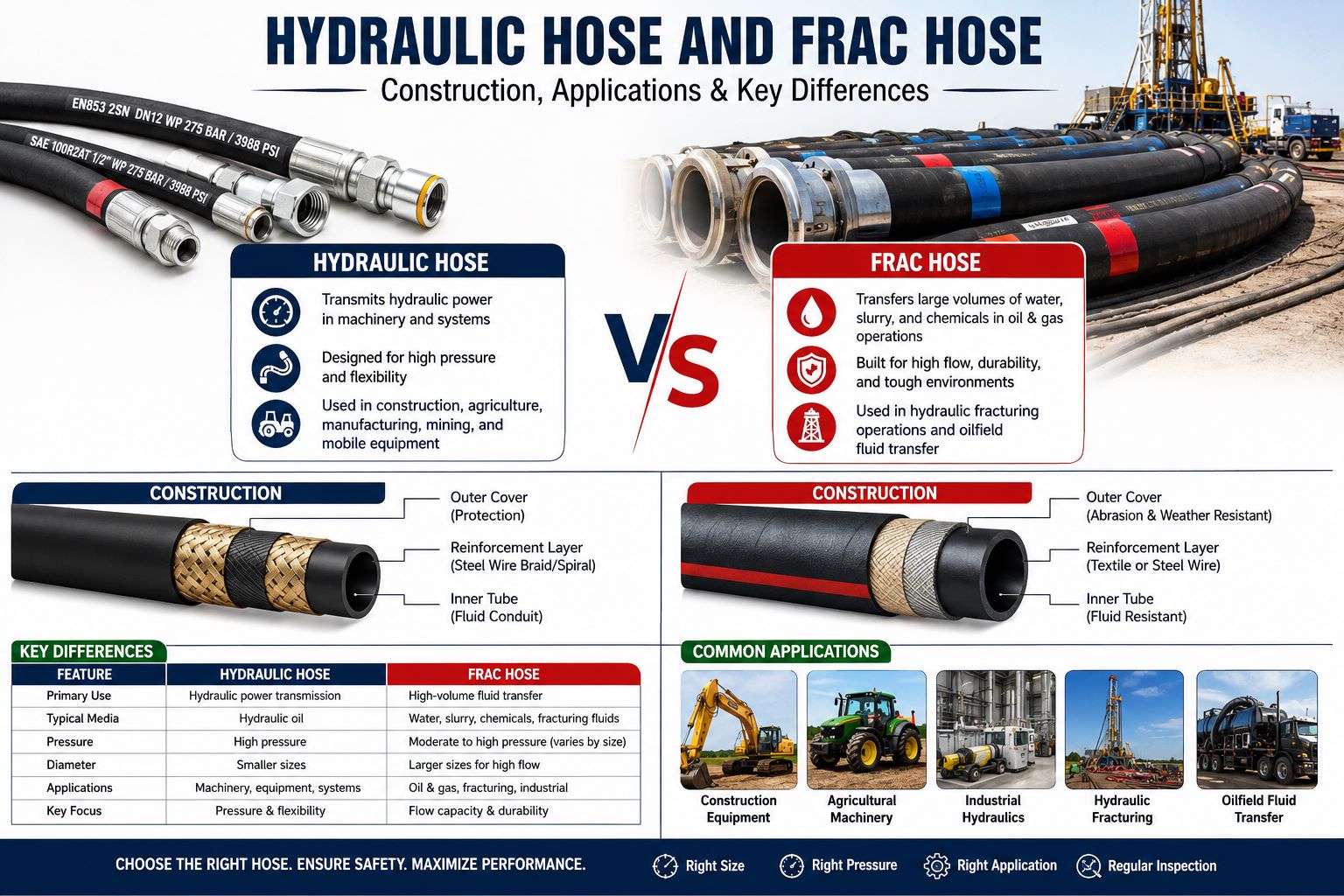
Industrial fluid-transfer systems depend on hoses that can handle pressure, vibration, movement, abrasion, temperature changes, and harsh environments. Two important solutions are Hydraulic Hose and frac hose.
A Hydraulic Hose transfers compatible fluid between pumps, valves, cylinders, and motors. A frac hose is mainly used in oilfield and well-stimulation operations where water, fracturing fluids, slurries, or abrasive media must be moved efficiently.
What Is a Hydraulic Hose?
A Hydraulic Hose is a flexible reinforced tube designed to transmit hydraulic fluid while maintaining pressure and allowing movement between machine components. It is widely used in mobile and industrial equipment.
A typical hydraulic hose contains three layers:
- Inner tube compatible with the working fluid.
- Reinforcement made from braided or spiral wire or textile materials.
- Outer cover protecting against abrasion, weather, oil, and damage.
Why Reinforcement Matters
The reinforcement layer gives the hose its pressure-carrying strength. The correct type depends on working pressure, impulse cycles, flexibility, bend radius, and operating conditions.
Common Performance Factors
Important factors include pressure, temperature, fluid compatibility, hose size, bend radius, fittings, and environmental exposure.
What Is a Frac Hose?
A frac hose is a heavy-duty industrial hose used in hydraulic fracturing, well stimulation, water transfer, slurry handling, and related oilfield operations. These applications may involve abrasive fluids and demanding conditions.
Frac hoses can move water, fracturing fluids, flowback water, or abrasive mixtures between tanks, pumps, manifolds, and other equipment. Their construction is selected for durability, abrasion resistance, flexibility, and dependable pressure performance.
Many frac hoses are larger in diameter because oilfield operations often require high-volume fluid movement.
Hydraulic Hose vs Frac Hose
| Feature | Hydraulic Hose | Frac Hose |
| Primary use | Hydraulic power transmission | Oilfield fluid and slurry transfer |
| Typical size | Small to medium diameter | Medium to large diameter |
| Media | Hydraulic oil and compatible fluids | Water, frac fluids, slurry, flowback |
| Main priority | Pressure, impulse resistance, flexibility | Flow capacity, abrasion resistance, durability |
| Common industries | Construction, agriculture, factories, mining | Oilfield, drilling, well stimulation |
Both products must be selected according to system requirements rather than appearance alone.
How to Select the Right Hose
Correct hose selection improves performance and reduces leakage, premature failure, pressure loss, and downtime.
Use this checklist before ordering:
- Confirm the required inside diameter and hose length.
- Check maximum working pressure and pressure spikes.
- Verify operating and ambient temperature.
- Identify the exact fluid or slurry being transferred.
- Consider abrasion, UV exposure, chemicals, and weather.
- Check minimum bend radius and routing space.
- Select compatible couplings and end connections.
- Confirm whether suction, discharge, mobile, or pulsating service is involved.
For a Hydraulic Hose, pressure rating and impulse performance are especially important. For a frac hose, also consider volume flow, abrasive media, external wear, and field handling.
Why Hose Quality Matters
A poorly selected hose can cause more than maintenance problems. Leakage can reduce efficiency, contaminate work areas, damage equipment, and expose workers to pressurized fluid hazards.
Quality hose construction can provide:
- Reliable fluid transfer
- Better abrasion and pressure-cycle resistance
- Longer service life
- Fewer maintenance interruptions
- Improved equipment productivity
- Compatibility with matched fittings
Even a premium hose can fail if installed incorrectly or used beyond rated conditions.
Installation and Maintenance Best Practices
Proper installation is essential for both Hydraulic Hose and frac hose systems. Avoid twisting during assembly because torsion can weaken reinforcement. Routing should prevent excessive bending, rubbing, crushing, and contact with sharp edges.
Inspect hose assemblies for:
- Cracks or cuts in the outer cover
- Exposed reinforcement
- Bulges, blisters, or soft spots
- Coupling movement or corrosion
- Leakage around fittings
- Excessive abrasion
- Kinks or permanent deformation
Replace damaged hoses before they become serious operational problems. Maintenance intervals should reflect service conditions, duty cycle, manufacturer instructions, and site safety procedures.
Applications Across Industries
The Hydraulic Hose is essential wherever hydraulic power travels through flexible lines. Excavators, loaders, forklifts, presses, tractors, cranes, molding machines, and industrial power units depend on properly specified hoses.
The frac hose supports oilfield water movement, well-stimulation fluid transfer, slurry handling, flowback operations, and other applications requiring large-bore hose systems.
Choosing the correct hose improves fluid-transfer efficiency and equipment reliability.
Frequently Asked Questions
1. What is a Hydraulic Hose used for?
It transfers pressurized hydraulic fluid between components such as pumps, valves, cylinders, and motors.
2. What is a frac hose used for?
It commonly transfers water, fracturing fluids, slurries, and related media during oilfield operations.
3. Are hydraulic and frac hoses the same?
No. They can differ in diameter, construction, pressure requirements, media compatibility, and application.
4. How do I choose the correct hose size?
Select the inside diameter according to required flow rate, pressure loss, velocity, and connection size.
5. Why is pressure rating important?
Using a hose below the required rating can increase the risk of leakage, damage, or sudden failure.
6. Can one hose handle every type of fluid?
No. The inner tube must be compatible with the fluid, chemicals, temperature, and operating conditions.
7. What causes premature hose failure?
Common causes include abrasion, heat, incorrect routing, twisting, incompatible fluids, pressure spikes, and poor fittings.
8. How often should hoses be inspected?
Frequency depends on usage, environment, duty cycle, manufacturer recommendations, and workplace safety procedures.
9. Can damaged hose be repaired?
Critical pressure hose assemblies are usually replaced when damage affects safety or structural integrity.
10. Why are compatible fittings important?
Correct fittings create a secure connection and support safe performance within intended service conditions.