Modern electronic products require displays that are clear, reliable, energy-efficient, and suitable for specific operating environments. Although advanced color touchscreens receive considerable attention, the Monochrome Display continues to be one of the most practical display technologies for industrial equipment, medical devices, smart meters, handheld instruments, and embedded electronics. At the same time, the Square LCD Screen has become increasingly useful for devices where compact dimensions and balanced visual presentation are important.
Choosing the right display is not simply about screen size. Engineers and product designers must consider viewing angle, operating temperature, power consumption, interface compatibility, contrast, backlighting, mechanical dimensions, and long-term availability.
This guide explains how monochrome and square LCD technologies work, their advantages, common applications, and important factors to consider before selecting a display.
What Is a Monochrome Display?
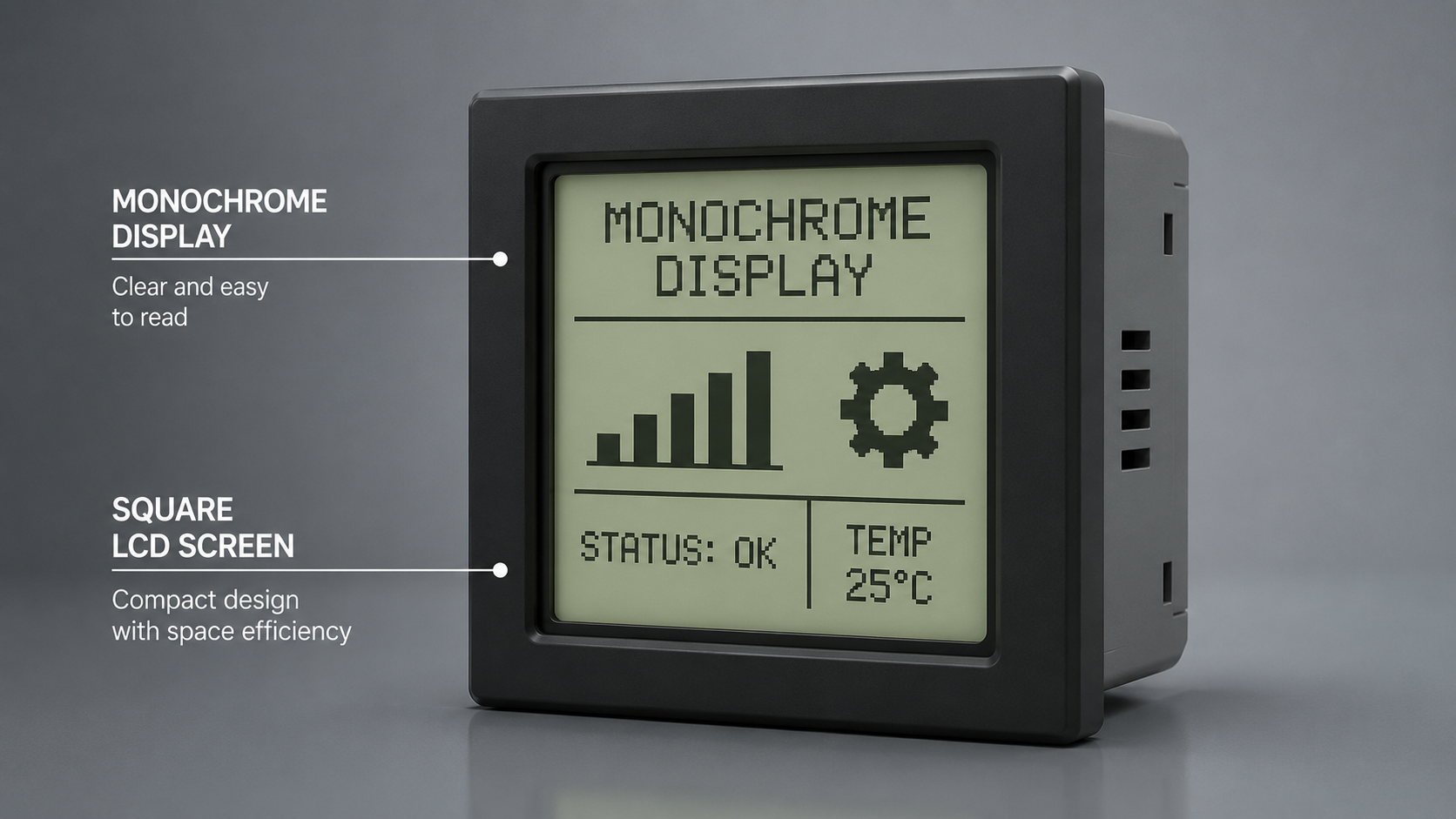
A Monochrome Display is an electronic display designed primarily to show information using one foreground color against a contrasting background. Unlike full-color TFT displays, monochrome LCD modules focus on delivering simple graphics, characters, numbers, icons, and status information with excellent readability.
Common monochrome LCD technologies include:
- TN LCD
- STN LCD
- FSTN LCD
- VA LCD
- Graphic LCD
- Character LCD
- Segment LCD
- COB and COG LCD modules
Depending on the application, manufacturers can combine the LCD panel with LED backlighting to create different visual effects, including white, blue, amber, green, or customized illumination.
Because fewer display-driving resources are required, monochrome modules can provide an efficient solution for battery-powered and continuously operating devices.
Why Monochrome Displays Remain Popular
Despite the growth of high-resolution color displays, the Monochrome Display remains highly relevant because many electronic devices do not need complicated graphics or video.
Its major advantages include:
- Low power consumption
- Excellent visibility for numerical and textual information
- Cost-effective manufacturing
- Long product lifecycle
- Simple electronic integration
- Compact module dimensions
- Reliable operation in industrial environments
For products such as electricity meters, temperature controllers, weighing equipment, testing instruments, and medical monitors, clarity is often more important than displaying millions of colors.
A properly selected monochrome module can therefore reduce product cost while improving operational efficiency.
Understanding the Square LCD Screen
A Square LCD Screen uses a display format where the width and height are identical or close to identical. This format offers designers additional flexibility when traditional rectangular screens do not match the mechanical structure of a device.
Square displays are increasingly used in:
- Smart home control panels
- Industrial controllers
- Measurement instruments
- Medical equipment
- Wearable electronics
- Automotive control interfaces
- Portable monitoring equipment
- Custom electronic products
The symmetrical screen format is particularly effective for dashboards containing icons, numerical readings, circular indicators, menus, and centralized information.
A Square LCD Screen can be produced using monochrome LCD technology or full-color TFT technology depending on application requirements.
Monochrome Display vs Color LCD
Understanding the differences between monochrome and color displays can simplify product development.
| Feature | Monochrome LCD | Color LCD |
| Power Consumption | Low | Moderate to high |
| Display Complexity | Simple | Advanced |
| Cost | Generally lower | Generally higher |
| Graphics | Basic graphics and text | Detailed graphics and images |
| Controller Requirements | Simple | More complex |
| Ideal Applications | Instruments, meters, controllers | Multimedia and advanced interfaces |
| Battery Efficiency | Excellent | Moderate |
A Monochrome Display is usually suitable when the interface mainly contains numbers, symbols, menus, or status information.
Color LCD screens become more appropriate when an application requires photographs, animations, detailed graphical interfaces, or multiple visual indicators.
Important Features of a Square LCD Screen
Selecting a Square LCD Screen requires attention to several technical specifications.
Resolution
Resolution determines the amount of information that can be displayed clearly. Higher resolutions support detailed icons, graphics, and smaller text, while lower resolutions may be sufficient for basic instruments.
Viewing Angle
Displays installed in industrial panels or medical equipment may need to remain visible from different positions. Wide viewing angle technologies can improve readability for operators.
Brightness and Backlight
The required brightness depends on the operating environment. Indoor equipment generally needs moderate brightness, while outdoor or high-ambient-light applications may require stronger LED backlighting.
Interface Compatibility
Typical display communication interfaces include:
- SPI
- I2C
- Parallel interface
- RGB
- MCU
- MIPI
The selected LCD must communicate efficiently with the product’s microcontroller or processor.
Operating Temperature
Industrial applications may experience extreme temperatures. Display modules designed for extended temperature ranges are therefore preferable for equipment used outdoors, inside vehicles, or in factories.
Common Applications of Monochrome LCD Technology
The versatility of the Monochrome Display allows it to support numerous industries.
Medical equipment uses monochrome screens for diagnostic instruments, portable health monitors, infusion systems, and measurement devices.
Industrial automation systems use them in PLC interfaces, controllers, timers, pressure meters, and production machinery.
Utility equipment such as electricity meters, water meters, and gas meters relies on monochrome technology because of its excellent energy efficiency and dependable readability.
Consumer electronics may also use monochrome modules in remote controllers, electronic scales, clocks, thermostats, and household appliances.
These applications demonstrate why simple display technology continues to play an important role in modern electronics.
Benefits of Custom LCD Display Solutions
Standard modules can meet many requirements, but customized displays offer additional flexibility.
Manufacturers can customize:
- Screen dimensions
- Glass dimensions
- Viewing area
- Display segments
- Interface design
- Backlight color
- Connector type
- Operating voltage
- LCD polarizer
- Viewing direction
- Touch panel integration
Customizing a Square LCD Screen can be particularly useful when an existing standard rectangular display does not fit the enclosure or user-interface layout.
A customized Monochrome Display can also include application-specific symbols and segments, helping reduce processor requirements and simplifying the electronic design.
How to Choose the Right LCD Screen
Before selecting a display, define the actual requirements of the electronic product.
Consider the following factors:
- Determine whether color graphics are necessary.
- Calculate the available installation space.
- Identify the required viewing area.
- Select the appropriate display resolution.
- Confirm the microcontroller interface.
- Define operating temperature requirements.
- Evaluate indoor or outdoor visibility.
- Determine power consumption limitations.
- Check backlight requirements.
- Consider expected product lifecycle and supply stability.
Working with an experienced LCD supplier during the development stage can help avoid compatibility problems and unnecessary redesign costs.
Frequently Asked Questions
What is a Monochrome Display?
A Monochrome Display primarily presents information using one foreground color against a contrasting background and is commonly used for text, numbers, symbols, and basic graphics.
What is a Square LCD Screen?
A Square LCD Screen is an LCD module with approximately equal width and height, making it suitable for symmetrical interface designs and compact equipment.
Are monochrome LCDs energy efficient?
Yes. Their relatively simple driving requirements make monochrome displays highly suitable for low-power and battery-operated devices.
Can monochrome displays include backlighting?
Yes. LED backlighting can be added in white, blue, green, amber, and other colors depending on the product design.
Where are square LCD screens commonly used?
They are used in industrial controllers, medical equipment, smart home panels, testing devices, automotive electronics, and portable instruments.
Can a Square LCD Screen be customized?
Yes. Dimensions, resolution, interfaces, backlights, connectors, viewing direction, and other specifications can often be customized.
Are monochrome LCD screens suitable for industrial devices?
Yes. Their simplicity, reliability, low power usage, and readability make them especially suitable for industrial applications.
What interfaces are available for LCD modules?
Common interfaces include SPI, I2C, parallel MCU, RGB, and MIPI, depending on the display technology.
What is the difference between segment and graphic LCDs?
Segment LCDs display predefined numbers and symbols, while graphic LCDs use pixels to create more flexible text, icons, and graphics.
How do I select the correct LCD size?
Consider the enclosure dimensions, active viewing area, readability distance, interface layout, and available PCB space before choosing the screen.