
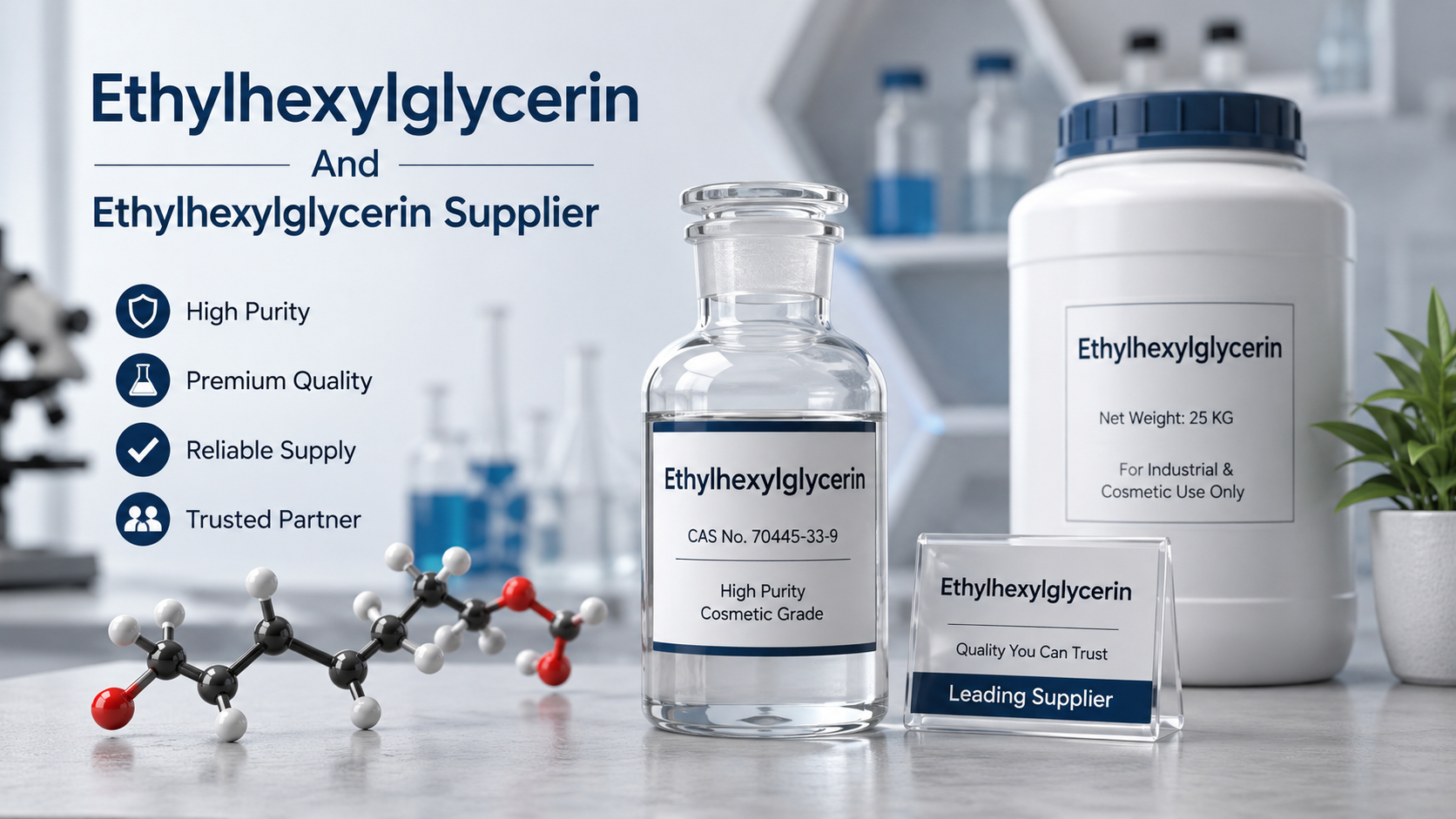
The modern cosmetics industry is moving toward multifunctional ingredients that can improve product stability, sensory quality, and preservation efficiency at the same time. Among these ingredients, Ethylhexylglycerin has become increasingly important in skincare, haircare, deodorants, cleansers, and other personal care formulations.
Its value goes beyond being a simple supporting ingredient. Ethylhexylglycerin can contribute to skin conditioning, enhance certain preservation systems, and improve formulation flexibility. For manufacturers, however, ingredient performance depends heavily on raw material quality. This makes the selection of an experienced Ethylhexylglycerin Supplier an essential part of product development and commercial manufacturing.
Understanding Ethylhexylglycerin in Greater Detail
Ethylhexylglycerin is a glycerin-derived multifunctional ingredient commonly used in cosmetic and personal care formulations. Chemically, it contains a glycerol-based structure modified with an ethylhexyl group, giving it properties that make it suitable for both aqueous and emulsion-based cosmetic systems.
Unlike ingredients used for only one purpose, Ethylhexylglycerin can provide several formulation benefits. It is primarily known for:
- Supporting preservation systems
- Providing skin-conditioning effects
- Improving product sensory properties
- Supporting deodorant formulations
- Increasing formulation efficiency
Because it performs multiple roles, formulators can sometimes simplify ingredient systems while still maintaining the desired product performance.
How Ethylhexylglycerin Functions in Cosmetic Formulations
The importance of Ethylhexylglycerin lies largely in its ability to interact with microbial cell membranes and enhance the activity of certain preservatives.
When microorganisms contaminate a cosmetic product, they can multiply if the formulation contains water and nutrients. A preservation system is therefore required to prevent bacteria, yeast, and mold from growing to unacceptable levels.
Ethylhexylglycerin can support this process by increasing the effectiveness of compatible preservation ingredients.
It is frequently used alongside preservatives such as phenoxyethanol. This combination has become common in many modern cosmetic products because it can provide broad preservation support while maintaining formulation flexibility.
However, the final effectiveness depends on multiple factors, including:
- Product pH
- Water content
- Packaging design
- Ingredient compatibility
- Manufacturing hygiene
- Preservative concentration
- Product storage conditions
For this reason, laboratory testing remains essential.
Preservative Boosting Mechanism
One of the strongest reasons formulators use Ethylhexylglycerin is its preservative-boosting capability.
Rather than functioning only as a traditional standalone preservative, it is often incorporated into a broader preservation system.
The ingredient can influence microbial membrane integrity, making microorganisms more vulnerable to other antimicrobial substances within the formulation.
This creates a complementary effect.
For example:
| Ingredient Role | Main Function |
| Traditional preservative | Direct antimicrobial protection |
| Ethylhexylglycerin | Preservative boosting and conditioning |
| Chelating agent | Supports preservation by binding metal ions |
| pH regulator | Helps maintain an environment suitable for preservation |
The combination of these approaches can create a more robust preservation strategy than relying on a single component.
Skin-Conditioning and Sensory Benefits
Another important characteristic of Ethylhexylglycerin is its skin-conditioning capability.
Modern consumers expect skincare products to feel light, smooth, comfortable, and non-sticky. Ingredients used in creams, lotions, serums, and cleansers therefore need to contribute not only to stability but also to the sensory experience.
Ethylhexylglycerin can help improve the feel of formulations on the skin.
Its conditioning properties make it useful in:
- Facial moisturizers
- Body lotions
- Anti-aging creams
- Facial serums
- Cleansing products
- Sunscreen formulations
- Makeup
- Hair conditioners
The actual sensory performance depends on the complete formulation rather than a single ingredient, but Ethylhexylglycerin can contribute positively to the finished product.
Role in Deodorant and Personal Hygiene Products
Ethylhexylglycerin is also used in deodorant formulations.
Body odor is primarily associated with microbial activity on the skin. Sweat itself does not necessarily have a strong odor, but microorganisms can break down components of sweat and produce odor-associated compounds.
Because Ethylhexylglycerin can influence microbial activity, it may support deodorizing systems in suitable formulations.
This makes it useful in products such as:
- Roll-on deodorants
- Deodorant sprays
- Body sprays
- Personal hygiene products
- Underarm creams
However, product manufacturers must still conduct appropriate performance and microbiological testing.
Applications Across the Personal Care Industry
The versatility of Ethylhexylglycerin allows it to be used across multiple cosmetic categories.
| Product Category | Functional Benefit |
| Skin creams | Conditioning and preservation support |
| Lotions | Improved sensory properties |
| Facial serums | Preservation enhancement |
| Shampoos | Microbial stability support |
| Hair conditioners | Conditioning assistance |
| Cleansers | Preservation boosting |
| Deodorants | Odor-control support |
| Makeup | Product stability |
| Sunscreens | Preservation system support |
| Body care products | Conditioning and stability |
Manufacturers should determine the appropriate usage level based on formulation requirements, regulatory conditions, and supplier recommendations.
Why Raw Material Purity Matters
Not all raw materials supplied under the same chemical name necessarily deliver identical performance.
Differences in manufacturing processes, impurity profiles, storage conditions, and quality-control procedures may influence consistency.
A professional Ethylhexylglycerin Supplier should therefore maintain strict specifications covering characteristics such as:
- Appearance
- Purity
- Odor
- Chemical composition
- Moisture level
- Identification parameters
- Batch consistency
Reliable raw materials help manufacturers achieve repeatable results when producing large commercial batches.
How to Evaluate an Ethylhexylglycerin Supplier
Choosing the right supplier requires careful technical and commercial evaluation.
Price should never be the only selection factor.
A dependable Ethylhexylglycerin Supplier should be capable of supporting customers with product quality, documentation, logistics, and technical information.
Important evaluation criteria include:
- Consistent product quality
- Certificate of Analysis
- Safety Data Sheet
- Technical specifications
- Traceability
- Packaging standards
- Batch identification
- Storage guidance
- Reliable delivery
- Technical customer support
Long-term supply stability is particularly important for cosmetic manufacturers because unexpected ingredient shortages can interrupt production.
Importance of Certificates and Technical Documentation
Documentation allows buyers to verify raw material quality and regulatory suitability.
A Certificate of Analysis usually provides batch-specific information showing whether a supplied material meets defined specifications.
A professional supplier may also provide technical and safety documents required by manufacturers, formulators, distributors, and regulatory teams.
Documentation becomes especially important when products are manufactured for international markets where ingredient requirements may differ.
Storage and Handling Considerations
Correct handling helps maintain raw material quality.
Manufacturers should store Ethylhexylglycerin according to recommendations provided by the supplier. Containers should generally remain properly sealed and protected from inappropriate environmental conditions.
Warehouse teams should also follow proper inventory management practices.
A useful approach is:
- Maintain clear batch identification
- Follow recommended temperature conditions
- Avoid unnecessary contamination
- Keep containers tightly closed
- Use suitable transfer equipment
- Follow first-in, first-out inventory practices
These procedures support manufacturing consistency.
Formulation Testing Is Essential
Even high-quality Ethylhexylglycerin does not automatically guarantee that a finished cosmetic product will remain microbiologically stable.
Manufacturers must evaluate the complete formulation.
Important testing may include:
- Stability testing
- Compatibility testing
- Microbial challenge testing
- Packaging compatibility evaluation
- Accelerated stability studies
Challenge testing is particularly important because it evaluates how effectively a formulation controls introduced microorganisms.
Manufacturers should therefore avoid assuming that a preservation system is effective simply because individual preservative ingredients are present.
Ethylhexylglycerin and Future Cosmetic Formulation Trends
The personal care industry is increasingly focused on multifunctionality.
Formulators want ingredients that provide multiple benefits while reducing unnecessary complexity.
This creates strong opportunities for ingredients such as Ethylhexylglycerin, particularly as manufacturers develop advanced skincare, haircare, deodorant, and hygiene formulations.
Future growth may also be influenced by increasing demand for:
- Efficient preservation systems
- Improved sensory performance
- Transparent ingredient documentation
- Consistent global raw material supply
- Multifunctional cosmetic ingredients
- Optimized formulation strategies
Suppliers that provide both quality materials and technical expertise are likely to become increasingly valuable partners.
Frequently Asked Questions
1. What is Ethylhexylglycerin?
Ethylhexylglycerin is a multifunctional cosmetic ingredient commonly used for skin conditioning and preservative boosting.
2. Is Ethylhexylglycerin a preservative?
It can support preservation systems, but formulators commonly use it together with established preservatives.
3. Why is it combined with phenoxyethanol?
The combination can provide complementary preservation performance in many cosmetic formulations.
4. Can Ethylhexylglycerin be used in skincare?
Yes. It is commonly found in creams, lotions, cleansers, serums, and other skincare products.
5. Is it used in haircare products?
Yes. Shampoos, conditioners, and other haircare products may contain Ethylhexylglycerin.
6. Does Ethylhexylglycerin help deodorants?
It can support deodorizing systems by helping control microorganisms associated with body odor.
7. Why is supplier quality important?
Reliable supplier quality helps maintain consistent formulation performance between production batches.
8. What documents should buyers request?
Buyers commonly request a Certificate of Analysis, Safety Data Sheet, technical specification, and relevant regulatory documentation.
9. Is microbial testing still required?
Yes. Finished products should undergo appropriate testing to verify preservation effectiveness.
10. How should manufacturers select a supplier?
They should evaluate purity, documentation, consistency, traceability, logistics, packaging, technical support, and long-term supply reliability.