
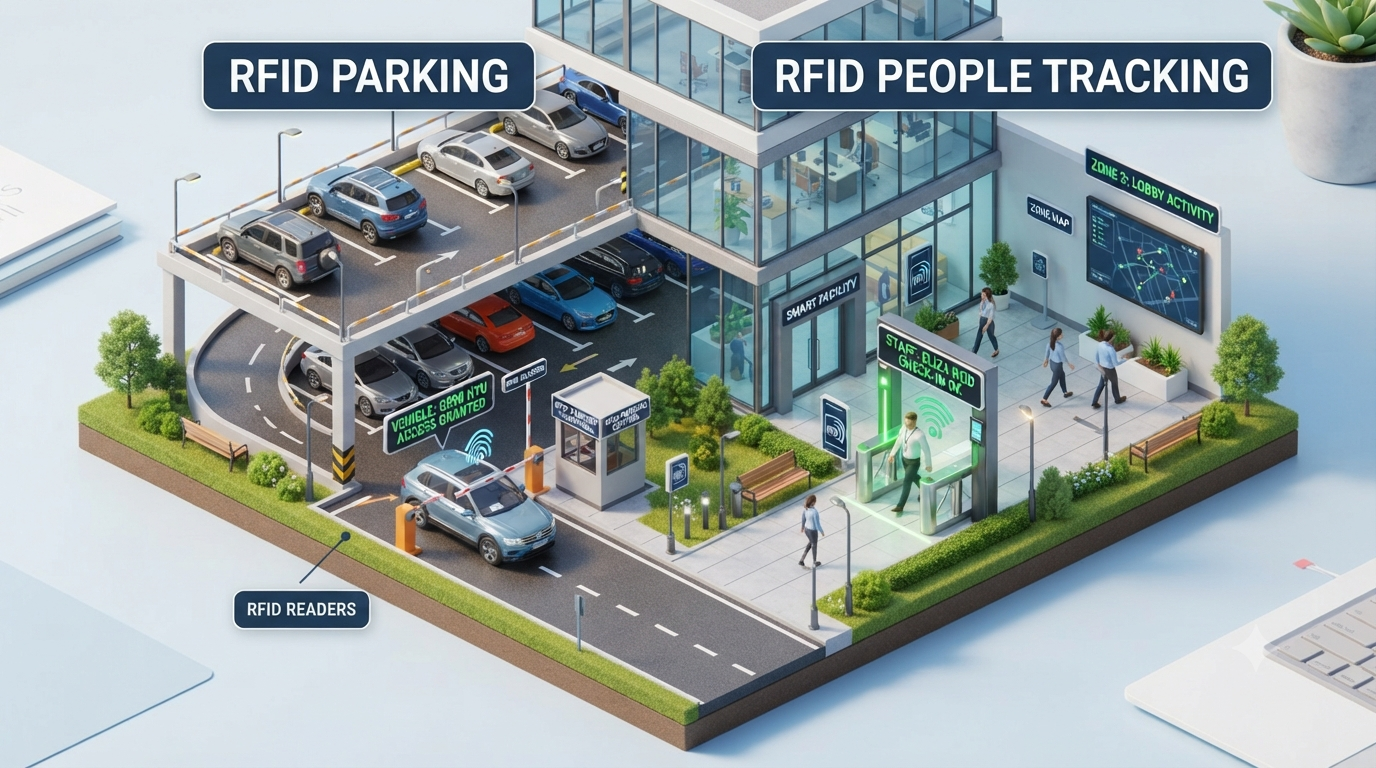
Technology has completely changed the way organizations manage vehicles, employees, visitors, and restricted areas. In the past, most facilities depended on guards, paper records, parking slips, and manual attendance systems. These methods were simple, but they often created delays, inaccurate records, and security challenges.
The arrival of Radio Frequency Identification, commonly known as RFID, introduced a more automated approach. Solutions such as RFID Parking and RFID People Tracking made it possible to identify vehicles and individuals quickly without relying entirely on manual verification.
Today, RFID is already widely used across commercial buildings, factories, hospitals, educational campuses, parking facilities, and industrial environments. In the future, its role is expected to become even more intelligent as RFID integrates with cloud software, IoT devices, automation systems, and data analytics.
How Vehicle Access Worked in the Past
Traditional parking management was mostly manual. Security staff often recorded vehicle numbers in registers and issued physical passes to drivers.
Parking tickets and stickers were also widely used.
Although these methods worked for small parking areas, they became difficult to manage when traffic increased.
Common problems included:
- Long waiting times at gates
- Manual checking of vehicle details
- Lost parking slips
- Duplicate or unauthorized passes
- Incorrect entry and exit records
- Difficulty checking historical information
Businesses needed a faster system that could identify vehicles automatically.
This need eventually encouraged the adoption of RFID Parking technology.
The Early Growth of RFID Parking
In the beginning, RFID parking solutions mainly depended on short-range RFID cards. Drivers had to bring the card close to a reader positioned near the entrance.
The system would verify the RFID identification number and allow access if the user was authorized.
Over time, long-range UHF RFID technology improved the entire process.
Vehicle-specific RFID tags could be placed on windshields, headlights, or other approved areas. Readers could recognize these tags from a greater distance.
How RFID Parking Changed Vehicle Management
With RFID Parking, parking access became faster and more organized.
Instead of manually checking every car, the system could automatically capture:
- Vehicle identity
- Entry time
- Exit time
- Parking authorization
- Assigned parking zone
- User account details
This gave organizations better control over their parking facilities.
From Manual Gates to Automated Access
Modern RFID systems can also connect directly with boom barriers.
When an authorized vehicle approaches the gate, the reader captures its RFID tag. The parking software checks the database and sends a signal to open the barrier.
The entire process can happen within seconds.
How People Were Monitored in the Past
People management also relied heavily on manual systems.
Employees often signed attendance registers or used punch cards. Visitors were required to provide their names and details at reception desks.
Security personnel manually checked identification cards before allowing entry.
These processes created several limitations.
For large organizations, it was difficult to identify exactly who was inside the building, when they entered, or whether they had access to restricted areas.
This created demand for digital identification systems such as RFID People Tracking.
The Evolution of RFID People Tracking
Early RFID systems were mainly used for basic attendance and door access.
Employees were issued RFID cards that could be presented near readers installed at entry points.
The system recorded their identity and time of access.
As RFID technology developed, companies started using RFID for broader applications, including:
- Employee attendance
- Visitor management
- Restricted-area control
- Workforce movement records
- Emergency identification
- Location-based operations
- Personnel safety management
This expanded the role of RFID People Tracking from simple identification to operational visibility.
Past and Future of RFID Technology
| Area | Past Approach | Future Approach |
| Parking | Manual tickets and guards | Automated vehicle recognition |
| Attendance | Registers and punch cards | RFID-based digital attendance |
| Data storage | Paper or local records | Cloud-based platforms |
| Security | Physical verification | Integrated identity control |
| Monitoring | Manual observation | Automated movement data |
| Reporting | Basic records | Smart dashboards and analytics |
| Integration | Standalone systems | IoT and API-connected systems |
The biggest change is that RFID is moving from basic identification toward intelligent facility management.
Future of RFID Parking Systems
The future of RFID Parking is likely to focus on connected and fully automated parking environments.
RFID systems can increasingly work alongside technologies such as Automatic Number Plate Recognition, smart cameras, mobile applications, digital payments, and occupancy sensors.
Smarter Parking Entry and Exit
In future parking environments, an authorized vehicle could be detected before reaching the gate.
The system could automatically verify access rights, check parking availability, allocate a space, and open the barrier.
This could reduce waiting times significantly.
Parking Data and Predictive Planning
Modern parking systems generate valuable operational data.
Future platforms may use this information to identify:
- Peak arrival periods
- Frequently occupied areas
- Average parking duration
- Traffic congestion points
- Parking utilization trends
Facility managers can use these insights to improve parking operations.
Future of RFID People Tracking
The future of RFID People Tracking will likely extend beyond attendance management.
Organizations may use RFID to improve workforce safety, operational planning, emergency response, and facility usage.
For example, industrial companies may use RFID to identify how many authorized employees are present inside specific working zones.
Supporting Emergency Response
One important future application will involve emergency management.
During an evacuation, RFID records can help authorized safety teams understand who has entered specific areas and who may still be inside the facility.
This can support faster and more organized emergency procedures.
RFID and Smart Facility Management
RFID will increasingly become part of larger connected building ecosystems.
Future smart facilities may combine RFID with:
- IoT sensors
- Cloud dashboards
- Access control systems
- Video surveillance
- Building automation
- HR software
- Mobile applications
This creates a centralized infrastructure where multiple systems can communicate.
For example, parking access, building entry, attendance, and visitor permissions may all be managed from one integrated platform.
Privacy and Data Security in Future RFID Systems
As RFID People Tracking becomes more advanced, privacy and data protection will become increasingly important.
Organizations should use RFID responsibly.
Only information that is necessary for business operations should be collected.
Important policies should cover:
- Purpose of tracking
- Authorized system users
- Data storage duration
- Security controls
- Employee and visitor awareness
- Access permissions
Responsible tracking practices help organizations gain operational benefits while maintaining trust.
Integration of RFID Parking and People Tracking
One of the most useful future developments will be the integration of RFID Parking with RFID People Tracking.
Consider an employee arriving at a company campus.
The employee’s vehicle could first be identified using an RFID vehicle tag.
After parking, the employee’s RFID badge could provide access to the office.
The same digital ecosystem could then record attendance and apply role-based access permissions.
This eliminates many repetitive manual checks.
Frequently Asked Questions
1. What is RFID Parking?
RFID Parking is a system that uses RFID tags and readers to identify vehicles and manage parking access automatically.
2. What is RFID People Tracking?
RFID People Tracking uses RFID badges, cards, tags, or wristbands to identify people at specific locations.
3. How was parking managed before RFID?
Most parking areas relied on guards, paper slips, stickers, and manual registers.
4. How did RFID improve parking systems?
RFID reduced manual checking and allowed faster vehicle identification.
5. Can RFID People Tracking be used for attendance?
Yes. RFID can record employee entry and exit automatically.
6. Can RFID work with smart barriers?
Yes. RFID readers can communicate with compatible boom barriers and gate controllers.
7. Will RFID integrate with cloud software?
Yes. Many modern and future RFID systems can operate with cloud-based dashboards.
8. Can RFID help during emergencies?
RFID records can help authorized teams understand who may be present inside a monitored facility.
9. Can RFID work with other security technologies?
Yes. RFID can integrate with cameras, access control, sensors, and building-management systems.
10. What is the future of RFID technology?
The future of RFID will focus on automation, connected facilities, intelligent analytics, real-time information, and stronger system integration.